


Russia's Chief of the General Staff, Army General Valery Gerasimov, made a series of sweeping statements about battlefield progress during a visit to the Southern Grouping of Forces command on 21 April, according to the Institute for the Study of War (ISW), which found that the claims contradicted available evidence, including reporting from pro-Russian sources. ISW assessed that Russia's spring-summer 2026 offensive has produced zero tactically significant gains since it launched no later than 17 March, and that Russian forces have lost ground since 1 March.
What Gerasimov said — and what ISW found
Gerasimov claimed Russian forces had taken over 1,700 km² and 80 settlements across Ukraine since early 2026 — Luhansk Oblast among them — with a further 700 km² and 34 settlements falling in March and April alone. ISW's tracking puts Russian forces at 381.5 km² gained and 13 settlements taken since 1 January — while finding a net 59.79 km² loss across the theater since 1 March.
The Luhansk claim is not new. ISW noted that Russian military command had made the same assertion three times before 21 April — including twice after Ukraine's Fall 2022 counteroffensive retook portions of the oblast.
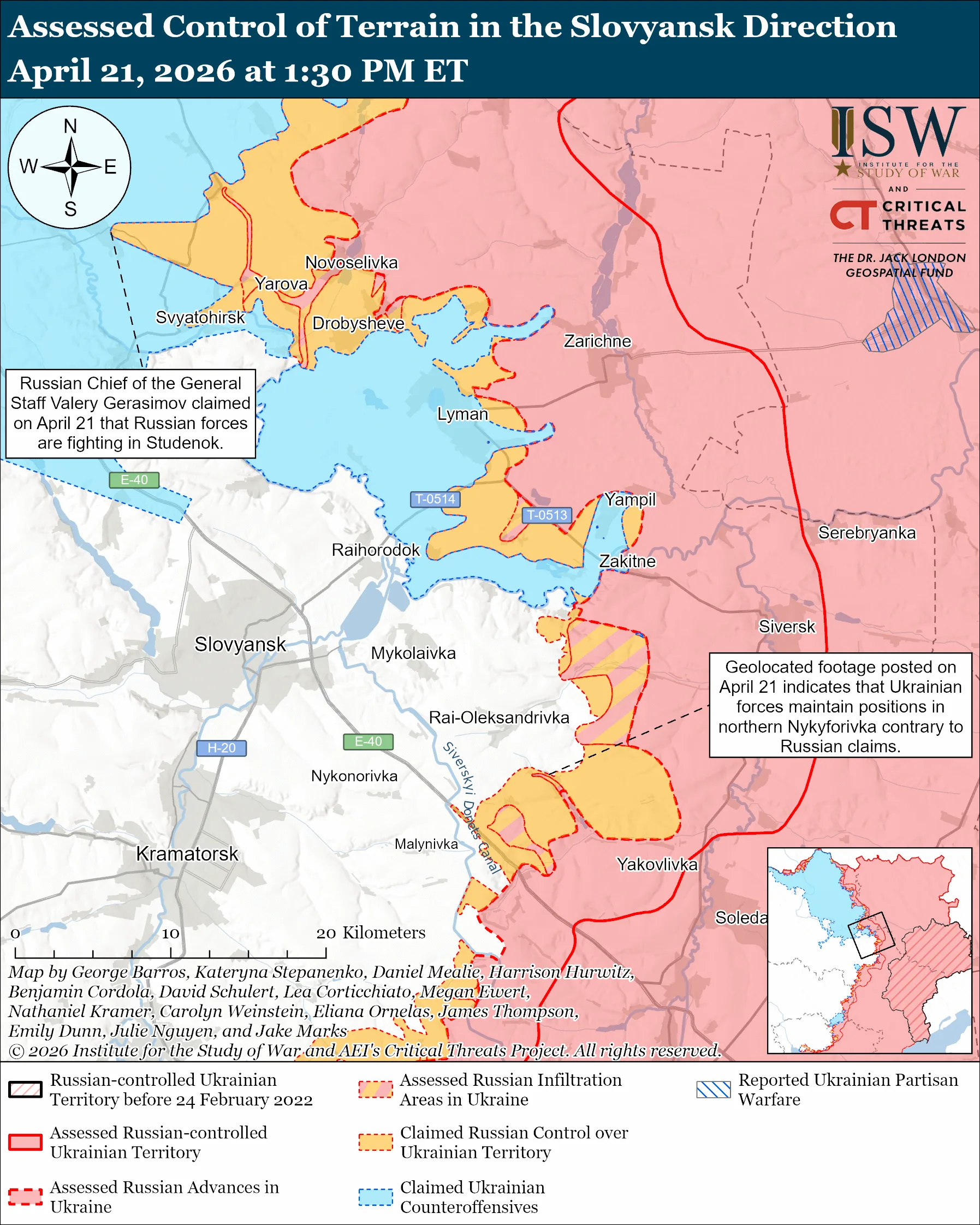
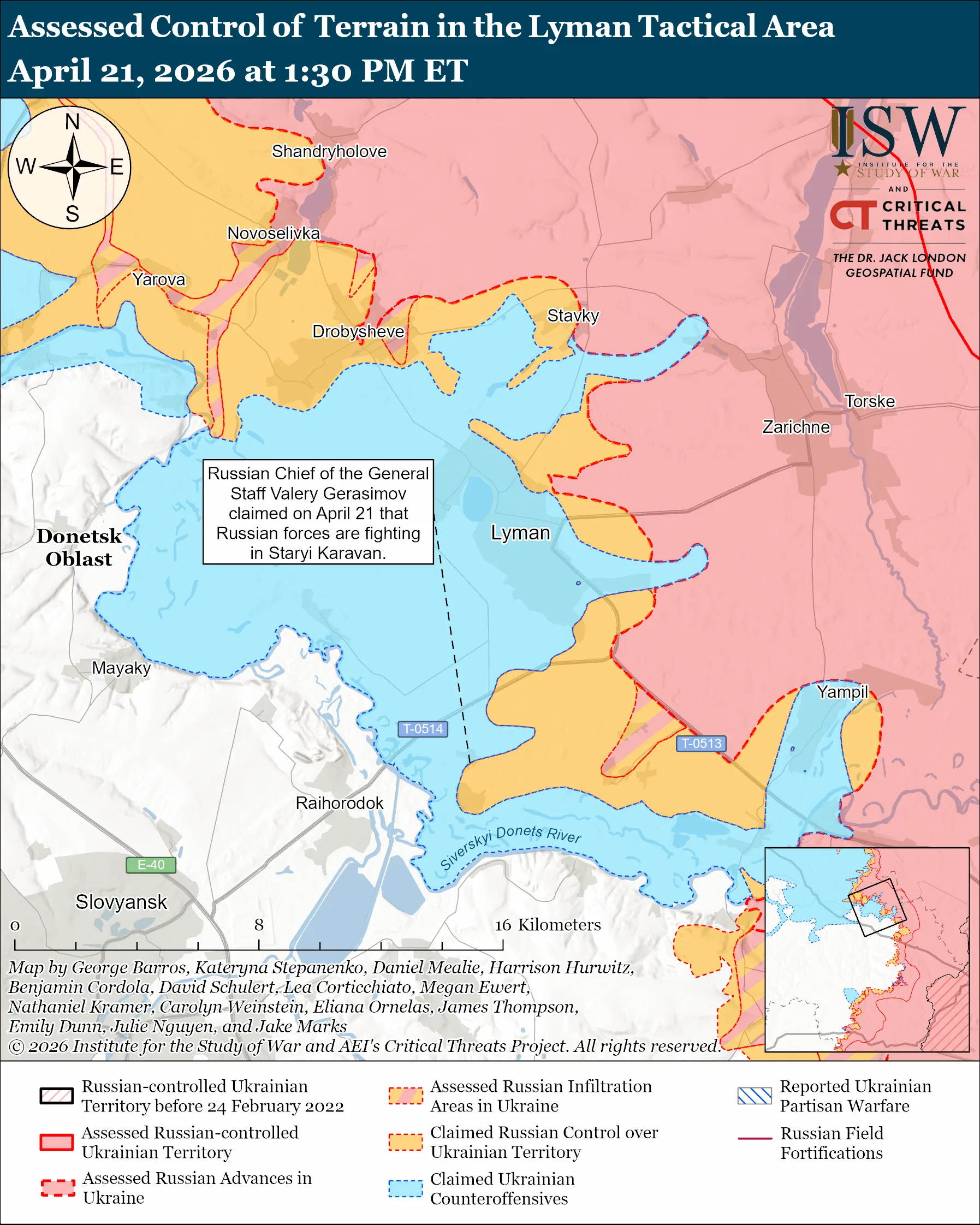
Gerasimov also stated Russian forces had advanced to within 7 km of Kramatorsk and 12 km of Sloviansk. Even the most optimistic figures from Russian sources ISW had on record placed forces no closer than roughly 14 km from Kramatorsk and 9 km from Sloviansk. On specific settlements, the gap is equally stark: Gerasimov stated 70% of Lyman seized — ISW found no evidence Russian forces had seized any of it — and 75% of Novopavlivka, where ISW assessed 20.51% actual Russian control.
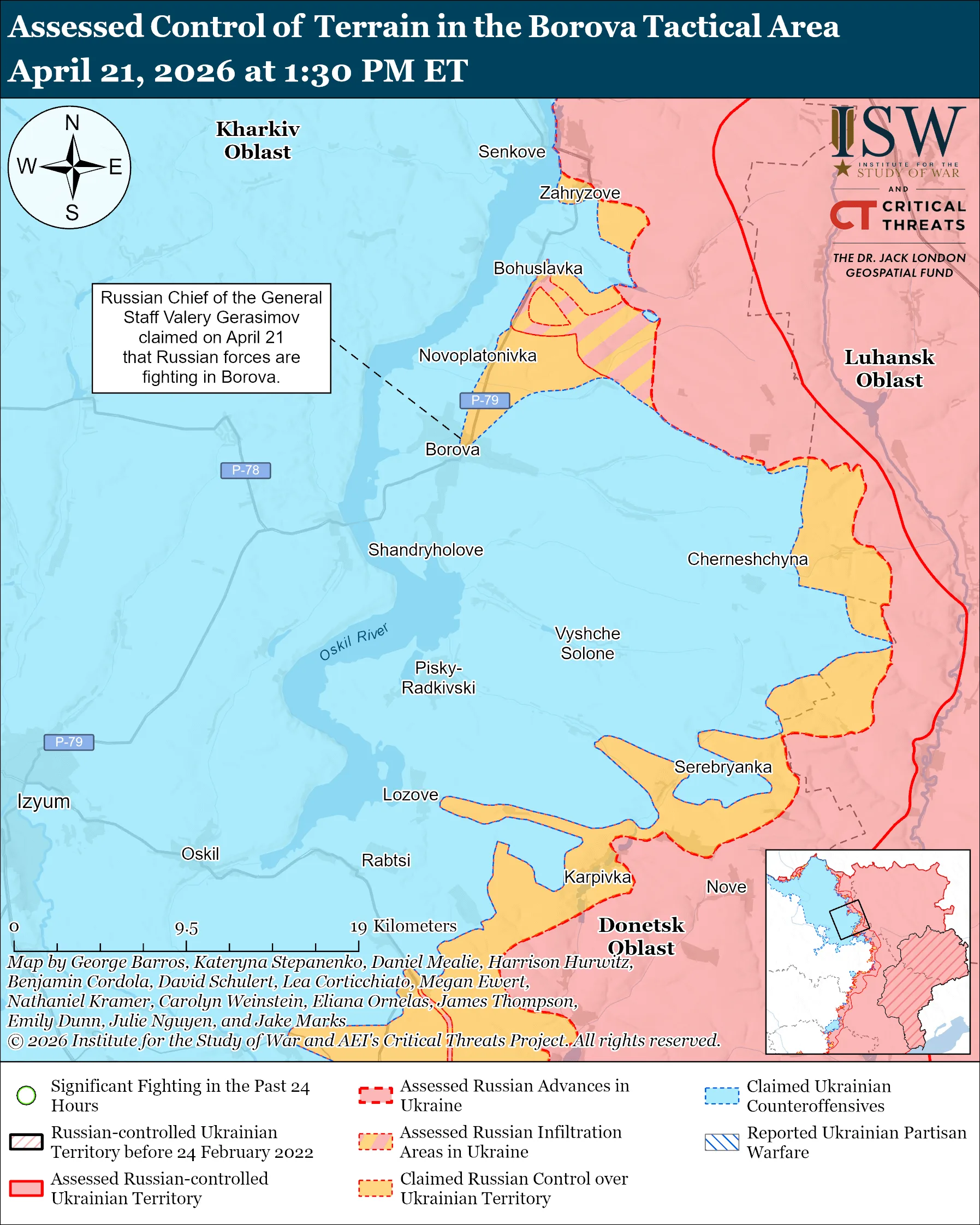
Gerasimov went further, stating Russian forces had entered Borova, Studenok, and Zaporozhets — three settlements ISW places several kilometers from the furthest extent of any confirmed Russian advances. Rybar's pro-Russian frontline map from 20 April depicted Zaporozhets as territory still held by Ukraine.
Even maximalist Russian sources don't support the claims
ISW calculated that combining confirmed Russian advances with all unconfirmed Russian claims produces a total of 715 km² — just 42% of Gerasimov's stated figure. No Russian source published a map consistent with 1,700 km² of gains in 2026. Several of the settlements Gerasimov named sit beyond even the outer edge of what Russia's own milbloggers have claimed. Russian milbloggers have repeatedly accused Gerasimov of sending “beautiful reports” up the chain of command — their term for embellished or fabricated claims of progress.

1.5 million more Russian soldiers would have to die to take rest of Donetsk Oblast — Ukraine’s UN ambassador
ISW also noted that the April speech covered two to four months of "gains" instead of the single month covered in previous addresses — a tactic ISW assessed as designed to disguise the absence of recent progress behind a larger cumulative figure. Gerasimov also recycled previous settlement claims, presenting them as fresh to manufacture an image of rapid ongoing advances. He has now delivered comparable exaggerated claims five times in 2026, on 15 January, 27 January, 15 February, 16 March, and 21 April.
Russia is pulling strategic reserves to prop up a failing offensive, HUR says — and 20,000 troops is less than one month of its own losses
What the offensive is actually producing
Russia launched its spring-summer 2026 offensive more than a month ago and has made no tactically significant gains since then, losing roughly 10 km² across the theater, and its rate of advance has slowed all across the front. Heavy casualties have forced Russia to reduce its operational tempo in several sectors. ISW assessed that Russia's troop generation is being squeezed from both ends — recruitment falling while casualties climb — eroding the viability of its mass-assault approach.
Read also
-
Ukraine destroys record 76 Russian air-defense systems this month, losses analyst says Russia “will never be able to restore”
-
Asked if Ukraine would send troops to defend NATO, Zelenskyy offered something else: know-how to stop drones now reaching its neighbors
-
Combat shows speed alone can’t catch Russia’s jet-powered drones, despite eight Ukrainian makers’ assurances. So why can’t they stop them?


