


On 15 July, President Volodymyr Zelenskyy dismissed Mykhailo Fedorov, his fourth defense minister since the start of the full-scale war, after just six months in office.
Neither Zelenskyy nor the Presidential Office has attributed the decision to poor performance or misconduct, and there is no evidence of incompetence, corruption, or scandal. The evidence points the other way. Fedorov was removed at the peak of Ukraine's best months of the war—and if performance is not the reason, the question is what is.
Under Fedorov, Ukraine has at times liberated more ground than it lost and driven up the cost of every meter Russia takes: ISW assessed that in June 2026 Russian forces suffered over 19 times as many casualties per square kilometer seized as a year earlier.
The clearest results are at sea. What the Financial Times has called the largest naval warfare in half a century has, by Ukraine's own count, put at least 136 Russian and Russia-linked vessels under drone attack between 6 and 15 July—oil tankers, shadow-fleet tankers, cargo ships, ferries, even the tugs sent to rescue them.
The first round, in the Sea of Azov, is over; the campaign has now moved into the Black Sea. Ukrainian forces are striking the ships that fuel and supply occupied Crimea, at an intensity analysts compare to the Iran–Iraq "Tanker War" of the 1980s. The campaign is effectively turning Crimea into an island, setting the stage for its future liberation.
On land, the same logic runs 200 kilometers deep. Rather than seizing terrain, Ukrainian forces contest the airspace above it—a sustained interdiction campaign against the M-14 and H-20 highways that sustain Russian forces in the occupied south, striking convoys, fuel and ammunition depots, command posts, and the recovery vehicles sent after earlier losses.
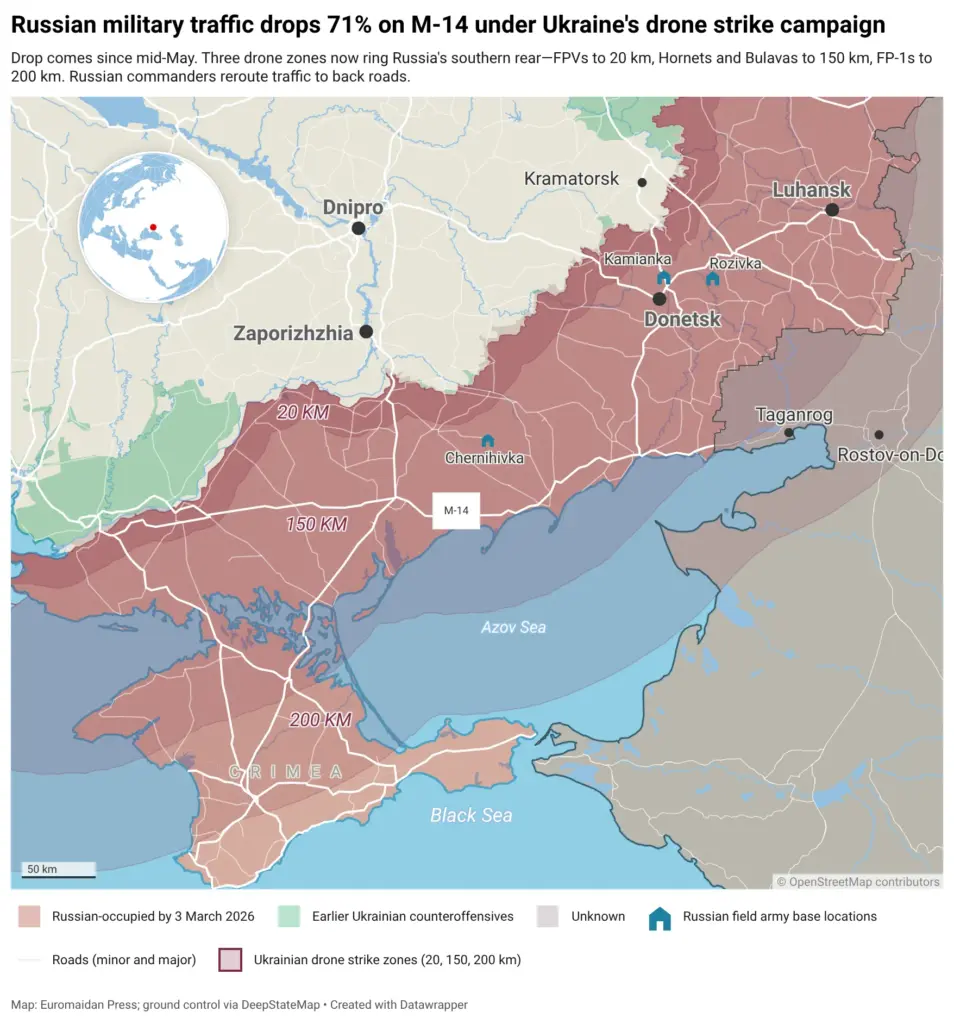
In June 2026 they temporarily severed every land route between occupied Kherson Oblast and Crimea. The potential prize is large: the isolation of Crimea, and with it the recovery of Zaporizhzhia and Kherson oblasts, the Zaporizhzhia Nuclear Power Plant, the farmland, and the port of Kherson.
Then the deep strikes on Russian oil. Ukraine's long-range campaign has knocked out a large share of Russia's refining capacity—by Kyiv's estimate more than 40%, by independent analysts closer to a quarter—enough to force gasoline rationing across dozens of Russian regions, hours-long queues, a fuel emergency in Crimea, and imports from India and Belarus. It has not stopped Russia's offensives, but it has degraded logistics, stretched air defenses, slowed the tempo, and made the war more expensive to keep fighting.

Not all of this is Fedorov's, and he never claimed it was: these are the work of the Armed Forces, Defence Intelligence (DIU), and the Security Service of Ukraine (SBU). But the ministry he ran made them possible. By his own accounting—a farewell list of 22 points—his team shut down Starlink for Russian forces, rebuilt procurement so that Ukraine bought more drones in four months than in all of 2025, funded the Drone Line, and pushed interception rates sharply upward through mandatory after-action review. Western partners and Ukrainian civil society rated him one of the most effective and incorruptible ministers in the government.
So why was he sacked?
The official reason is the one Zelenskyy gave: unity. He wanted the army and the Defense Ministry aligned, and made clear he would not let the two fight each other while the war continued. That much is true—but it explains the friction, not the choice: why the friction was resolved by removing the reformer and keeping the general. The real reason is harder. Reporting from multiple outlets points not to one cause but to several, reinforcing each other.
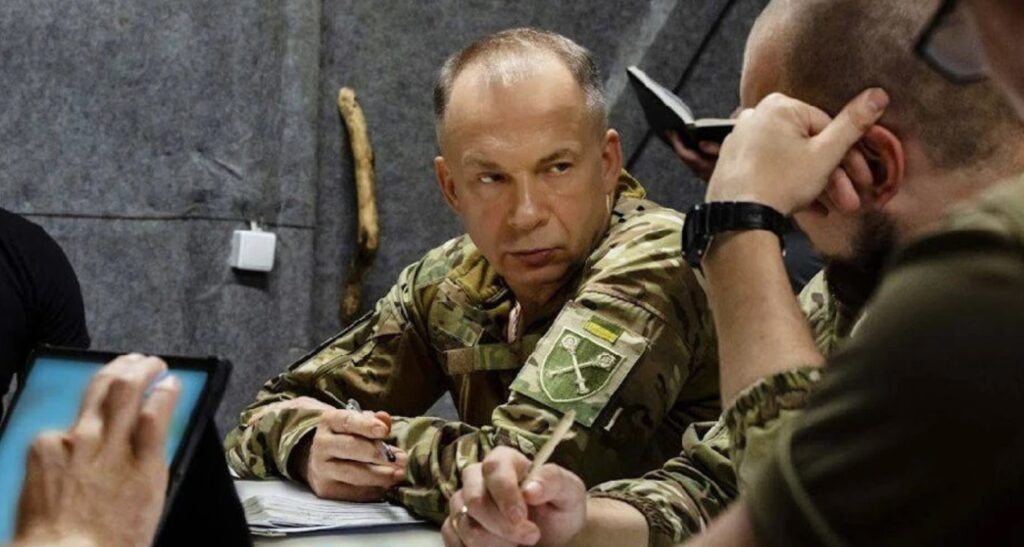
The first is a real and deepening conflict with Commander-in-Chief Oleksandr Syrskyi—over priorities, procurement, and command—described by well-connected Ukrainian journalists as a generational clash between a young reformer with a startup background and a traditional military general. Zelenskyy reportedly told his own faction that ideally both should go, but that he could not remove both now. Choosing between the past and the future, he chose the past. He chose Syrskyi.
The second is resistance to reform. Fedorov tried to restructure the ministry along NATO lines, digitize procurement and logistics, and close off the corruption an unreformed defense sector runs on—threatening entrenched interests inside the ministry and the defense industry, and generating significant institutional resistance.
The third is political. Fedorov had become one of the country's most popular figures, trusted by the military, civil society, and Western partners. A minister that successful, that independent, and that popular is exactly the kind a presidential office prefers to keep on a shorter leash.
No single one of these explains the decision. Together they do—and the shape is familiar. In February 2024, Zelenskyy removed General Valerii Zaluzhnyi, then Ukraine's most trusted and popular commander—also amid a real clash with Syrskyi, whom Zelenskyy then installed in his place, and also against a growing political rivalry. Success, popularity, a Syrskyi conflict, a potential future opponent: the same configuration, the same choice.
The dismissal drew rare wartime protests in Kyiv and open criticism from Western allies. "It is a pity our country today is significantly further from victory," wrote Serhii Sternenko, a former aide to Fedorov, on the day it was announced. "Real reforms have not even been allowed to begin, although we have still managed to bring about a great deal of change."
That is the cost, and it will be part of Zelenskyy's legacy: he removes the innovators and the reformers, and the potential rivals along with them—while the war is still on, and Ukraine still needs them.
Editor's note. The opinions expressed in our Opinion section belong to their authors. Euromaidan Press' editorial team may or may not share them.
Submit an opinion to Euromaidan Press


