


According to reports on G7 summit discussions, Donald Trump expressed admiration for Ukraine’s long-range strikes against Russia and advised Kyiv to act more boldly. “For the first time since early 2023, the momentum in the Russo-Ukrainian war is on Kyiv’s side,” US Under Secretary of State for Foreign Assistance, Humanitarian Affairs, and Religious Freedom Jeremy Lewin said on 24 June.
Ukrainian forces are on the offensive while Russia appears to be in a holding pattern, Lewin said. “This is a crucial moment; Ukraine can keep applying pressure on the battlefield.”
Ukraine’s Armed Forces commander-in-chief Oleksandr Syrskyi offered a far more sober assessment in an interview with The Times on 26 June. “I cannot say unequivocally that the war is nearing a turning point. We hope there will come a moment when the enemy mobilizes all its forces, resources and efforts, after which exhaustion will set in, and a turning point may follow,” Syrskyi said.
Two qualified but widely different assessments of the situation on the battlefield
Both reflexes distort the picture. When the battlefield disfavour Ukraine, the reporting declares it doomed; when it moves the other way, Russia is being crushed. Neither holds.
What the trends below show—drawn from four years of Ukrainian General Staff daily reports—is more specific: Russia’s losses have become unsustainable in the war it set out to fight, which is precisely why it abandoned maneuver warfare for attrition.
Attrition, however, is survivable for both sides, because both are kept in the fight by their partners—Russia by China, Ukraine by the collective West minus the United States. Unless fundamentally reconfigured, changing the military balance on the battlefield, this is why the war will continue, and why Ukraine’s present success, as Syrskyi warns, may prove temporary.
Russia’s losses have become unsustainable in the war it set out to fight
To fully understand the status, situation reports alone are insufficient. One also needs to study trends. The following analysis is based on a synopsis of the daily reports from the Ukrainian General Staff, providing detailed insight into Russian losses and casualties.
A note on the figures: annual totals for 2026 are full-year projections based on the trends through the first half of the year, while cumulative “to date” figures are actuals as of June 2026. The two are therefore not directly comparable—the projected annual totals run higher than the running totals.
Personnel
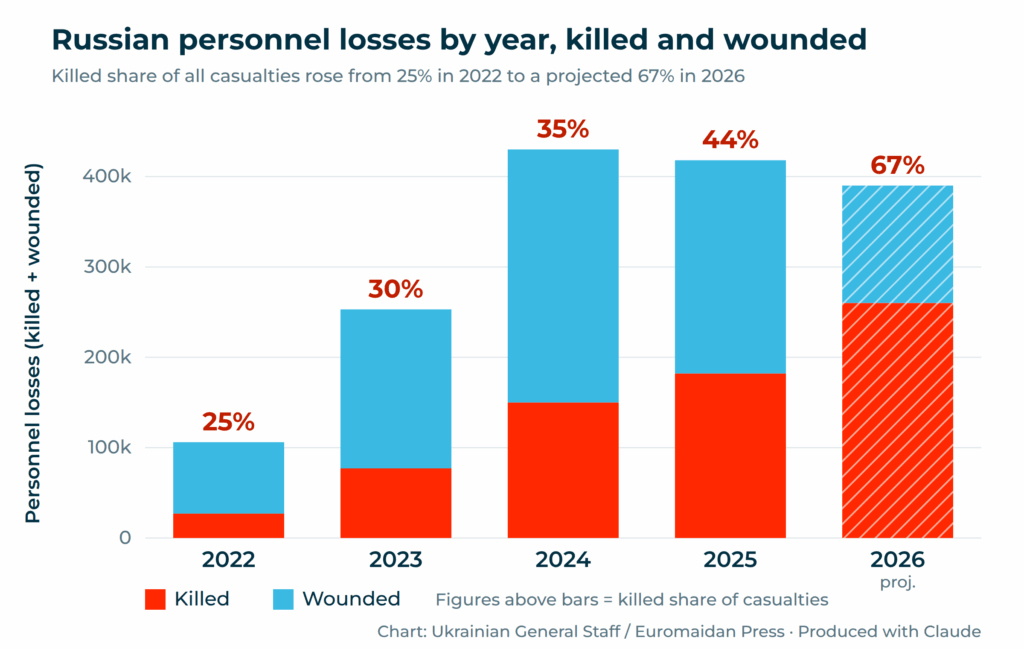
Russia has lost more than 1.4 million soldiers since the full-scale war started, including both wounded and killed in action. The numbers have varied from year to year:
| Year | Personnel losses (KIA + WIA) | Assessed KIA | KIA:WIA ratio | Main developments |
|---|---|---|---|---|
| 2022 | 106,000 | 27,000 | 1:3 | Full-scale invasion. Ukrainian liberation of Kyiv, Chernihiv, Sumy, Kharkiv, and western Kherson oblasts. |
| 2023 | 253,000 | 77,000 | 1:2.3 | Ukrainian counteroffensive toward Melitopol and Berdiansk to sever the land bridge between mainland Russia and Crimea, and to liberate territory around Bakhmut. |
| 2024 | 430,000 | 150,000 | 1:1.9 | Russian grinding offensive and Ukraine's Kursk incursion. Mass industrialization of FPV production. |
| 2025 | 418,000 | 182,000* | 1:1.3 | Russia's war of attrition to seize the rest of Donetsk Oblast and establish a buffer zone along Ukraine's northern borders. Infiltration tactics and fiber-optic FPV drones. |
| 2026 (proj.) | 390,000 | 260,000 | 2:1 | Transition into a highly contested war of attrition shaped by tactical drone supremacy, localized counteroffensives, and battlefield air interdiction. |
| Total | 1,597,000 | 696,000 | 1:1.3 overall, trending against Russia |
In June, Russia suffered its highest losses since March 2025: about 39,300, of which potentially 26,200 were killed in action. Why?
Today, up to 90% of Russian casualties are caused by FPV drones with unrivalled precision.
Russia launched a staggering 301,000 FPV drones against Ukrainian positions this month. Ukraine, however, is launching 50% more. “Ukraine maintains a 1.5-to-1 numerical advantage over Russia in FPV drones and is outpacing Russian recruitment into drone units by 12,500 personnel since January,” according to commander-in-chief General Oleksandr Syrskyi.
Additionally, Ukraine is scaling up its ground robotic capacity, an area with possibly significantly greater combat potential. In May alone, the Ukrainian Armed Forces executed 12,500 missions, indicative of a rapidly scaling capability.

The frontline is replaced by a “kill zone”

This is why Russia is finding it increasingly difficult to recruit new soldiers. According to CNN, military recruitment was down by 20% in the first quarter of this year compared to 2025, and there are signs it is still faltering, according to Russian economy expert Janis Kluge. In Moscow, the number of people willing to sign contracts with the Defense Ministry and go to war against Ukraine fell by one-third in the spring. The same pattern is emerging in the regions.
In an interview with The Times, Syrskyi said that Russian losses during the first half of 2026 for the first time exceeded the number of recruits to the occupying army.
Analysts say the Kremlin is resorting to increasingly desperate measures to shore up its forces, and President Putin will likely be forced to make more unpopular decisions this year if he wants to continue the full-scale war against Ukraine.
The problem is that Russia is not the only party struggling to recruit soldiers for frontline duty. Despite fighting for its survival, Ukraine is also struggling to recruit enough soldiers.
Heavy weapons
At the start of the full-scale war, artillery, main battle tanks (MBT), armored fighting vehicles (AFV) and multiple launch rocket systems (MLRS) were Russia’s preferred offensive tools.

That is no longer the case in Ukraine. Against a less qualified opponent like NATO, the picture remains more nuanced.
From a doctrinal perspective, artillery has been one of the defining features of Russian and Soviet military thought for over a century. It is not simply another combat arm—it has traditionally been regarded as the primary means of destroying enemy forces, with infantry and armor often maneuvering to exploit the effects created by artillery.
At the start of the full-scale war, artillery inflicted about 80% of the casualties. It has been overtaken by FPV drones, which have transformed the traditional 1:3 KIA/WIA ratio into a horrific 2:1 ratio as of 2026. Equally important, Ukraine has long hunted what used to be Russia’s main weapons. The number of artillery pieces destroyed and damaged has grown persistently from day one of the war: 2022: 2,016 — 2023: 6,448 — 2024: 13,009 — 2025: 14,105 and, if present trends continue, 2026: 18,770.
Artillery is still relevant on the battlefield, not least when weather makes FPV drone operations impossible. But it is today, by far, less crucial than only two years ago.

Russia has lost 1,901 MLRS to date; 598 of which have been confirmed.
Russian losses of MLRS are following the same trajectory as that of its artillery: it is escalating. 2022: 423 — 2023: 519 — 2024: 319 — 2025: 327 and, if present trends continue, 2026: 629—nearly as many as the last two years combined.
Russia has lost 12,066 MBT to date; 4,394 of which have been confirmed.

It has nearly emptied its strategic storages of old tanks to replace losses on the battlefield. Still, the losses have declined year by year since the peak in 2024, when industrialized-scale FPV drone production started: 2022: 3,029 — 2023: 2,948 — 2024: 3,678 — 2025: 1,813 and, if present trends continue, 2026: 1,180.
Despite the enormous losses, the Russian tank force is actually bigger than it was pre-war. Russia is losing fewer MBTs because it no longer fields them in numbers.
Main battle tanks are less relevant on a drone-saturated battlefield like Ukraine’s. That is why they are being spared for future conflicts against a NATO that still lacks Russia’s and Ukraine’s drone capabilities. NATO is not technologically behind—in many areas it possesses more advanced aerospace, sensor, networking, and AI capabilities than Russia. The gap lies in combat experience, doctrinal adaptation, and the ability to field inexpensive drones at massive scale.
Almost none of Russia’s newly produced tanks are being sent to Ukraine; instead they are being stockpiled in Russia for “later use.”
According to ISW, the planned production increase indicates that Russia plans for military contingencies beyond the current war against Ukraine, on the backdrop of its “Phase Zero” operations against Europe, and that Moscow seeks to project power against NATO.
Russia has lost 24,845 AFVs to date; 9,641 of which have been confirmed.

The trend follows the same trajectory as the Russian MBT: Ukraine is destroying fewer AFVs because Russia is fielding fewer on the battlefield. The losses have declined year by year since the peak in 2024: 2022: 6,075 — 2023: 5,005 — 2024: 8,951 — 2025: 3,787 and, if present trends continue, 2026: 2,000.
Russia has not run out of AFVs. Rather, it has reached a point where AFVs have become the limiting factor for force expansion and mechanized operations. Russia continues to produce and refurbish vehicles, but not fast enough to fully equip its expanding army or replace losses with modern equipment.
As a result, Russian soldiers are forced either to use unarmored vehicles—civilian cars, ATVs and motorcycles—or to walk through the kill zone to attack Ukrainian defensive positions.
Reports indicate that 60% to 70% of Russian soldiers are killed or wounded before ever reaching Ukrainian lines or firing a shot during unarmored or dismounted “meat assault” tactics.
Trending Now
The Center for Strategic and International Studies concluded that Russian territorial gains throughout 2024–2025 came at exceptionally high material cost. The Russian rate of advance in 2026 has been the lowest since the start of the war. During the spring, it lost more territory than it gained.
Russia has lost its ability to conduct maneuver warfare and to secure a mechanized breakthrough and the subsequent collapse of the frontline. Its ability to defeat Ukraine is therefore no longer linked to territorial conquest, but to its ability to destroy Ukraine through attrition warfare across all domains.

Air defense
Russia produces some of the most formidable air defence systems in the world and fields them in large numbers. Before the full-scale invasion, Russia had as many air defense systems as all NATO countries combined, according to estimates by the International Institute for Strategic Studies. Russia is believed to have possessed about 2,000 to 2,500 ground-based air-defence systems.
But it has since suffered enormous losses.
To put it in context: NATO has identified Integrated Air and Missile Defense (IAMD) as a top priority for the Alliance’s survival and deterrence and has called for a 400% increase in air and missile defense capabilities across member states to counter the evolving threat from Russia.
In October 2024, NATO’s “minimum capability requirements” suggested increasing the number of ground-based air defense systems from 293 to 1,467.
Russia has lost nearly as many air defense systems as NATO is planning to procure: a staggering 1,454.
There is no authoritative public estimate of Russia’s annual production of complete ground-based air defense systems (launchers/vehicles), but open-source intelligence, industry analysis, and expert assessments allow a reasonable estimate.
Russia is probably producing around 80–160 new launcher vehicles per year—not nearly enough to replace the air defense systems destroyed by Ukrainian strikes. Additionally, Russian air defense interceptors are currently being fired faster than they can be produced.

If everything continues as it is now, the situation for them should become extremely critical by the fall. That said, Ukraine’s efforts to destroy Russia’s air defense capability escalated in 2023 already, and not in the last year as some claim. From 2022 until the end of 2025, Ukraine destroyed 212, 411, 399 and 235 air defense systems respectively. If present trends persist, Ukraine will destroy an additional 380 systems in 2026.
The fluctuation in numbers destroyed reflects in part that Russia fields fewer air defense systems because of Ukrainian strikes, but also tactics. They have started hiding to avoid being destroyed. The effect is the same: Russian air defense is reluctant to perform its main task out of fear of being struck.
Ukraine notably intensified its strikes, primarily with drones, against Russian ground-based air defenses and radars in late 2025. According to a recent analysis by the international open-source intelligence collective Tochnyi, Ukraine executed over 492 strikes on air-defense infrastructure between June 2025 and early March 2026, alongside hundreds more targeting A2AD (anti-access/area-denial) assets—the wider systems that support air defense, such as electronic warfare, command systems and missile units.
To date, at least 23–25 dedicated air-warning/air-surveillance radar losses have been confirmed destroyed, which means the real losses are higher.
Russian forces also lack sufficient Airborne Warning and Control System (AWACS) aircraft to maintain surveillance and detect low-flying missiles. Ukrainian forces have struck Russian AWACS aircraft throughout the war, contributing to shortages, ISW reports. Russia reportedly has fewer than ten operational A-50 AWACS aircraft as of 1 June 2025, of which only four or five are the modernized A-50U variant.
The campaign has enabled increasingly more long- and medium-range Ukrainian missile and drone strikes against Russian military bases, command-and-control networks, defense industry, logistical hubs and—not least—its ground lines of communication.
Ukraine’s deep-strike capability has increased immensely since the start of the full-scale war. More importantly, it will continue to increase as Russia’s air defense network is slowly taken apart.
This is why Ukraine is about to cut the land bridge between mainland Russia and Crimea, isolating and starving the occupation forces in Zaporizhzhia and Kherson oblasts. It is also the reason Ukrainian strikes have turned the Crimean Peninsula from what Moscow once cast as the “jewel of the empire” and Putin’s “historic achievement” into a strategic burden.
Missiles and medium- to long-range UAVs
In February, I published the article “Russia’s war is getting cheaper. That’s the worst news Europe has heard in years.” Building on statistical trends over the last four years—based on reports from the Ukrainian General Staff—the article outlined the strategic shift on the battlefield: from expensive heavy armor to cheap mass drones, from maneuver warfare to attrition, from soldiers to robotics.
The numbers are staggering.

In January 2025, Russia launched 2,330 FPV drones per day at Ukrainian positions. In June 2026: more than 10,000. If the trend holds, Russia will launch 3.8 million FPV drones this year—up more than 300% in less than 1.5 years. Its Unmanned Systems Forces now number 87,000 troops, with plans to raise new brigades and 96 battalions this year.
Long-range strike drones tell the same story. Russia launched 11,200 in 2024, then 54,500 in 2025. Projections for 2026: 96,700. At current intercept rates, nearly 10,000 will hit targets—energy infrastructure, rail networks, hospitals, schools.

Guided glide bombs surged from tens per day to nearly 240, with range growing from 60–80 km to over 150 km. Russia is developing variants reaching 400 km—putting more Ukrainian cities in range of indiscriminate bombing. It is using about twice as many guided glide bombs this year as in 2025. Despite Ukrainian strikes against Russian combat aircraft on the ground, Russia has increased the number of sorties flown by 15% over the last two months.
Conclusion
In the February article, I stressed that this is not a war for territory. It is a war about Ukraine’s right to exist. In the Russian world, Ukraine does not exist.
Sovereignty is not defined by territorial integrity alone. It encompasses the state’s monopoly on legitimate force, political self-determination, security autonomy, economic independence, and information sovereignty. Russia’s stated demands—“demilitarization,” “denazification,” neutrality, and territorial concessions—collectively amount to something far more far-reaching than a border adjustment. If accepted, they would strip Ukraine of the ability to defend itself, choose its own leaders, join Western institutions, or resist future coercion.
The strategic shift from heavy weapons and maneuver warfare to drone warfare and attrition means Russia’s ability to sustain this war improves while Ukrainian devastation increases.
This is not a war for territory. It is a war about Ukraine’s right to exist. In the Russian world, Ukraine does not exist.
Ukraine’s ability to execute deep- and medium-range strikes against Russia has improved tremendously this year. In April 2026, French analyst Clement Molin claimed Ukraine had already overtaken Russia in deep-strike drone attacks. While many called that report overly optimistic, it can be stated with certainty that over the past year the number of successful and large-scale Ukrainian attacks has increased dozens of times and become almost a daily occurrence.
More crucially, the Ukrainian capability is likely to continue to increase, inflicting ever more pain on the aggressor. It might even help force Russia to withdraw from Kherson and Zaporizhzhia oblasts, turn the Crimean Peninsula into an island and, ultimately, help liberate Crimea.
During a briefing on 11 June, General Syrskyi described a drone-warfare ecosystem in which Ukraine holds a quantitative advantage in FPV systems, a qualitative advantage in interceptor capabilities, and a structural advantage in the attrition of Russian drone-operator personnel.
Ukraine has built its unmanned-systems capacity faster than Russia can build a counter.
Syrskyi’s closing note, however, was a warning against complacency. Russia is studying Ukraine’s methods and adapting. The advantage Ukraine holds today is not permanent—it must be maintained through continued production, innovation, and the same accelerated development cycle that produced the current position. “The results achieved must not lead to relaxation,” Ukraine’s Armed Forces commander-in-chief stressed.
In order to set the Ukrainian strike campaign into proper context: Ukraine is today doing what Russia has been doing for more than four years already, without breaking the spirit of the Ukrainian population.
Ukraine has survived because it is supported by the collective West (minus the United States). Russia is being supported by the world’s second-largest economy, China—and by all the other states that do not support the West’s attempt to isolate the aggressor.
Europe’s efforts are being undermined by the world’s largest economy.
The bottom line is that the war of attrition is likely to continue, potentially indefinitely, as long as Russia is being supported by China—or until Russia attacks a NATO member state, with the silent consent of China.
My main message, therefore, remains the same as before: this war can only be ended by fundamentally changing the military balance on the battlefield—a military intervention by a Coalition of Like-Minded Countries (CALM).
| Year | Personnel losses (KIA + WIA) | Assessed KIA | KIA:WIA ratio | Main developments |
|---|---|---|---|---|
| 2022 | 106,000 | 27,000 | 1:3 | Full-scale invasion. Ukrainian liberation of Kyiv, Chernihiv, Sumy, Kharkiv, and western Kherson oblasts. |
| 2023 | 253,000 | 77,000 | 1:2.3 | Ukrainian counteroffensive toward Melitopol and Berdiansk to sever the land bridge between mainland Russia and Crimea, and to liberate territory around Bakhmut. |
| 2024 | 430,000 | 150,000 | 1:1.9 | Russian grinding offensive and Ukraine's Kursk incursion. Mass industrialization of FPV production. |
| 2025 | 418,000 | 182,000* | 1:1.3 | Russia's war of attrition to seize the rest of Donetsk Oblast and establish a buffer zone along Ukraine's northern borders. Infiltration tactics and fiber-optic FPV drones. |
| 2026 (proj.) | 390,000 | 260,000 | 2:1 | Transition into a highly contested war of attrition shaped by tactical drone supremacy, localized counteroffensives, and battlefield air interdiction. |
| Total | 1,597,000 | 696,000 | 1:1.3 overall, trending against Russia |


