


Andy Burnham's first move on Ukraine as British prime minister was to promise that none of Britain's commitments would lapse. Hosting President Volodymyr Zelenskyy at Portsmouth Naval Base on 27 July, a week into the job, he handed Kyiv the intellectual property behind Britain's Stone Cloak drone jammers and pledged to honor "every commitment this country has made to Ukraine in full."
What London, Paris, and the roughly 40 other members have not settled is what the force those commitments promise would be armed with.
A French and British contingent of up to 10,000 troops in Ukraine would be a useful demonstration of solidarity, but not very effective unless they, and the Ukrainian soldiers alongside them, are extremely well equipped with weapons that would deter Russia from another invasion.
Those weapons are the part of the plan that does not yet exist—and the only deep-strike production line scheduled to open before the guarantee could be called on runs through Ukrainian factories.
What the Coalition has actually promised

Neither leader said anything new at Portsmouth about the troops themselves, and the Presidential Office recorded only that Burnham would continue co-chairing the coalition. French President Emmanuel Macron and then-Prime Minister Keir Starmer launched it in London in March 2025 to unite countries dedicated to Ukrainian peace.
Its political leaders have been putting diplomatic and economic pressure on Russia while military commanders continue to put together plans to secure Ukraine in the event that Russia agrees to a ceasefire and peace negotiations.
Those plans became clearer on 6 January 2026, when Coalition members signed security guarantees including US-led truce monitoring and a multinational troop presence in Ukraine if a ceasefire is reached, to be activated at Ukraine's request once a credible cessation of hostilities takes place. Poland, which borders Ukraine, agreed to provide logistical support only, with Prime Minister Donald Tusk stating at the time that Polish troops would not be deployed "under any scenario."
The Coalition has grown well beyond its founding pair. Around 40 countries were represented at the Paris summit on 13 July, where Moldova and North Macedonia joined; Bulgaria's government announced its exit the following day. France and the UK remain the only two to have pledged ground troops, which is why Zelenskyy has called their presence "mandatory" for the guarantees to mean anything.
The two will put 1,500 troops through the Coalition's first joint exercise in Poland in September, which Warsaw describes as logistics and transport maneuvers rather than combat ones.

Britain’s incoming leader promises Ukraine aid “will not waver”—but money is the catch
The missiles that would actually deter Russia
Long-range deep precision strike (DPS) missiles and one-way effectors (OWE), aka kamikaze drones, are in demand following their demonstrated strategic use in the Middle East and in Russia's war on Ukraine. Ifri argued the main lesson from Ukraine is that effective deep-strike posture emerges from a layered mix of capabilities rather than from any single weapon system.
The layers do different jobs.
- Less-expensive, mass-produced systems like OWEs and attack drones saturate air defenses, as Iran has been doing with Shahed drones in the Middle East.
- MBDA, which builds both ends of the range, describes its own one-way effector as the weapon that breaks the door down for high-end systems like Storm Shadow/SCALP.
Getting through the door is not the same as destroying what Moscow values on the other side, and it is the heavy-payload end of the spectrum where Europe has bought least.
That gap matters because deterrence here is deterrence by counter-strike. European countries are pursuing high-value DPS systems because the alliance seeks to make its enemies fear that the use of their own deep-strike weaponry will be met with powerful retaliation.
Ground-launched systems carry that threat more credibly than air- or sea-launched ones, and Europe has been short of the class since the Intermediate-Range Nuclear Forces Treaty collapsed in 2019.
Why ground-launched, and why Europe has none
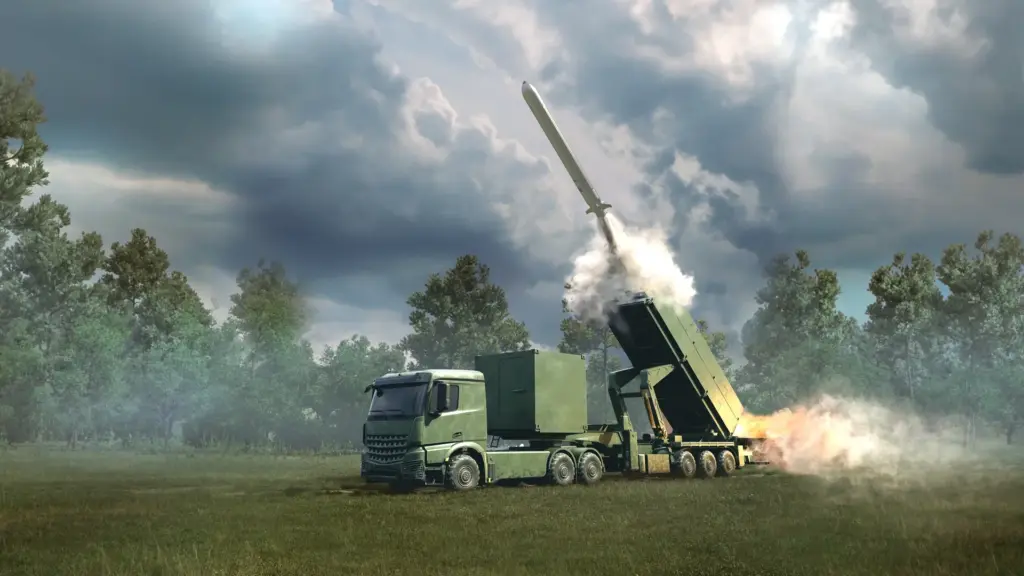
Same missile, different launcher. MBDA's land system is its naval cruise missile on a truck rather than a warship, and the American system Europe has been eyeing fires the same Tomahawks a destroyer does.
What changes is whether the launcher survives to fire a second time:
- Warships must be on station and can be tracked.
- Aircraft must reach a launch point through Russian air defenses, which is why Ukraine's Storm Shadow sorties are rationed by how many jets can get close and come home.
- A road-mobile launcher in a treeline has neither problem—and deterrence by punishment works only if the adversary believes retaliation will still arrive after his opening strike.
Why does Europe have no ground-based deep-strike missiles?
Europe starts near zero because it was once forbidden to start. The INF treaty removed the entire class from the continent for three decades, and Europe—the theater, never a party to the agreement—complied. Russia did not.
- 8 December 1987 — Washington and Moscow sign the INF Treaty, banning ground-launched missiles with ranges of 500-5,500 km. It eventually eliminates 2,692 of them.
- 2014 — The United States first declares Russia in violation, over a ground-launched cruise missile later identified as the 9M729.
- December 2017 — Russia admits the missile exists and insists it complies.
- December 2018 — The United States declares Russia in material breach. NATO allies back the finding.
- 2 August 2019 — The treaty lapses. Neither side is bound, and Russia already has the missile.
- February 2026 — Six European states sign an ELSA letter of intent covering low-cost one-way effectors above 500 kilometers: the cheap layer, not the heavy one.
- June 2026 — MBDA unveils its ground-launched cruise missile. First test firing planned for 2028, earliest availability 2029. Nobody has ordered it.
Seven years after the treaty lapsed, European militaries still lack a category of weapon they were once forbidden to field and their adversary was already building.
Despite years at war, Russia retains a substantial stock of long-range missiles, including the Oreshnik ballistic missile, the Novator 9M729 cruise missile, and its Shahed/Geran-2 attack drones. It is not holding them back.
Russia fired 126 ballistic missiles at Ukraine in July alone, the most in any month this year, from road-mobile ground launchers—the class of weapon Europe is still three years from fielding at deep-strike range.
If a ceasefire is declared and a small contingent of European troops is deployed, a significant arsenal of ground-launched DPS weapons might be the only thing standing between that contingent and a repeat.

Russia is firing more missiles and drones than Ukraine can stop, and the gap is widening
The heavy layer arrives at the end of the decade
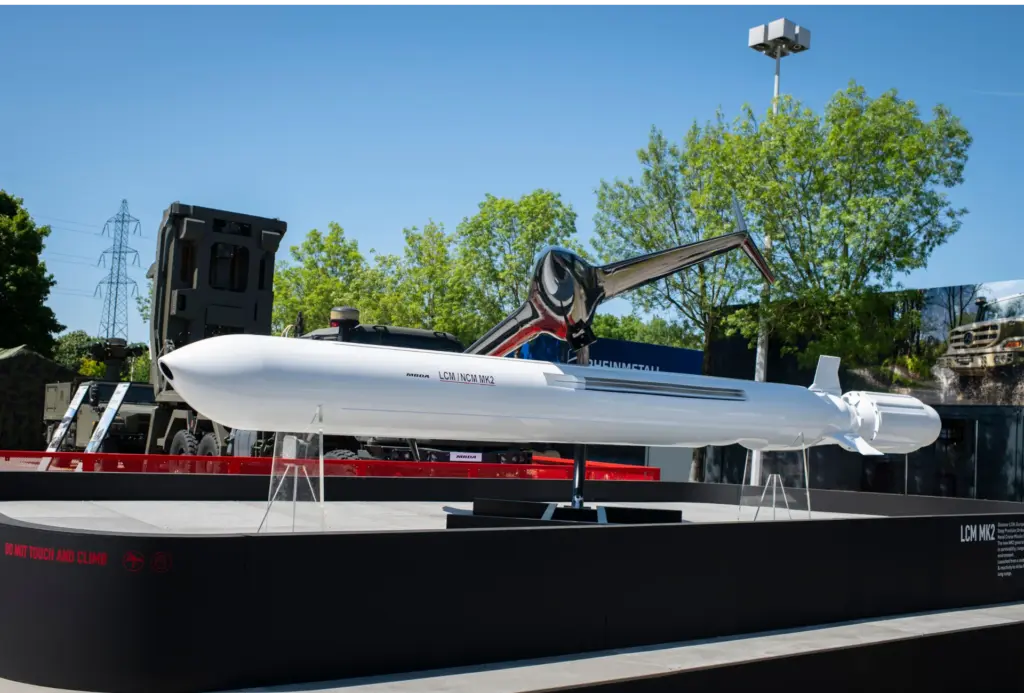
France's MBDA unveiled a complete version of its "European Tomahawk," the Land Cruise Missile (LCM Mk2), at the Eurosatory show in June—the ground-launched version of its battle-proven MdCN, with a first launcher firing planned for 2028 and availability from 2029.
The naval variant is in contract negotiations with France's armaments agency, the DGA. No order has been confirmed for the land-launched version, though Poland remains interested in collaborating through the European Long-Range Strike Approach (ELSA).
ELSA itself shows where European money is going. When France, Germany, Italy, Poland, Sweden, and the UK signed a letter of intent under the program on 12 February, it covered collaborative development of low-cost effectors with ranges above 500 kilometers—the saturation layer, not the heavy one.
The six did agree in June to split ELSA into eight implementation groups, three of them covering ground-launched strike by range band. None of those lines is expected to field before the 2030s.

Trending Now
The American shelf is no fuller. Ukraine unsuccessfully requested Tomahawks from Washington, even though they would have come with authorization-to-use requirements. That option looks increasingly off the table after America's sustained use of Tomahawks under Operation Epic Fury—more than 1,000 missiles fired over the campaign's 39 days, according to CSIS—a burn rate that will take years to replace at current production rates, with Washington's own orders taking priority.
US forces also ran their Precision Strike Missile (PrSM) inventory down hard: CSIS estimates 40 to 70 fired from a prewar stock of about 90, and quotes one Army official who says the entire inventory went. Either figure casts doubt on Poland's plans to buy the American system.
The Coalition's planned "reassurance force" is being designed against that background.
As Armida van Rij, senior research fellow at the Centre for European Reform, put it in mid-July, it would likely be "a small force, light footprint, very defensive posture, quite far away from the front line," which raises the question of "how useful actually is that as a deterrent to Russia." She added that there remains "a bigger issue around the credibility of such a force and the credibility of a European deterrent without a US backstop."
Zelenskyy has made the same objection about placement, telling partners that 10,000 troops stationed in Lviv would not stop anything.

Telegraph: Coalition of the Willing will only send troops to Ukraine with Putin’s consent
The factories are not moving faster than the schedule
The two countries pledging troops are also the two whose military leadership says it is not ready. General Fabien Mandon, chief of staff of the French armed forces, warned that France was not prepared for high-intensity conflict, citing an "insufficient number of ships and armaments" and a particular need for "more missiles with greater range and lethality."
In the UK, General Sir Roly Walker, chief of the general staff, said British land forces must act "with the urgency of wartime," warning that Russia "will only take us seriously ... when they see our factories producing at wartime production rates."
The money has since moved.
An additional 36 billion euros for France's 2024–2030 Military Programming Law was definitively adopted by Parliament on 1 July, bringing total planned defense investment to 436 billion euros—nearly $500 billion—by 2030.
Britain's Defence Investment Plan was published on 30 June, a year overdue, setting out £298 billion, about $400 billion, of investment over four years. Industry welcomed the clarity.
How quickly either plan converts into contracts, and contracts into missiles, is the question the 2029 date already answers.
The one deep-strike line that opens inside the window
Ukraine had to increase domestic defense production quickly, initially with drones and OWEs, then heavier systems like Fire Point's Flamingo cruise missile, shown internationally for the first time at Eurosatory in June.
Its combat record has improved: a 27 June strike on the Titan-Barrikady arms plant in Volgograd was among its most damaging yet, and Germany's Diehl Defence is now in talks to co-produce it, as Berlin looks for alternatives after Washington shelved plans to station Tomahawks there.
For deep-strike missions Ukraine has also relied on UK and French Storm Shadow/SCALP missiles, and on 13 July France went further, licensing Ukraine to manufacture SCALP missiles, AASM bombs, and Aster interceptors on its own soil.
The bilateral roadmap authorizes SCALP and AASM production "before the end of 2026 and starting as soon as possible," the Telegraph reported, though it attaches no date to the first missiles and notes that the factories will more plausibly run after a settlement than before one.
It is the only European deep-strike production line in the plan with a 2026 authorization attached at all—and it runs through Ukrainian factories, not European ones.
The Paris declaration commits the Coalition to activate its guarantees the moment a ceasefire enters into force, at Ukraine's request. No European ground-launched deep-strike missile is scheduled to be available before 2029, and the one closest to ready has no customer.

Editor's note. The opinions expressed in our Opinion section belong to their authors. Euromaidan Press' editorial team may or may not share them.
Submit an opinion to Euromaidan Press


