


Ukraine's strikes on Russian refineries are pushing Moscow to export crude it can no longer process at home, Bloomberg reported. Buyers are not taking it fast enough, so Russian oil is piling up on tankers at sea. The value of those exports keeps sliding, and tanker loadings dipped in the week to 12 July.
Ukraine's refinery strikes are forcing crude onto the water
Ukraine has stepped up its strikes on Russia's refineries. Yesterday, it hit the Gazprom Neftekhim Salavat plant far inside Russia, and the Afipsky facility near the Black Sea. The wave of attacks has driven Russian refining runs to their lowest in more than 21 years this month. That deepens a domestic fuel crunch and squeezes the global market. With less crude to process at home, Moscow is likely diverting more into exports as its own production falls. Russia pumped 8.93 million barrels a day in June — about 830,000 below the level it promised the OPEC+ producer group.
The Azov Sea wasn’t enough—Ukraine’s drones followed Russia’s oil fleet into the Black Sea
The oil is piling up faster than buyers take it
Soaring exports are not being matched by deliveries. So Russian crude is stacking up on tankers, loaded but not yet discharged, Bloomberg wrote. The total has climbed back near its start-of-2026 highs — about 135 million barrels by Sunday.
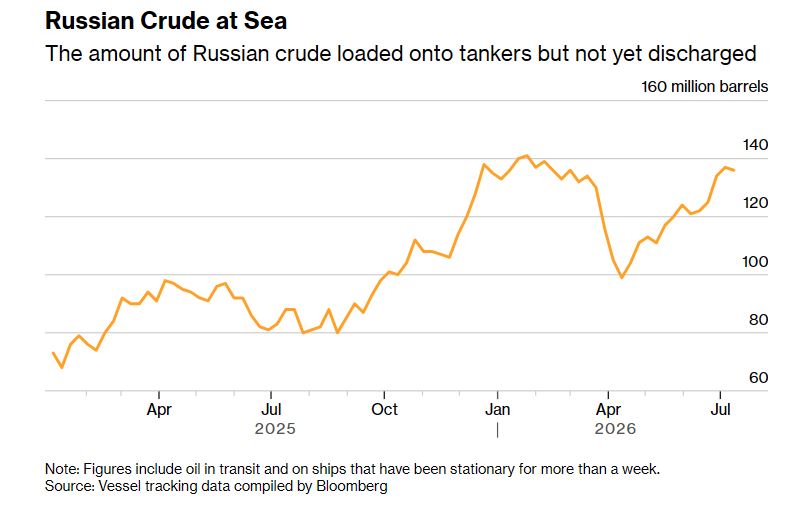
Cargoes are building up near Egypt in the Mediterranean and east of Singapore. Five Urals tankers are anchored off Egypt, and another five have halted near Singapore, a gathering point for shadow-fleet ships hauling sanctioned oil. A growing share of the oil at sea is on vessels that seem to be sitting idle rather than sailing.
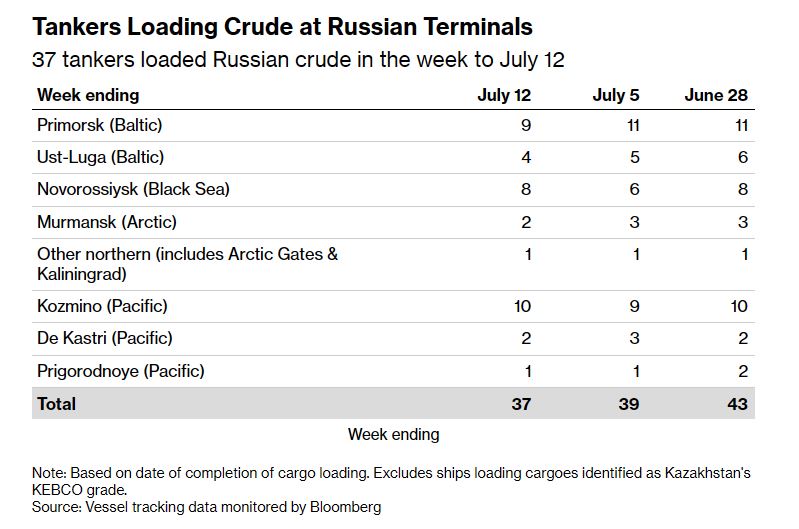
Fewer tankers, and less money for the same oil
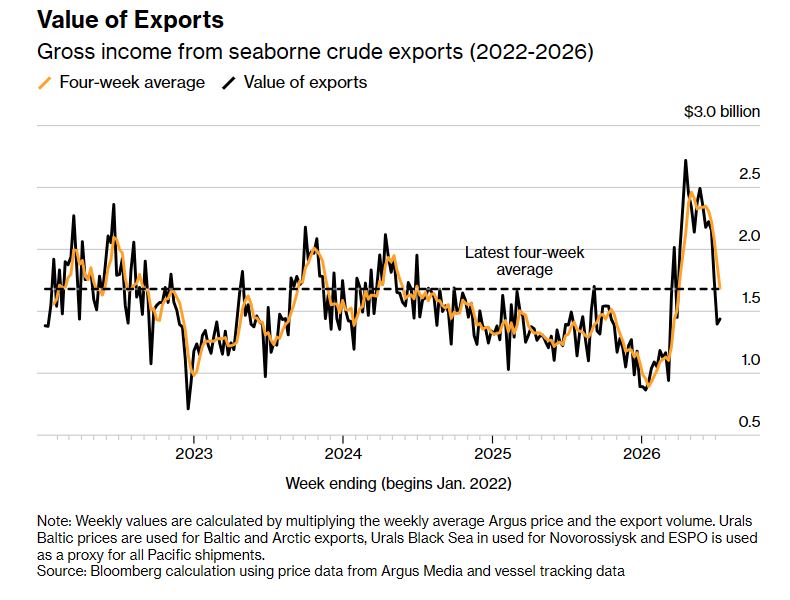
Russia shipped 3.98 million barrels of crude a day in the week to 12 July, down from 4.08 million. Year-to-date volumes remain above every annual average since 2022, yet the four-week export value fell $200 million to $1.68 billion a week. Urals prices have nearly halved since mid-April.
Russia sent 4 million barrels of oil a day toward Asia. Only about half was openly bound for India and China, while 1.9 million barrels a day remained undeclared, likely until tankers crossed the Arabian Sea. Türkiye took 160,000 barrels a day, and Syria 40,000.
Read also
-
Russia has the oil. It no longer has the gasoline—so Russians are learning to make their own
-
Fires at both ends of Russia’s fuel chain: a Lukoil depot in Stavropol Krai and a ferry port facing Kerch
-
Russia wrapped its fuel tanks in protective nets—Ukraine’s drones burned them regardless: two oil depots burned last night


