


Sir Richard Shirreff has spent a decade being right about Russia and ignored for it. So when NATO's former deputy supreme commander told Euromaidan Press at the GLOBSEC conference that no one apart from Ukraine names the war's objective plainly—victory, meaning the defeat of Russia, with no lasting peace until it comes—we had to check to see precisely who.
What we found: across the people who run Western defense—the NATO Secretary General, the alliance's top soldiers, the leaders of its largest members—Shirreff is right. But there's a twist. The word was once spoken, loudly, at the very top, after Ukraine's inspirational 2022 counteroffensive. It has since drained out of the same mouths that used it—and it has not come back, even now, with deep strikes becoming so effective as to give Ukraine a realistic chance of retaking Crimea.
Occasionally, western officials slip into saying “Ukraine can win.” But it is always followed by “let’s negotiate a ceasefire.” It is never followed by “therefore, let’s make a plan so Ukraine will win.”
The gap between the premise and the conclusion is costing Ukraine the victory its soldiers are winning—because victory is a decision, not an outcome. Someone has to name the political end-state and hold to it. When no one does, the battlefield wins evaporate into a settlement that hands the loser what he could not take by force.
Admiral Rob Bauer, who chaired NATO's Military Committee through the war's first three years, told Euromaidan Press that if the West had armed Ukraine in 2022 as it eventually did, "you might have won." His explanation for why it didn't was not about Russian strength: "It was never formulated as, 'We're doing this so that Ukraine can win the war.'"
Whether this scenario repeats now depends on exactly that—whether victory is named as a goal.
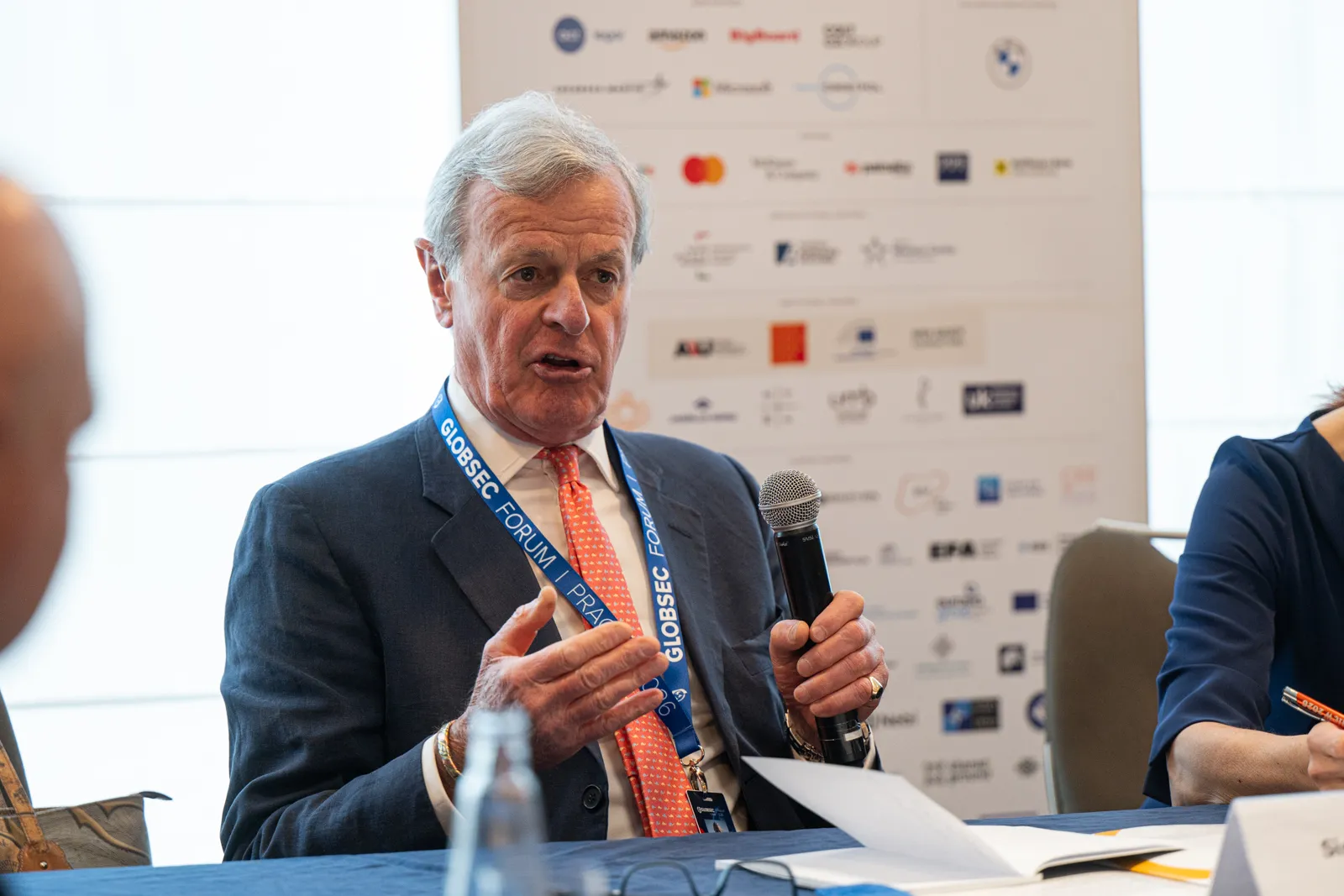
NATO’s former second-in-command says what the alliance won’t: only Russia’s defeat ends the war
The severed sentence, in one man
Nobody performs this better than Finland's President Alexander Stubb, and he did it in a single interview.
Speaking to the Swiss daily NZZ in early June, Stubb laid out the most detailed victory case any sitting leader has offered. The war, he said, has moved through three stages: "The first year of the war was about survival. The next three years were about resilience. Now it is a question of mathematics—battlefield mathematics." Then he did the math—35,000 Russian casualties a month against 27,000 recruits, a loss ratio gone from one-to-three to one-to-eight, Ukraine in April retaking more ground than it lost for the first time in the war.

His conclusion: Ukraine is in "a much stronger position on the battlefield today than at any time since the beginning of the conflict."
And the step he takes from it is not "so let us resource the win." It is: "I think we should talk to Putin." Why now? Because—his words—"you can only negotiate with the Russians when they are not in a position of power."
Read that twice. Stubb has just proven Ukraine holds the upper hand, and he converts the upper hand into a reason to open talks, not a reason to finish the job. The advantage becomes leverage for a ceasefire. It never becomes a mandate for victory. Even at his most bullish—at Munich in February he told Ukrainians "it seems to me that you will win this war" and that Putin "has suffered a strategic defeat"—the verb is descriptive.
Stubb exemplifies a pattern by Western officials. You may win, we'll grant you that. Never: we will make you win, and here is how.
The same NATO chair, the word gone
Stubb is one clever Finn. NATO is the alliance—and NATO is where the disappearance is the starkest, because you can watch the identical chair change its mind.
In July 2023, at the Vilnius summit, Secretary General Jens Stoltenberg put it without a hedge: "unless we ensure that Ukraine wins this war, unless we ensure that Ukraine prevails as a sovereign independent nation... the most imminent task is to ensure that Ukraine prevails and President Putin does not win this war." At Munich that February he had been blunter still: "we must give Ukraine what they need to win."
The word, the verb, the objective—all of it, from the top of the alliance.
Now the same chair. Asked directly at a January 2026 forum whether Ukraine needs to win the war rather than merely survive it, Secretary General Mark Rutte did not say yes. He answered that the task was to bring Ukraine to a place where "the Russians will never attack again. But that then will lead to a very sensitive discussion about territory."
The chair that said "win this war" in 2023 now pivots, on the direct question, to a sensitive discussion about territory, implying that Russia will keep its landgrabs.
Mark Rutte could not bring himself to imply that such a situation could be called Ukraine's "victory."
Even the soldiers say "can," not "must"

The retreat is starkest where you would least expect it—among the serving commanders whose job is winning wars.
General Christopher Cavoli, supreme allied commander until July 2025, does not lack confidence in Ukraine. In a June 2026 interview he called Ukraine's war effort "one of the most remarkable military feats of the century," said Ukraine was "regaining moderate amounts of territory" and "rapidly moving into a position of gaining advantage." And then, in the Q&A after: "this does not appear to be the sort of war that's going to move toward an unconditional surrender of one side or the other... anything short of that is going to be some sort of brokered decision."
Ukraine gaining, in the same breath as a brokered deal. The general sees the advantage and does not name the win.
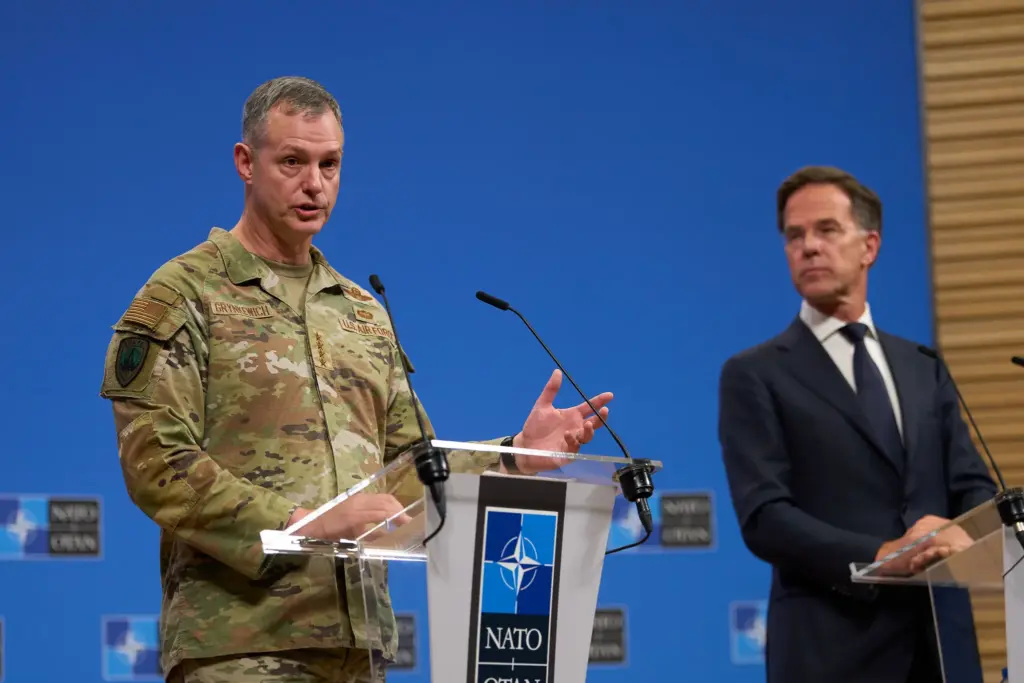
His successor, General Alexus Grynkewich, went as far as "can." Asked at his June 2025 confirmation hearing whether Ukraine could win, he answered without hesitation: "I think Ukraine can win." In the same hearing he described his own task as giving President Trump options to reach the president's stated objective—a ceasefire.
NATO's top commander expressed optimism about Ukraine's chances and, in the same sitting, defined his job as delivering a draw.
There was a time when "victory" was sayable

In September 2022, as Ukraine's forces broke the Russian line at Kharkiv and retook thousands of square kilometers, European Commission President Ursula von der Leyen stood in Kyiv and told Zelenskyy, "I'm deeply convinced you will win this war." In February 2023, on the war's first anniversary, US President Joe Biden declared in Warsaw that "Ukraine will never be a victory for Russia — never." It was then that Stoltenberg said the alliance's most urgent task was to "ensure that Ukraine prevails."
Trending Now
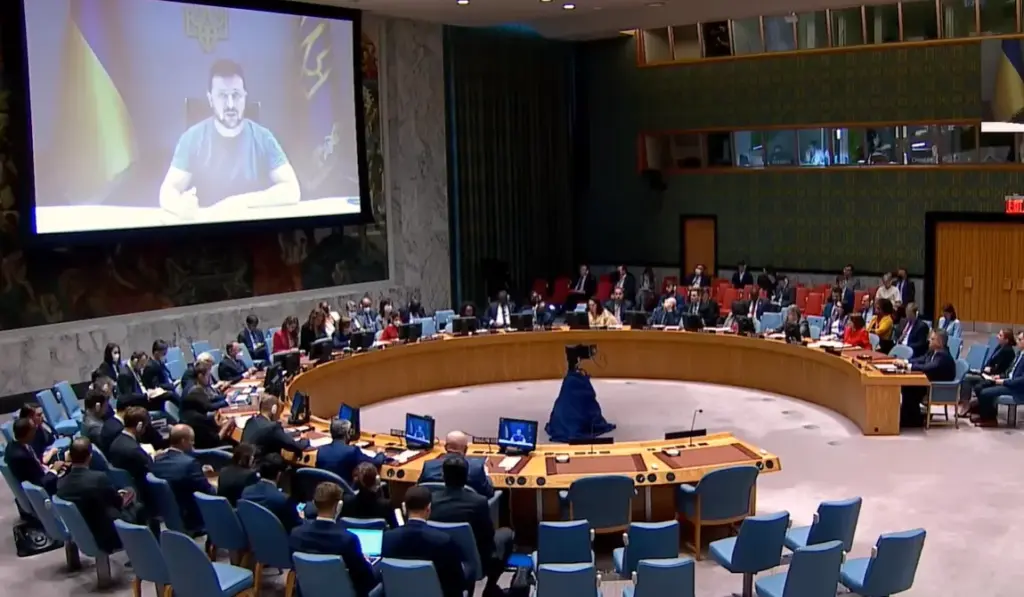
This matters because a “just and lasting peace” can mean many things. In September 2022, when Zelenskyy spoke at the UN General Assembly, he presented "not any kind of peace… but just and lasting peace" as the umbrella over what became his 10-point Peace Formula—meaning Russia is fully forced out and pays reparations.
In 2026, it has devolved to mean “the fighting freezes at the current line of contact and Ukraine gets unclear security guarantees,” with equally unclear consequences for Ukraine’s future.
The change of meaning of "just and lasting peace" was most recently evident in the E3 statement that Keir Starmer, Emmanuel Macron, and Friedrich Merz signed with Zelenskyy this June. The statement "welcomed recent Ukrainian successes on the battlefield, including the recent liberation of territory," and then, a line later, set out that "the current line of contact should be the starting point for negotiations."
Ukraine is retaking ground, and the same document proposes to freeze it where it stands. The words held; what they carried was hollowed out.
The thing is that nobody really knows how to live with a 1,200 km-long frontline that, even if frozen, will need immense money and resources to patrol and repel Russian attacks. And attack it will: we have seen this scenario play out during 2014-2022 in Donbas, when Russia exploited a low-level war as it tried to destabilize and drag Ukraine back into Russia’s sphere of influence—until it invaded outright.
Western officials are mostly unanimous that a frozen conflict means Russia will recuperate, rearm, and reattack. The experts say that even before this happens, the frozen conflict scenario will cost the EU twice as much as helping Ukraine win. Nobody is making a victory plan to spare both Ukraine and the EU from facing this outcome.
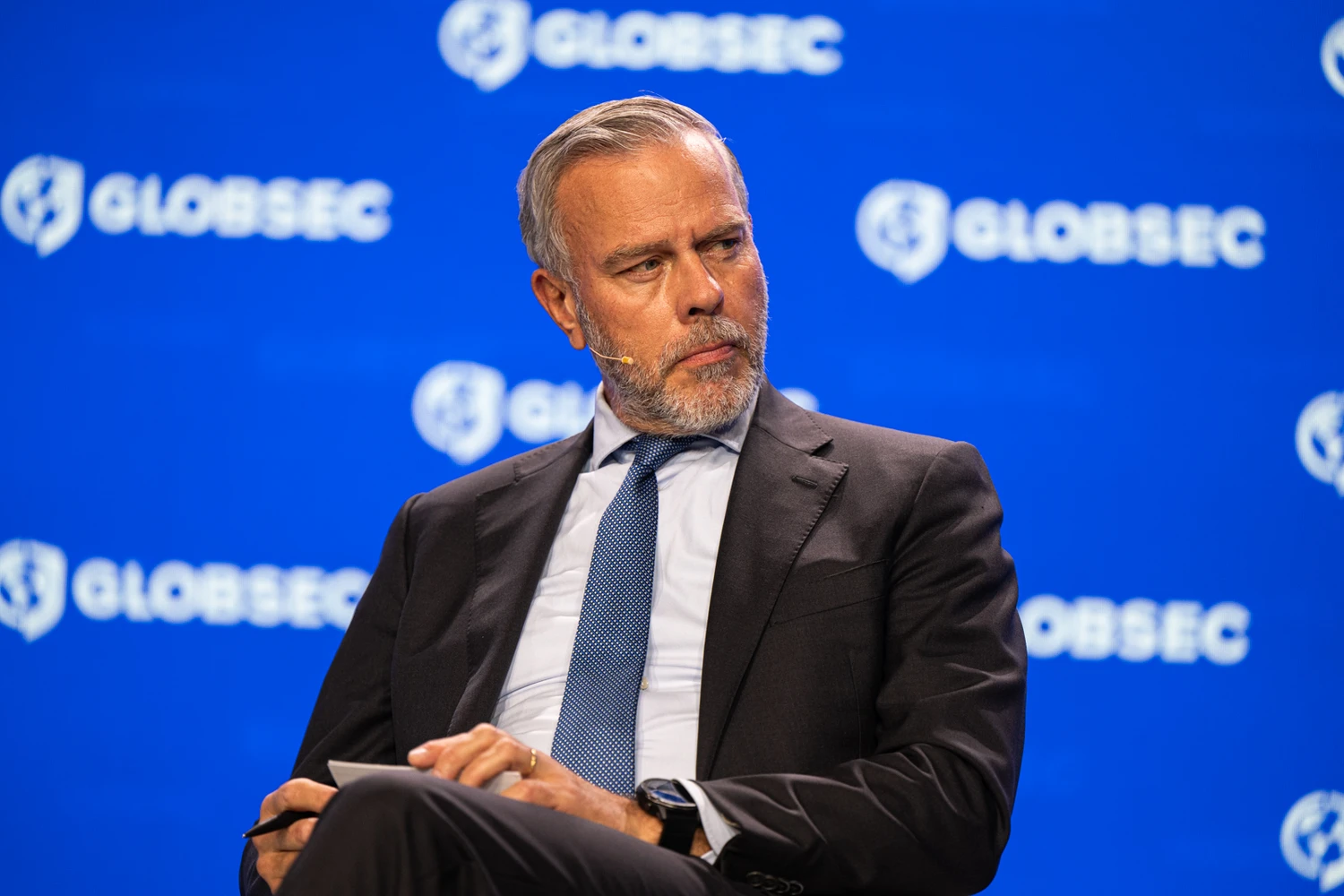
Why the V-word left—and it was not Trump

So, what changed? It is tempting to read this as the Trump effect, the negotiations track imposed from Washington. The timeline says otherwise, and a Ukrainian who watched it happen said so at the time.
Andriy Zagorodnyuk—Ukraine's former defense minister—told Euromaidan Press in November 2023 that the coalition "still cannot entertain the idea of its victory," that Western leaders were "too afraid to say we are going to go for victory," and that what was missing was "a joint strategic plan, which currently we don't have." A year later, in October 2024—still under Biden, before Trump took office—he was blunter: asked whether the West was truly choosing Ukrainian victory, he said, "the short answer is absolutely not."
He named the mechanism, too. In late 2022 Washington had convinced itself Russia was ready for nuclear escalation, and that caution, he argued, "actually promotes escalation because it encourages Russia to keep playing with nuclear threats—they see it works."
The self-deterrence set in at the very peak of the victory talk, as Euromaidan Press documented last year. Trump did not kill the objective. He inherited one that had already been hollowed out, and formalized the ceasefire track the hollowing had made inevitable.

The coast is clear, and yet "victory" has not returned
Every condition that once made the word sayable is present again. Ukraine is striking Russian refineries, gas plants, and arsenals more than a thousand kilometers deep. The US-brokered ceasefire push has, in Shirreff's phrase, become a "groundhog day" that "has run out of steam"—stalled not on any Ukrainian refusal, but on Russia's use of each truce as a pause to regroup, while Zelenskyy plays along to keep Washington on side.
The battlefield argument for naming victory is stronger now than in 2022. The word still has not come back. That is the measure of how completely it left: renewed success does not restore it, because what went missing was never the evidence. It was the will to name the goal.
Shirreff wants to change that. "It just defies belief that people don't see it so clearly, so crystal clear, that the only way there will be a lasting peace is the defeat of Russia," he told Euromaidan Press.
Why has the word not returned? His answer: "timidity, fear, lack of political will, complacency"—and a policy establishment that half-believes Russia's story that it is unbeatable because of its size. "I don't accept that," he added. What is missing, in his account, is the courage that comes from the determination not to be beaten. The case that strong action now prevents a worse war later is a hard one to make in a democracy, where the instinct in the face of the worst case is to look away and hope it does not come.

The men outside the room
The word survives, intact and prescriptive, among those no longer accountable for delivering it.
Retired US general Ben Hodges, former commander of US Army Europe, draws the whole line: "the best way to make sure that Russia never attacks Europe is to help Ukraine defeat Russia," he told Charter97—and he names the method, strangling Russia's oil and gas export revenues until the war economy seizes. His blunter version is the title of another interview: we are not helping Ukraine to win. Zagorodnyuk argues it from Kyiv. And Shirreff, now chief foreign military advisor to Ukraine's Commander-in-Chief Oleksandr Syrskyi, has stopped merely warning and started pushing for the plan.
His prescription inverts the very word the rest of the field hides behind. He does not oppose a ceasefire; he opposes the capitulation being sold as one. The only ceasefire worth having, he told us, is one "that means victory over Russia." Getting there starts now: a Sky Shield over the parts of Ukraine Russia does not occupy, Article 5's guarantee extended to that territory, and the West supplying what Ukraine needs to win rather than what is convenient to give.
But beyond these first steps, achieving the defeat of Russia will require, in Shirreff's words, a grand strategy with several strands of operation. See what they are in our full interview.


