


In an interview with Euromaidan Press during the GLOBSEC 2026 Forum in Prague, Admiral Rob Bauer—who chaired NATO's Military Committee from 2021 to 2025—told us that if Ukraine had received in early summer 2022 the weapons it eventually received much later, "you might have won" the war. The admission, from the senior officer who oversaw NATO's military response during the war's first phase, is among the most direct concessions from a NATO authority that the West's incremental approach to arming Ukraine was a strategic mistake.
In a wide-ranging conversation, Bauer described an alliance that operated without a strategy for Ukrainian victory—"It was never formulated as, 'We're doing this so that Ukraine can win the war'"—confirmed on the record that Russia's nuclear threats to Paris, London, and Washington in 2022 were met with a US promise of conventional destruction of Russian forces in Ukraine, and argued that Ukraine must now be admitted to NATO because excluding "the biggest nation with the latest experience in war with the Russians" would compound the original mistake.
The conversation that follows has been edited for length and clarity. Bauer's framings and corrections — including where he pushed back on our questions — are preserved.
EP: Admiral Bauer, in November 2022, you said if the Russians did not have nuclear weapons, NATO would have driven Russians out in Ukraine. Was nuclear deterrence the dominant constraint for NATO's response in Ukraine, or one of many, and does that constraint still hold today?
Admiral Rob Bauer: First, the war in Ukraine is not a NATO event, but a decision to go out of area to help another nation. As long as you're not a member, you're not part of the regional plans or the automatic responses we have if Estonia or Italy are attacked. The authorities the Supreme Allied Commander Europe has are connected to everything concerning the Allied territory.
But if you go to Afghanistan or Ukraine, it's not only a military consideration—it starts with the political will. Do we want to get involved? If "yes," then the military will start to develop the plans, then the politicians will say "yes" to the plans and we'll start doing it, like we did in Afghanistan, Kosovo, and Iraq.
And second: nuclear was and is part of the political considerations. Because, for example, Putin said every time there is a red line: with the HIMARS, then tanks, and then F-16s and ATACMS and missiles. And every time we found out later that it wasn't a red line—after we took too long to say "yes" to the additional capability for Ukraine.

Now, with the benefit of hindsight, you can say, "Why didn't we do this earlier?" And that is true, but we have to be honest as well: if you are the American president, in this case President Biden, and you believe that you might start a war with the Russians as the Alliance which might end up in a nuclear confrontation, part of his considerations to say "no." And he might not have been the only one to say "no." So, it's not as easy as you depict.
I still stand by what I said. I think if the Russians were not a nuclear-capable armed force, we would have gone in pretty quickly as the Alliance.
EP: Ukraine gave up its nuclear weapons in 1994 under the Budapest Memorandum with security assurances. And three decades later, you have described an architecture in which nuclear weapons gave Russia an effective veto over the most powerful military alliance in history.
Admiral Bauer: No, no, no. That's not the right formulation. They don't have a veto over an Alliance: if it comes to a fight between the Russians and the Alliance, we'll fight them.
EP: But nevertheless, Ukraine is not part of NATO and you said that nuclear weapons are part of the reason.
Admiral Bauer: So, for helping someone outside the Alliance, which is a separate discussion than fighting for ourselves, that's the difference. So the Russians don't have a veto over what we do as an Alliance.

NATO Defense Committee Head: “If Russia didn’t have nuclear weapons, we’d be in Ukraine”
EP: Okay, but they have a veto over whether Ukraine is admitted to the Alliance.
Admiral Bauer: Well, that's another discussion.
EP: Okay, they do have this veto—they restrain NATO's response in Ukraine. You have said it yourself, that you were restrained because of the fears of nuclear escalation that turned out not to materialize.
Admiral Bauer: Part of it is self-restraint. And some of it is deterrence. Deterrence is not necessarily what people think will happen, but what they believe will happen. If people believe this could lead to a nuclear war, that might be the reason you don't want to get involved. But it doesn't mean that it would have happened.
Now, again, you say they had a veto. I agree with you that it's not smart that we, as an Alliance, started to say from the start what we were not going to do. That doesn't help with deterrence. If you say, "Oh, by the way, we're not going to get militarily involved," that helps the enemy greatly. But this was new territory: Afghanistan and Iraq were different because they weren't a near-peer fight like in Ukraine. And a lot of politicians tread cautiously because it was new territory and not part of the "normal" plans for NATO. Maybe too cautiously.

Top NATO official urges leaders to get ready for “wartime scenario” after Russia threatened retaliation for Ukraine’s strikes at its territory
EP: By "new territory," you mean Russia has nukes, yes?
Admiral Bauer: No, no, no. This was a near-peer conventional fight at a scale that we hadn't done in Afghanistan or in Iraq. This is an actual war where the adversary actually fights back.
EP: Is there any serious discussion in NATO about how to deal with nuclear powers gone rogue? Or is the doctrine effectively "avoid escalation at all costs," even at the cost of de facto licensing nuclear coercion as foreign policy?
Admiral Bauer: These are all political questions first and foremost. The more interesting question is: what would have happened if the Russians used nuclear weapons? They threatened this in September 2022, when Ukraine was about to take 20,000 Russian soldiers as POWs, with them losing all their materiel, on the western side of the Dnipro River [in Kherson Oblast-Ed]. They were trapped with one little bridge, and you were pushing them back.
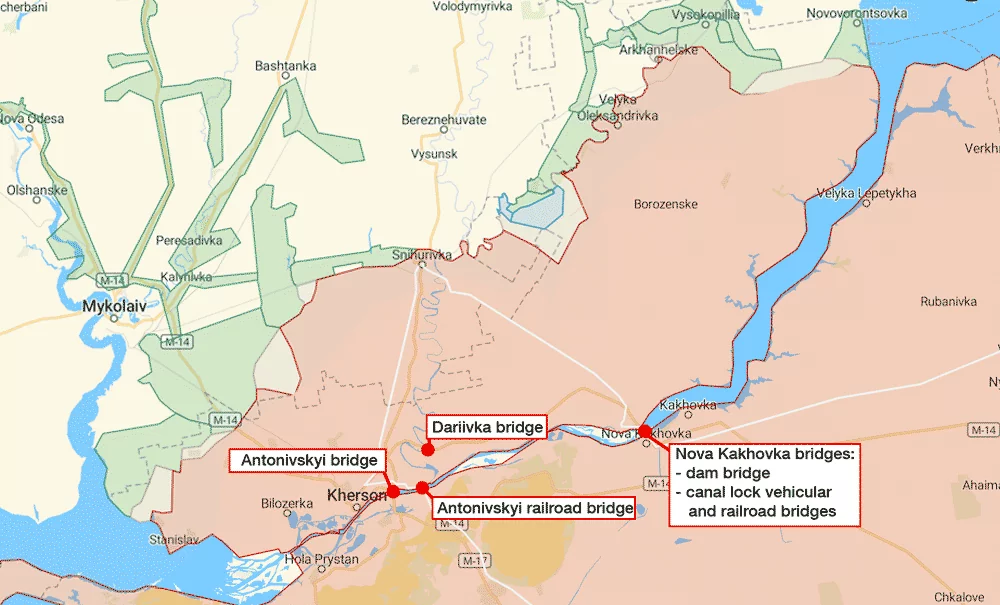
Then the Russians started to make phone calls to Paris, London, and Washington about the use of nuclear weapons. And the interesting thing was that nobody knows exactly what the capitals replied, but in the end they didn't use it. I heard at one point that the response was that if the Russians would have done that, they would have been taken out conventionally by the Americans. It didn't happen because the Russians were told, "Don't even try to do this. Keep this a conventional fight, which is bad enough, but don't go into the nuclear territory because you will be punished—and you will be very, very sorry that you ever started thinking about this."
So I think in that sense we were not hijacked by the Russians. But it is of course cynical that Ukraine gave up its nuclear weapons for security guarantees from three nations, one of which attacked and the two others didn't stop it from happening. So that does mean indeed for talk about security guarantees, if it's not Article 5? And we even have a debate in NATO now: is Article 5 a guarantee as we think it is? I still think it is, but there are critical people debating that as well. Of course it's a different ball game if you have a nuclear weapon.
Trending Now
EP: So is there any discussion happening? Has this incident in 2022 converted into an evolution of NATO's doctrine of what to do with nuclear rogue states such as Russia?
10:56 | Admiral Rob Bauer: I haven't been privy to that. I haven't seen it happening whilst I [chaired the NATO Military Committee], and don't know whether it is at the moment, because I'm no longer there. [Admiral Bauer left in January 2025 - Ed.]
EP: NATO generals have told me at GLOBSEC that Ukraine is buying Europe time to rearm and that no one apart from Ukraine says the objective is victory; there is no strategy, no coordination, no political will. These two framings fit together. If nuclear deterrence prevents direct NATO action, then buying time via Ukrainian fighting becomes the only strategy available, which means there's no incentive to construct a victory plan. From the Military Committee seat, is that the architecture you described in November 2022? And at what point does buying time become accepting indefinite Ukrainian sacrifice as foreign policy?
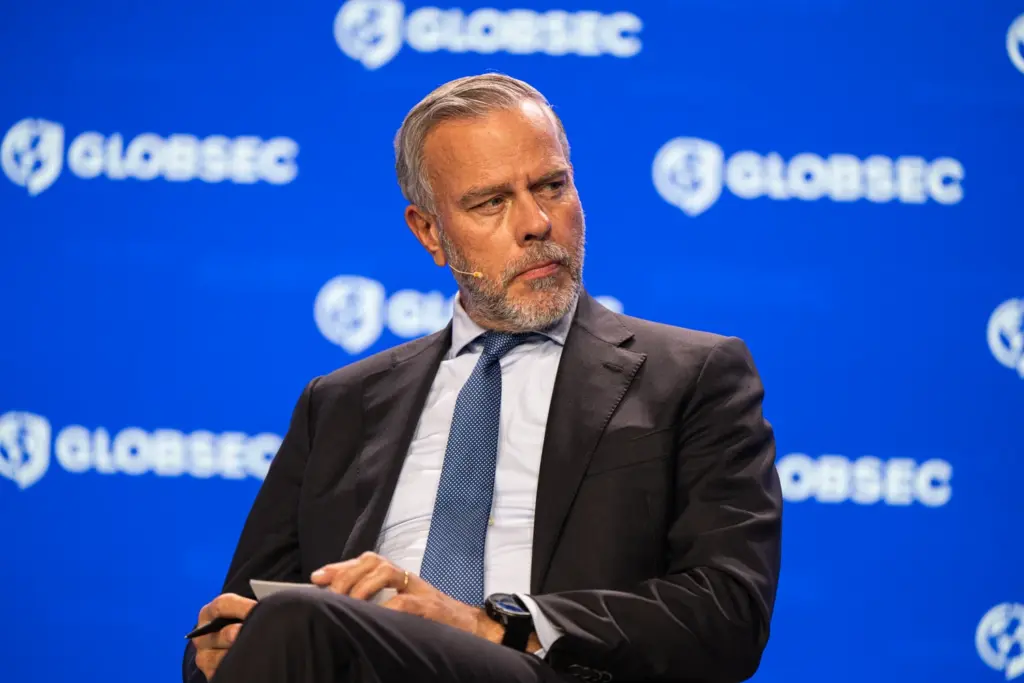
Admiral Bauer: It is true that there was actually not a real strategy, neither within NATO, nor the 50 nations that help Ukraine as of today. It was never formulated as, "We're doing this so that Ukraine can win the war." It was also not formulated, "We're doing this so that Russia can lose this war." So the formulation became, "We're going to support Ukraine for as long as it takes."
Time plays a role. If in the late spring of 2022, early summer of 2022, when you retook 50% of what the Russians originally conquered, we had given everything that we eventually gave—tanks, HIMARS, ATACMS, F-16s—the outcome now would have been different: the Russians would be in a much more difficult spot. And because we allowed all these discussions on "let's give tanks, HIMARS, etc." to last so long, the Russians built the defensive works and then retaking your land became much more difficult, as you found out in the summer of 2023.
So other than the discussion of where we are now in relation to the non-strategy, if we had done something else in 2022 with regard to the weapons that we gave, you might have won.
EP: That is what we believe in Ukraine as well. So why is there no strategy?
Admiral Bauer: In the Alliance, there is a strategy for collective defense—not losing the war, winning the war. If you say that about another country outside the Alliance, then you basically promise to do that, and it becomes an extension of Article 5. I've never seen a debate as to what the strategy actually is amongst the 30, and later 32...
EP: That is so remarkable. Admiral, you're speaking as Ukraine as an external nation that has no connection to the Alliance, but that is not true...
Admiral Bauer: No, no, I'm not saying there's no connection. I'm saying you're not a member.
EP: We're not a member, but we're not a member because Russia has a nuclear veto over this, and we're fighting the threat that you recognize as a threat.
Admiral Bauer: I'm with you, don't get me wrong. But what you say about the Alliance needs to be technically correct. It's not that I believe what we did has always been right. I think we should have done more.
But the question is, how does it work in the Alliance? If there is no agreement amongst all the members, it's not going to happen. If there's one nation that says "no," it's not going to happen. And that's why you are not a member yet, why we didn't do more than what we have done, why we didn't deploy troops as the Alliance in Ukraine, etc., etc. Because there was one or more nations that objected in getting more involved. That's the reality.
And also NATO was still in the middle of learning how to defend itself. We moved from wars of choice in Afghanistan and Iraq, budget cuts for 30 years, underinvestment. So we had agreed to do more ourselves, then this war happens, then we start giving away weapons. The one thing I said a month after the war started: "It's great we're giving away weapons, ladies and gentlemen, but we're doing it from half-full warehouses, if not worse." So the next problem that is facing us is the defense production capacity. And if we don't solve that, we're not only not doing what we promised ourselves in terms of growing our armed forces, but we will in the long run be unable to continue to help Ukraine.
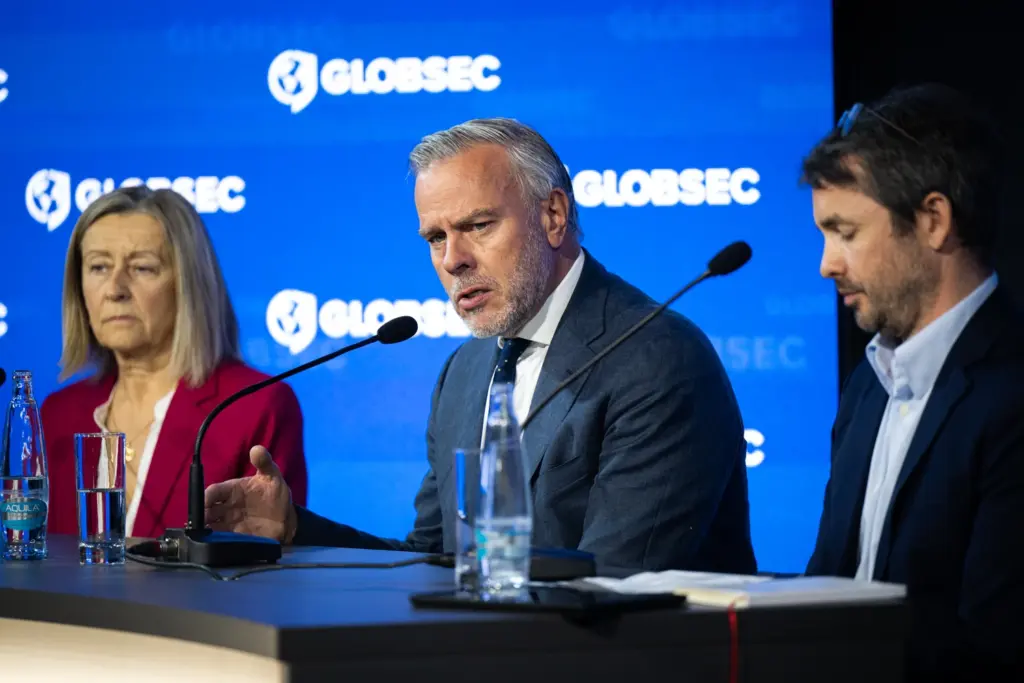
EP: Is there any way such a strategy could be developed in NATO in its current state?
Admiral Bauer: Unlikely. With the present government in the US, the way the Hungarian government was, Slovakian government now. So again, you need—it's not only the US, you need one nation that says "no" and it's "no."
EP: Ukraine has a 20-billion-euro state budget gap for 2026, and is now fully dependent on European support since US financial assistance ended. Meanwhile, the EU rearm plan is 800 billion euros for European rearmament, and Europe is still buying over 1 billion euros of Russian fossil fuels every month. From the Military Committee seat, is the funding architecture telling the strategy? European future readiness prioritized over Ukrainian present survival?
Admiral Bauer: A lot of questions in one. Of course there's a connection between funding Ukraine and our own ability to defend ourselves in the long run. If Ukraine goes sour, if Ukraine is no longer a sovereign state, we're in much more shit than we are now. So yes, there's a connection.
What war does is force you to look at everything at once, because it comes down to one thing: not losing. Preferably winning, but it starts with not losing. In our nations we're not there. We're still balancing social welfare, healthcare, defense, helping Ukraine—all of it at once. And I'm of the school that if we don't solve this more holistically, because everything is connected to everything, we won't be ready in time. These are problems we can actually solve.
Ukraine needs the help it needs, whether weapons or finances. Will it get everything it asks for? That will always be a problem—nations don't always have the money they need themselves, and you can't give away what you don't have. So there's friction, and that's all right. But for me it's clear: we have to make sure you remain a sovereign state. And I'm more and more convinced you need to be part not only of the EU architecture but of NATO. Because if we don't allow Ukraine into the Alliance, we make a big mistake—leaving out the biggest nation with the latest experience in war with the Russians.


