

He flashed his phone screen across the table. A mother in the Kyiv metro cradling her newborn, hiding from the Russian missiles that so often fall from the night sky in Ukraine.
"That could be you with your children, your baby.”
Sir Richard Shirreff had taken that photo earlier at an exhibition on the sidelines of the GLOBSEC conference in Prague. Europe's most senior NATO officer saw me in that picture after I had mentioned, in passing, that I have three children

The waiter brought our drinks. A Cuba Libre for me, an Aberfeldy without ice for him. Sir Richard glanced at his name tag.
"You're not Kenyan, are you?"
"No, I'm Ghanaian."
"Okay, I'm an East African. Africans have got to stick together." From under his sleeve, he pulled out a bracelet in black, green, and red—the colors of Kenya, where he was born and bred. "There were two Kenyans here today. I heard them speaking Swahili and I said 'Habari?' and they said 'Mzuri sana.'"
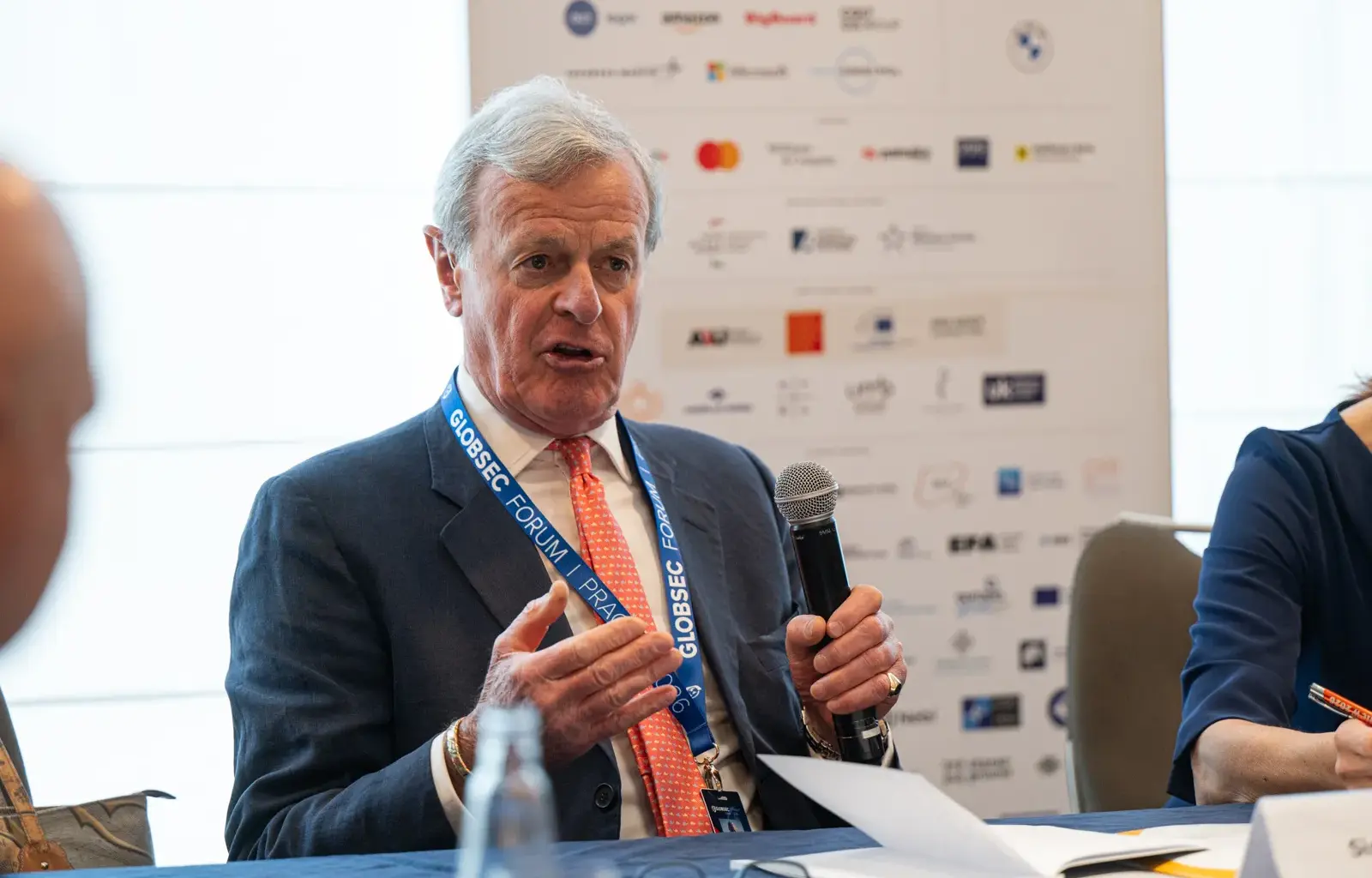
I reached out to General Shirreff, former Deputy Supreme Allied Commander Europe, at the GLOBSEC forum in Prague because he was the only western official openly saying the V-word—victory—that had been quietly retired over four years of Russia's war against Ukraine. GLOBSEC's own scenarios oscillated between a bad peace deal or continued protracted fighting.
There needs to be a clear, grand allied strategy to achieve victory
The general would have none of it. "There needs to be a clear, grand allied strategy to achieve victory" over Russia, he said at a panel about the scenarios. "There should be a clarion call for it, because that is what is missing at the moment in the international community."
Seeing and speaking clearly was a professional habit. In 2011, serving as DSACEUR, he invited General Valery Gerasimov to the NATO headquarters. The official NATO line at the time was that Russia should be the alliance’s most important strategic partner. “Almost from the moment we sat down, I knew that we should forget any thought of partnership. We were the enemy,” he told me.
On 18 March 2014, Vladimir Putin formally absorbed Crimea into the Russian Federation. An English transcript of Putin's Kremlin speech was on Shirreff’s desk the next morning. "It sent a chill down my spine. I could have been reading Mein Kampf in 1922. He laid out his intent." Two years later he published 2017: War with Russia, a novel that mapped, with uncomfortable specificity, the war that began in 2022. The British Foreign Secretary at the time, Philip Hammond, was asked about the book on BBC radio. "I know no one who thinks like that," Hammond said. "He's only written it to pay off his mortgage."
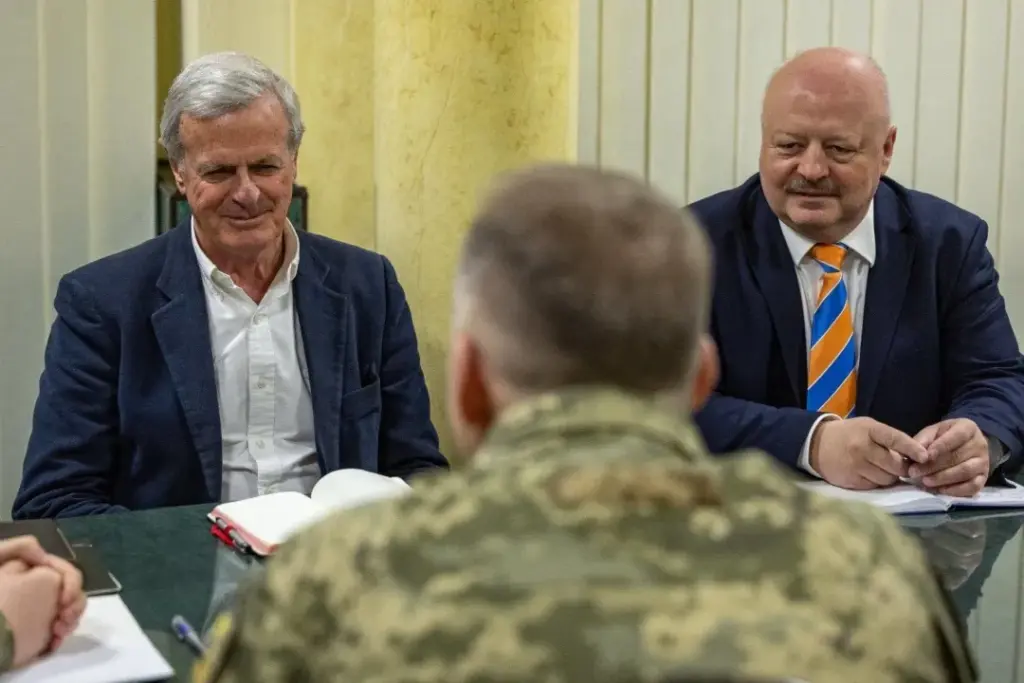
He is now, since April, chief foreign military advisor to Ukraine's Commander-in-Chief Oleksandr Syrskyi, on the ARES military expert council. Over drinks in the Prague bar, he tells me that the political will needed for the West to decisively help Ukraine achieve victory over Russia must be found in the heart. What follows is our conversation, edited for length and clarity.
Alya Shandra: General, I was very heartened by your comments today, that nobody apart from Ukraine has stated that the objective is victory, and that there is no “clear, grand allied strategy” to achieve the defeat of Russia in Ukraine. Why have the words "Ukrainian victory" disappeared from the agenda?
General Shirreff: What a question. I don’t know the answer. It just defies belief that people don’t see it so clearly, so crystal clear, that the only way there will be a lasting peace is the defeat of Russia.
And that means victory. Why does nobody mention it? It’s timidity, fear, lack of political will, complacency. It's Western Europe. It’s partially because a lot of people who should know better—responsible, experienced, senior policy makers and even senior military in the West—have swallowed Russian cognitive warfare line that "Russia will prevail because of the size and the scale." I don’t accept that.
Alya: You mentioned "political will,” a mysterious word for me. Where does it actually come from?
General Shirreff: It comes from the heart. It comes from the brain. It comes from courage. It comes from determination not to be overcome. The Ukrainian will is political. It is "we are not going to surrender." And that comes from a determination not to be in any way beaten. It’s the same will that a sprinter wins the Olympic gold with.
Alya: So, it’s a will that’s just called "political.”
General Shirreff: By "political" it means it’s the will of a politician, the will of the people in charge. But that has got to be sustained by the recognition that they have the will of the people behind them. And the problem with Western politicians is that nobody is explaining the truth of the situation.
Britain 80 years ago was the only country in Europe that had not been defeated by the Nazis. We went through the winter of ’39, the Blitz. There is an instinctive recognition, understanding, and respect for what the Ukrainians are doing. So the will is there. All it needs is for politicians with the courage to tap into it and say, "We can do this, we can support Ukraine." They talk about it, but they don’t turn it into the concrete, really—you know, they promise but don’t deliver what needs to be done.

“It was never formulated as Ukraine winning”—NATO’s ex-military chief on the missing strategy
Alya: What is the ultimate reason for this?
General Shirreff: I think it’s because they don’t feel an existential threat—their lives are not threatened in the way that your life is every night in Kyiv.
There are parallels. Britain, 1939. The recognition that this was going to lead to war really only kicked in when the Nazis moved into the rest of Czechoslovakia and the "peace at any price" deal in 1938 was shown to be a complete sham. My father joined the army because he knew he was never going to finish his Oxford career; there was that, "Okay, now we’re in it." Only when people are really pushed to the edge and fear for their lives and their welfare do they get frightened, and then they show that sort of will and courage.
Alya: Speaking of predicting wars, your 2016 book predicted a scenario that resembled what Putin actually did, but the book’s warnings were not heeded. Why do you think that happened?
General Shirreff: To me, the epiphany moment was reading Putin’s speech on the day Crimea was incorporated into the Russian Federation, 18 March 2014. It sent a chill down my spine because I could have been reading Mein Kampf in 1922. He laid out his intent.

Georgia was our Rhineland moment. Crimea was our Sudetenland moment. So, why didn't it get heeded? I remember the Foreign Secretary of the day, Philip Hammond, being quizzed on the BBC by a very sharp interviewer who said, "This retired general has written a book saying there’s going to be a war with Russia. What do you think?" And the Foreign Secretary, who had all the intelligence and information said, "I know no one who thinks like that, and he’s only written it to pay off his mortgage."
Pushing against the perceived wisdom is always going to make you an outlier. Particularly, nobody wanted to hear it in London, with huge Russian money swirling all around.
You only change your frame of reference after listening to outside influences. And my change of reference came clearly from that speech. It came from me meeting Valery Gerasimov.

At our very first meeting, I held the NATO line that Russia should be our most important strategic partner, we needed to cooperate with Russia to withdraw the ISAF mission in Afghanistan. Almost from the moment we sat down, I knew—forget any thought of partnership. It was bloody obvious that we were the enemy.
He started talking about ballistic missile defense, which Russia saw as a direct threat to its nuclear force—it would have blunted Russia's second-strike capability. And NATO at that time—2011, 2012—had just put nuclear into a box and locked it. We weren't thinking about it. Then I realized Russia was still fighting the Cold War.
Alya: When you said that there is no strategy, no coordination, and no political will to achieve the objective of Ukrainian victory, could you walk me through what each of those three failures looks like at the operational level? Where is the strategy missing—in NATO headquarters, in capitals, in the European Council?
General Shirreff: The strategy starts with a goal and a vision. To me, the vision is a Europe whole, free, secure against a Russia that will never give up its intent to rebuild another empire. It’s a vision of a NATO with Ukraine absolutely clearly embedded as a member, with a deterrent shield from the Baltic to the Black Sea. To me, that is the only way that Europe could live in peace. Russia’s aggression is generational and will go on forever, because Russia thinks empire. Russia is and has only ever been an empire. Russia cannot think of itself as the country it ought to be without Ukraine as an integral part of it.
To achieve the defeat of Russia is going to require a grand strategy with a number of strands of operation.
Like in any strategy, you start with a vision and you think right to left. What are the objectives? You map a pathway back from each one. To achieve the vision, you tick off the objectives along the way.
The first one is the defeat of Russia in Ukraine—there won't be lasting peace without it. That then enables the establishment of that NATO deterrent. It absolutely means Ukraine’s NATO membership. But to achieve the defeat of Russia is going to require a grand strategy with a number of strands of operation.
Number one is military. It’s providing Ukraine with the support it needs, not the support that the West can give on a bilateral basis. What is it Ukraine really needs? Is it money? Yes, in order to invest. Ukraine’s got the technology, the ingenuity, the innovation—reinforce that, and that’s great.
But we can do more: give them the logistics, the drones, the state-of-the-art technology, the long-range precision strike missiles. The support with advice on, and maybe training or manpower or command and control. There still will be things, and that’s something I’m hoping to achieve with the new military expert committee that General Syrskyi has set up.
Alya: Does that envision NATO troops on the ground? Because we’ve been fighting Russia for the fifth year and the number of Ukrainians is not infinte.
General Shirreff: It might. Because this is NATO’s war as well. The starting point is Sky Shield—to stop the attacks, the missiles, extending the Article 5 guarantee to parts of Ukraine not occupied by Russia, as it happened with Germany in 1956. But the requirement is that NATO’s got to be ready to fight Russia. And I know that NATO is not ready for it.
Alya: Will NATO ever be ready for it, given the NATO that we have now?
General Shirreff: The reality right now is you would never get that signed off by the North Atlantic Council at the moment.
So what do you do? You work on the basis of a strategy to give Ukraine over and above what it needs militarily. And help Ukraine to generate a big military idea, like during the First World War. Then, four years of attrition, of trench warfare, of infantry machine-gunned gained a few yards of no-man's-land.
Only after the innovation and revolution in military affairs in 1918 was a path carved through the German army. For the first time you had aircraft, tanks, artillery, and infantry coordinated by rudimentary radios — joined-up warfare [the combined arms warfare and the Hundred Days Offensive that ended the First World War -ed]. That's where NATO might be able to help.

Trending Now
Alya: But if a common NATO response is impossible, what is preventing, for instance, UK troops from being on the ground in Ukraine? Or is it all connected somehow with NATO?
General Shirreff: It’s connected with NATO, but ultimately it’s about the political will and the readiness of politicians to do what needs to be done.
Alya: How do we generate this political will? What is the missing strategy?
General Shirreff: The missing thing is fear. We’re trying to get the message across that strong action now will prevent a worse case later. It’s a very hard case to make. Instinctively one says much better to concentrate force now than face a major conflagration later, but that’s not the way politics works, is it? People can’t think that much forward, especially in a democracy.
Alya: So are we destined to be paralyzed then? Are we destined to not have a victory strategy?
General Shirreff: No, no, no! What we do is energize and slowly get the message around. Putin might decide to stop the war, but only on his terms and he’ll regenerate, rebuild, retrain and come back in three years' time. So the only way forward is a ceasefire that means victory over Russia. If you’d said that two years ago, people would have pushed back.
There’s been a sea change in the last two years, even in the last year. People know that Russia is fighting a covert war against Europe. It’s slowly happening, but that's not good enough because meanwhile, your guys are fighting and dying in Ukraine.
Alya: With every new cycle of Trump’s ceasefire talks, I see this media hype "now we’ll sign a peace deal and we’ll get back to normal life."
General Shirreff: I keep banging on in the media in the UK and saying, "Look, forget this, this is nothing other than a capitulation deal and it will not lead to peace." I think most people get that now. That sort of groundhog day of these Trump-driven efforts to force Ukraine to capitulate—I think that’s run out of steam. Did it fool anybody? It did, and then you get all the hype and talk about "coalitions of the willing" and "stabilization forces." This is just a complete waste of time. If you’re going to put a force in, it’s got to be bigger, stronger, uglier, and prepared to fight the Russians.

Alya: Today you said publicly, "America is no longer a reliable ally." For a former Deputy Supreme Allied Commander Europe who reported to the American SACEUR, that’s a serious statement. What is the European military plan that follows from it? And is anybody in European capitals actually planning for it or just talking about it?
General Shirreff: They’re certainly not planning about it, but they should be. However, they are absolutely acknowledging that. And it is a hell of a thing for a former DSACEUR to say that. I have the greatest respect, admiration for our American colleagues and comrades, because they’re brothers and sisters in arms. But we have to see the world as it is, not as we’d like to see it. And the reality is that under Trump, America is an inconsistent predator and a bully. Carney was right at Davos when he said this is a rupture. But where I would differ with him: it’s a rupture, but it needs a transition.

And this leads to the whole business of the NATO alliance. It has remained strong for 77 years because of that total certainty that whatever President was in the White House, America would, no ifs, no buts, come to the aid of a NATO member attacked. Under Trump, that’s gone. Who is going to trust America after America threatened, under Trump, to attack Greenland, the territory of a NATO ally? The Danes were preparing to fight America, they were putting out blood supplies, and Denmark’s allies were preparing to support...
NATO’s got to wake up. NATO should be saying, "We are going to start the planning process to Europeanize NATO." It doesn’t mean breaking links with America. No. It means maintaining strong links with America, but it needs a drawdown plan to cover the gap as Europe has to build up strategic capabilities and enablers hitherto provided by America. And that’s going to take time. And it means NATO as an ally, a Europeanized alliance—and Canadian—and absolutely Ukraine as an integral part of it too.

Alya: You also said that the political leadership has not said "this is the requirement." Could you name the leaders who have failed this test and the ones who have not? Who in your view has actually understood what this war requires?
General Shirreff: I think Prime Minister of Finland Alexander Stubb does. So does the leadership of Estonia, Poland, Latvia, and Lithuania. I think if you really pressed UK Prime Minister Keir Starmer, he would say he understands that. I think the Western leadership instinctively understands it but is not prepared to say it unequivocally to their electorates.
The reality is that under Trump, America is an inconsistent predator and a bully.
Alya: What would need to change for them to be able to state this?
General Shirreff: Well, I go back to the fear factor. It also requires them to have the confidence to look their populations, their electorates in the eye on prime-time television and tell them the reality of the situation we are in. And at the moment, what do I see in the UK? The parties are in complete tailspin about who's going to lead them, and the focus remains on other things, not on security.
Alya: Well, Ukraine also has not really succeeded at this test. After being elected, President Zelenskyy thought that it would be possible to strike a deal with Vladimir Putin. Up until the Russian invasion, he was saying that there would be no Russian invasion. Perhaps he should have read your book.
General Shirreff: Perhaps he should have. I think it’s only natural to run away from facing the worst scenario and its consequences. Shutting your eyes and just hoping that it will go away. I go back to my point about being ready to change your frame of reference to assume the worst... that’s the world we live in.
Alya: Okay, so what’s the realistic best-case scenario for the next 12 months, given the current trajectories?
General Shirreff: Best-case scenario is—I’m going to say "best case" and we’ll take out the "realistic" and we might come back to that—that Secretary General Rutte wakes up in the morning and finds that somebody’s stuck a steel rod up his spine, and says, "We are going to design and execute a strategy to support Ukraine and defeat Russia." And that the rest of NATO comes together and that we can then begin to energize that. And I promise you—I’m going to be going around as many NATO people as I can possibly can to try and get that message across.

Alya: I like that scenario. Let’s think a step further. What would have to change politically, and in which capital specifically, to produce it?
General Shirreff: Well, it’s going to have to change in London, Paris, Berlin—every NATO capital. And most importantly, around the North Atlantic Council table, so the Ambassadors say, "Right, this has got to happen." That’s where NATO’s center of gravity is, its strength. And that’s where you’ve got to make the case. I’d love to get together with every Ukrainian ambassador in every NATO country to go and talk to the Prime Minister and Secretary of Defense to make their case.
Alya: You wrote 2017: War with Russia. You spent a decade arguing for what NATO should be doing. From where you are now, what’s the strongest evidence that the warnings are being heard, and what’s the strongest evidence that they are not?
General Shirreff: The evidence that they’ve been heard is that NATO now has in place troops in the Baltic states, Poland, and Romania. That NATO has put together a reinforcement plan for Eastern Europe. That NATO is now engaged in a way it wasn’t before the full-scale invasion in the coordination and provision of lethal aid and support for Ukraine. So NATO is now on a deterrent footing.
But the evidence that it hasn’t is that NATO has made a promise to increase defense spending to 2% of GDP for every country by 2035. It’s easy to talk "blah blah blah" funding, but let’s see the spreadsheet, let’s see the money, the plan.

Alya: I have this pet theory that the real problem is that everybody’s afraid of what will happen if Russia falls apart. Right now it’s bad, but at least it’s predictable.
General Shirreff: I think that might be part of it. That might have been the Biden thinking—that a falling-apart Russia, like Yugoslavia collapsing, but massively larger and with nuclear weapons, is really, really scary. So that probably led to "we’ll just give Ukraine enough to defend itself, but we’re not going to do too much... we’d rather a sort of stalemate, a forever war in Ukraine than a Russia that was falling to pieces." And I think that is totally flawed thinking.
But this all points again to the need for a strategy that says “Europe whole, free, etc., etc.” And if Russia does fall apart, we’ll have to manage it as it happens. And we can only do that if we’re strong as an alliance.
Alya: Well, what would you do about the specter of nuclear war, this nuclear blackmail that Russia is employing?
General Shirreff: Make it 100% clear that if Russia so much as thinks about using it, warn them: "If you use this, you are going to be destroyed. We can destroy you conventionally, and you’ll be at war with NATO. Do you really want that? You’re going to be completely eliminated, every Russian capability in Ukraine will be destroyed." So why don’t we do it now? Good question.
US warned Russia it would “be very, very sorry” over 2022 nuclear use, NATO ex-military chief confirms
Alya: Are there calculations that show that Russia will be deterred if it hears this from NATO?
General Shirreff: I don’t know about calculations, but I do know that, as Churchill said, Russia only respects strength. And every time, if you show strength to Russia, they back off. Every time there’s been nuclear saber-rattling from Russia—after Britain gave tanks, or Finland and Sweden joined NATO—when NATO’s not backed down, Russia’s backed off. It helps that Xi said nuclear is off the limits. I’ve not seen anything that says China has changed that perspective. We should not be self-deterred.
Alya: I fully concur. I just wonder what remains to reach this, because four years going on five is a terribly long time. We’re approaching World War II terms.
General Shirreff: Well, we’ll just keep bloody pushing.
This material was produced as part of a project by the Institute of Mass Information with the support of the Ministry of Foreign Affairs of the Netherlands. The content of this publication does not reflect the official position of the IMI or the Kingdom of the Netherlands.


