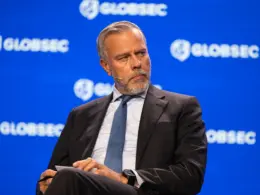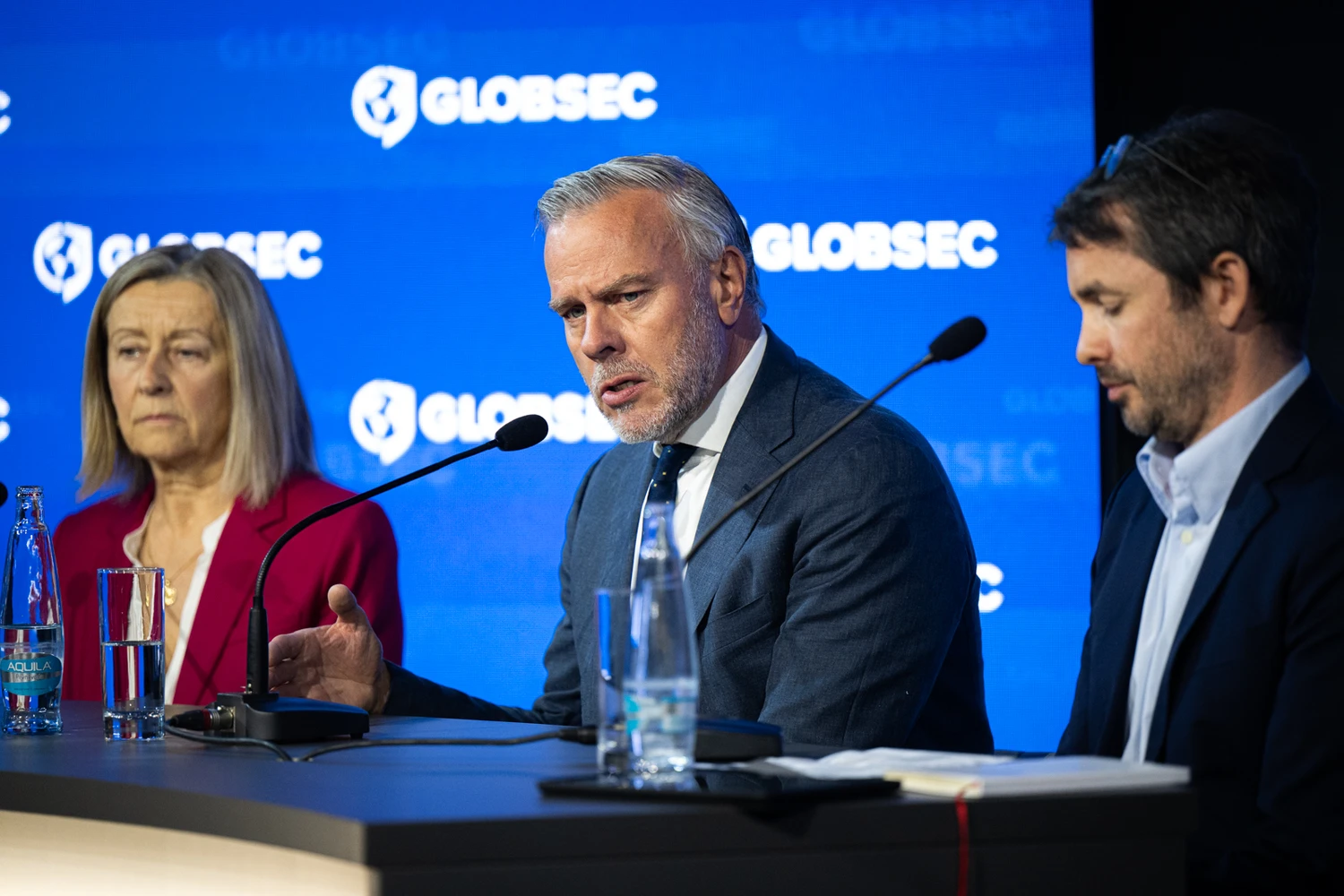
In autumn 2022, the Kremlin telephoned Paris, London, and Washington warning of nuclear weapons use, as roughly 20,000 Russian troops faced capture on the west bank of the Dnipro. The US response, according to Admiral Rob Bauer, who chaired NATO's Military Committee from 2021 to 2025, was that any nuclear strike would be met with the conventional destruction of Russian forces in Ukraine.
Russia did not use a nuclear weapon.
"So I think in that sense we were not hijacked by the Russians," Bauer told Euromaidan Press at the GLOBSEC 2026 forum in Prague.
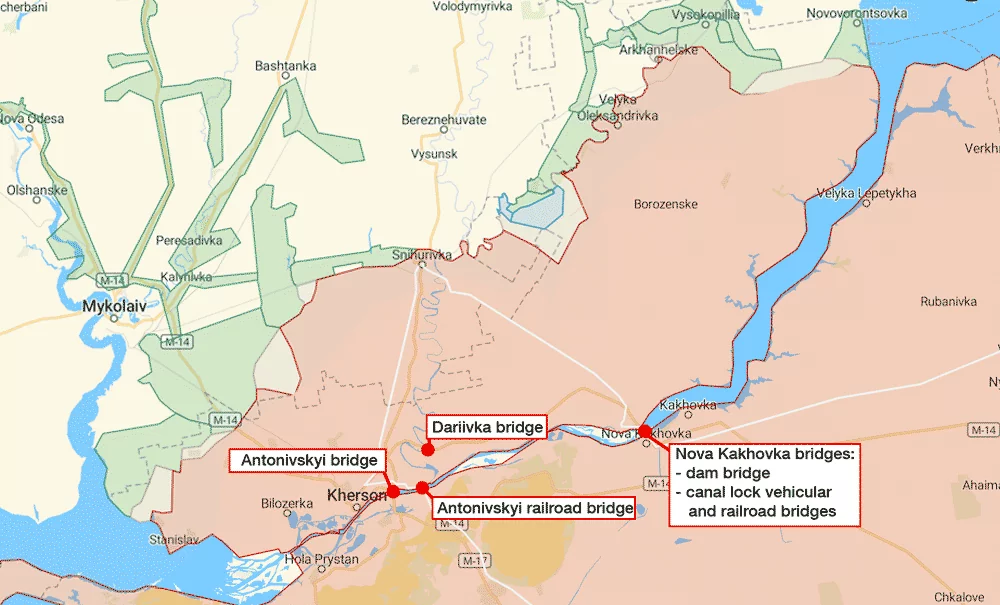
The Kremlin's threats arrived, in Bauer's account, on September 2022 as roughly 20,000 troops sat trapped on the west bank of the Dnipro, the Antonivskyi Bridge knocked out by HIMARS strikes.
"The Russians started to make phone calls to Paris, London, and Washington about the use of nuclear weapons," Bauer said. "Nobody knows exactly what the reply was from the capitals, but in the end they didn't use it. I heard at some point that the response was that if the Russians would have done that, they would have been taken out conventionally by the Americans."
The message, as Bauer described it: "Don't even try to do this. Keep this a conventional fight, which is bad enough, but don't go into the nuclear territory because you will be punished—that you will be very, very sorry that you ever started thinking about this."
The contradiction surfaced sharply in Bauer's interview.
Pressed on whether Russia holds an effective veto over the Alliance, Bauer rejected the framing: "No, no, no. That's not the right formulation. They don't have a veto over an Alliance, because if it comes to a fight between the Russians and the Alliance, they don't have a veto. We'll fight them."
Pressed further on whether Russia nevertheless holds a veto over Ukraine's admission, Bauer called that "another discussion"—and conceded a deeper point. The West, he said, had practiced "self-restraint" in Ukraine, by blocking deliveries of the weapons Ukraine most needed while it had the upper hand in the counteroffensive against Russia—tanks, HIMARS, F-16s, ATACMs, missiles.

"If we had done something else in 2022 with regard to the weapons that we gave, you might have won," Bauer said.
His account of the US response is secondhand. He heard the framing from those with direct knowledge; he was not in the room.
The broad outlines of what occurred have been previously reported. CNN's Jim Sciutto revealed in his 2024 book The Return of Great Powers that the Biden administration was rigorously preparing for a possible Russian tactical nuclear strike during the Kherson collapse, with officials concerned that Putin would view the loss of his trapped forces as a direct threat to the Russian state.
Academic analysis has identified what one Kissinger Center paper called "the shift in strategy to a conventional response" as the policy innovation that managed nuclear risk in autumn 2022.
What Bauer adds is specificity and rank: a senior NATO officer, on the record, by name, describing what the message conveyed and how Russia behaved when it landed.
Bauer also reaffirmed the position he articulated in November 2022—that nuclear deterrence is what kept NATO out of Ukraine. "I still stand by what I said," he told Euromaidan Press. "I think if the Russians were not a nuclear-capable armed force, we would have gone in pretty quickly as the Alliance."
Russia's nuclear weapons, by his own description, are what kept NATO from acting. The same weapons that, when Russia threatened to use them, drew the conventional-destruction warning Bauer described.
Asked whether the 2022 episode had been codified into NATO doctrine for handling nuclear-armed rogue powers, Bauer said he had not seen it happen during his tenure, and doesn't know if it developed.
The full interview with Admiral Bauer, including his admission that NATO never developed a strategy for Ukraine to win, was published by Euromaidan Press on 6 June 2026.
This material was produced as part of a project by the Institute of Mass Information with the support of the Ministry of Foreign Affairs of the Netherlands. The content of this publication does not reflect the official position of the IMI or the Kingdom of the Netherlands.

“It was never formulated as Ukraine winning”—NATO’s ex-military chief on the missing strategy
Read Also
-
“We are staying”: EU embassies remain in Kyiv after Russia warns diplomats to leave or risk their lives
-
“Mr Putin, put an end to this senseless war”: Merz in Kyiv, with €1 billion in military aid
-
Russia’s drones keep targeting the bridges Kyiv can’t easily replace—now the Northern crossing is cratered