Russian forces are deliberately burning crops across the Ukrainian-controlled Beryslav district of Kherson Oblast as harvest season begins, farmers warned, while steppe villages on the Russian-occupied left bank of the Dnipro have lost gas supply and are running nearly without electricity—with large fires spreading through surrounding fields and forests, accounts published on 2 July.
Together, the two accounts describe Russia stripping Kherson Oblast of its agricultural season from both sides of the front line: by fire from the air on Ukrainian-held land, and by infrastructure collapse in the territory it occupies.
Russian strikes target Beryslav farms at harvest
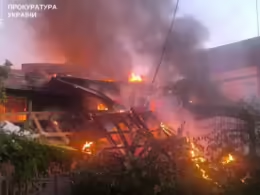
Farmers in the Beryslav district are sounding the alarm over what they describe as deliberate Russian targeting of standing crops. Sunflowers, rapeseed, barley, and wheat are burning across multiple communities. Rapeseed fields in the Mylivska hromada caught fire following Russian strikes; in the same area, farmer Ihor Yosypenko reported that his neighbor's sunflower field burned to ash before it had properly sprouted, and that his own barley was destroyed in the same fields days later.
"Farmers are working practically on the front line—under drones, artillery, and the constant threat of new strikes," Yosypenko wrote.
The strikes are destroying more than crops. Combines and tractors are being wrecked, farm workers wounded, and fires are increasingly spreading from fields into villages and burning residential buildings.
One comment left under Yosypenko's post put the human cost plainly: "As a farmer, I know: together with these fields, not just harvests and money burn—months of backbreaking labor burn, hopes burn, and a part of yourself."
Left-bank villages: no gas, almost no power, fires in the steppe
Across the river, in the Russian-occupied steppe areas of Kherson Oblast, Serhii Danylov, deputy director of the Center for Middle East Studies, reported that villages have lost gas supply entirely and receive almost no electricity.
"No electricity, and what little comes through isn't even enough to keep refrigerators running. No gas, so people cook on improvised stoves and hearths. No firewood, so they burn whatever they can—essentially all their waste," Danylov wrote. Large-scale fires are burning across the surrounding steppe and forests.
Bread deliveries to these villages are rare; residents try to source it in Skadovsk by sending orders through people who can make the trip. One thread of contact with Ukraine persists: intermittent mobile connectivity allows residents to watch Ukrainian television and stay aware of events beyond the occupation.
The conditions extend a pattern of left-bank collapse EP has documented since spring. In May, the town of Oleshky—also on the occupied left bank—had no power, heat, gas, or water, with residents foraging in abandoned homes and burning shelled trees for firewood. The steppe villages Danylov describes lie further from the front but in no better condition.