

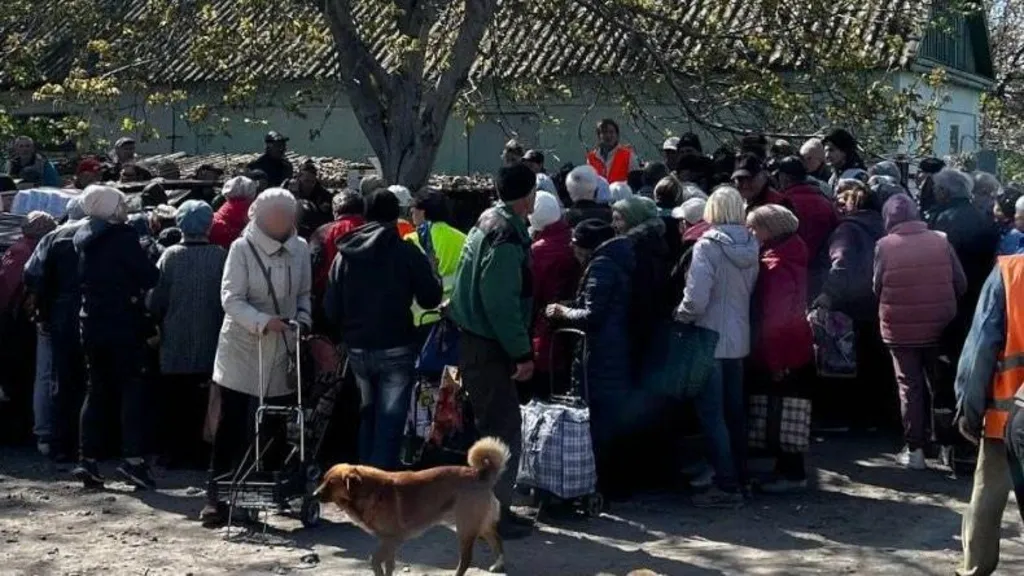
Ukraine's Ministry of Foreign Affairs on 6 May appealed to the United Nations and the International Committee of the Red Cross over what it called a "severe humanitarian crisis" in Russian-occupied parts of Kherson region.
About 2,000 civilians remain in occupied Oleshky on the eastern bank of the Dnipro, cut off from food and medicine for months as mined roads, FPV drones, and the wreckage of the Kakhovka dam choke off every exit, BBC Verify reported on 6 May, citing residents, satellite imagery, and Ukrainian officials.
What is happening in Oleshky is what Western politicians describe in the abstract when they talk about freezing the lines or giving Russia something to end the war. It is occupation playing out at full duration, three kilometers from a Ukrainian-held river bank: a city of 24,000 before the invasion reduced to a starving remnant, a hospital that treats only Russian wounded, and bodies that lie uncollected in the streets because no one can reach them.
A "road of death" and a river they cannot cross

The numbers Kyiv just made official are stark. The population of the affected settlements—Oleshky, Hola Prystan, Stara Zburivka, and Nova Zburivka—has collapsed from about 40,000 before the full-scale invasion to roughly 6,000 today, the MFA said. In Oleshky alone, 24,000 has fallen to 2,000. About 200 children are among those urgently needing aid. Ukrainian authorities have received more than 220 direct requests for evacuation. Russian forces are "artificially blocking evacuations and obstructing the delivery of essential goods, food, and medicine," the ministry's statement read. Parliament Commissioner for Human Rights Dmytro Lubinets calls it "deliberate terrorism."
The escape routes are all bad. The land routes from Oleshky to Hola Prystan are heavily mined—what residents now call "the road of death." Satellite imagery reviewed by BBC Verify shows at least eight burnt-out vehicles on a one-kilometer stretch heading southwest, plus a large scorch mark that appeared on the road in late January.
"Leaving Oleshky, everyone prayed to God that we wouldn't hit a mine," Volodymyr, a man in his 50s evacuated by ambulance, told the BBC. "The entire highway from Oleshky to Hola Prystan is littered with burnt-out cars. Some of them burned with people still inside."
The river is no better. Oleshky lies opposite Kherson—the city Ukraine recaptured in November 2022. Bridges to the north are wrecked. The Kakhovka dam, blown up by Russian forces in June 2023, drained the upstream reservoir and destroyed the wells and pump systems Oleshky residents had switched to after high-rise utilities failed. An Associated Press investigation found that Russian authorities undercounted Oleshky flood deaths by hundreds.
A burial crisis, a closed hospital, a robbed pantry
American journalist Zarina Zabrisky, who has reported on Kherson Oblast for nearly four years and recently briefed Brussels, Ukraine's Foreign Ministry, and the Ombudsman's office on conditions across the left bank, told Euromaidan Press the collapse runs deeper than residents can safely describe by phone.
Bodies of civilians and dead Russian soldiers are left in the streets and consumed by wild animals and street dogs, Zabrisky said. The hospital ran out of antibiotics and painkillers long ago. Whatever supplies still arrive are used to treat injured Russian soldiers. There is no power. No heat. No gas. No water supply. Almost no connection to the outside world. A few residents climb high-rises and occasionally pick up a Ukrainian signal.
When food does come in, Russian soldiers steal it. "I have reports, spoke to people who had their stocks taken away from them by Russians, and one guy who was trying to object was shot," Zabrisky said.
The drone safari moves to the left bank
Russia's drone war on civilians—the campaign UN investigators have classified as a crime against humanity on the right bank of the Dnipro—has crossed the river. Eyewitnesses in Stara Zburivka and Oleshky told Zabrisky that Russian operators use the territory as a training ground for new pilots, dropping inert practice rounds, walking out to retrieve them, and trying again on the same target until they get it right.
There have been killings on bread lines, she said—several incidents, she reported, in which Russian forces fired on civilians waiting for food and then blamed Ukrainian forces. Russia, she added, has tactical reasons beyond cruelty: a 2023 property law lets the state seize homes whose owners are recorded as missing or unregistered, and fear is itself a control tool.
The mine attribution is contested. Ukrainian forces have laid mines to interdict Russian resupply into Oleshky, one Ukrainian soldier told the BBC, while accusing Russia of "scattering" explosives indiscriminately. The result, on the ground, does not distinguish.
An evacuation plan that depends on Russian agreement
Lubinets has appealed to Russia and the International Committee of the Red Cross for a humanitarian corridor. Volunteers and military sources have proposed a direct river crossing—a 20- to 30-minute evacuation that several Ukrainian sources told Zabrisky is technically feasible. The Ombudsman's office is not pursuing it. The reason is simple: Russia would refuse.
The route that exists now—through occupied Crimea, Russia, and Belarus—does not work. Of 20 people who recently set out, only three reached Ukraine, Zabrisky said. Men of draft age were mobilized by Russian forces. Elderly and disabled civilians could not survive a journey of many days through checkpoints.
Russia's Embassy in London told the BBC the "humanitarian difficulties" in Oleshky are the result of "systematic strikes" by Ukrainian forces. The Russian-appointed governor of Kherson, Vladimir Saldo, did not address the humanitarian situation in his April Telegram posts.
What this looks like at the human scale
Almost everyone left in Oleshky is old, sick, or unable to move. They forage in the abandoned homes of neighbors. They burn shelled trees for firewood—at least those, Ludmilla told the BBC, are easier to break down. They trade pasta and tinned goods at high prices when volunteers manage to push a delivery through the road of death.
Hanna, another resident, recently watched a drone hover above a woman aged about 90.
"She just looked up, waved her hand as if to say: 'Come what may' and hobbled on," Hanna told the BBC.
That gesture is the war Western planners do not see when they talk about territorial concessions in the abstract. It is what occupation looks like after the food is gone, the hospital is closed, the road is mined, and the river will not open. The 90-year-old woman walking under the drone is what is being asked to endure.
Read also
-
A Russian drone knocked out an evacuation robot, so a Ukrainian commander drove into the kill zone in a pickup to save two wounded soldiers
-
Russia’s new drone outruns old Shahed by four times and tracks its target in real time. Its own heat is what lets Ukraine track it back
-
Former Polish PM accuses Ukrainian officials of letting robbers plunder massacre victims’ graves


