

On 11 March 2025, in Jeddah, the United States put a 30-day unconditional ceasefire on the table. Ukraine accepted it the same day. Russia refused.
Six weeks later, on 29 April 2025, Russia rejected Ukraine's proposal to extend Putin's 30-hour Easter pause to 30 days.
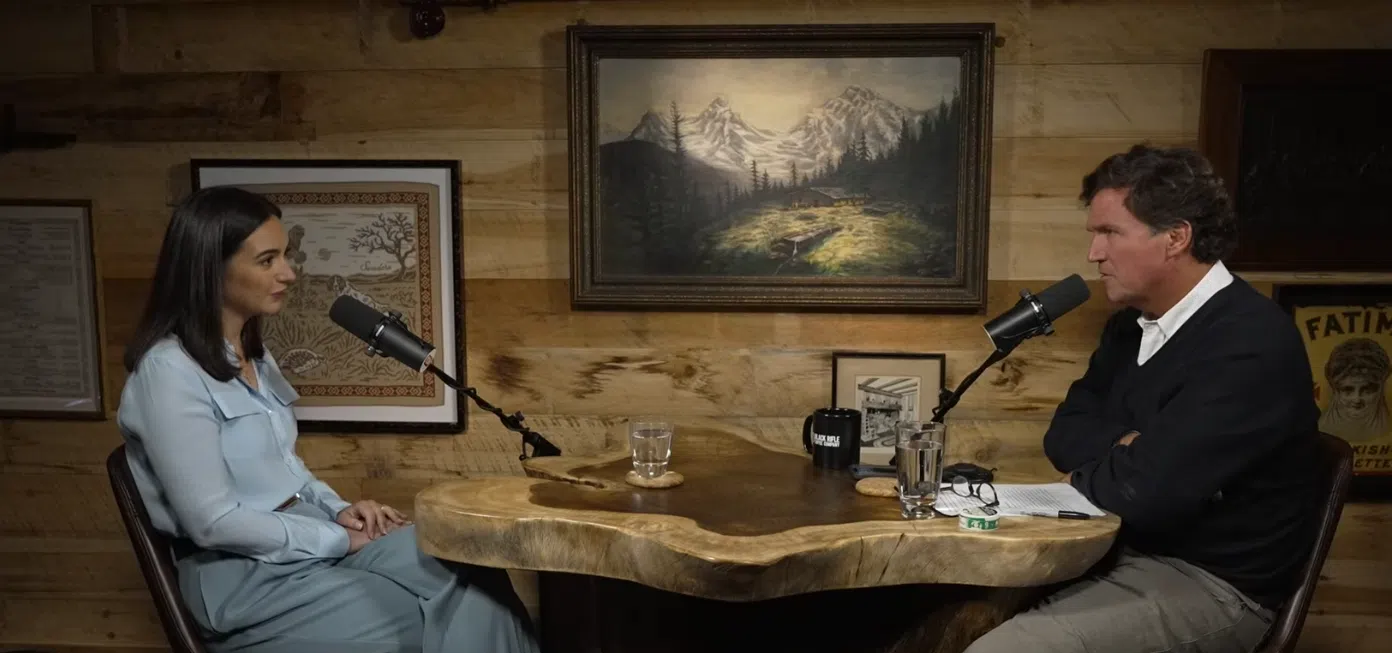
Keep that sequence in mind while watching former Ukrainian presidential press secretary Iuliia Mendel tell Tucker Carlson, in an interview released on 11 May 2026, that Volodymyr Zelenskyy is "one of the biggest obstacles towards peace today."
Mendel served as Zelenskyy's press secretary from 2019 to summer 2021, leaving eight months before Russia's full-scale invasion. Almost every claim she makes about events from 2022 onward, including Istanbul, the seven "blocked" peace attempts, current polling, and the state of the war, is hearsay from unnamed sources, using phrases to the effect of "I have a friend who…" or "I was talking to a person who…"
It is the structure of an influencer relaying unverified accounts, presented as insider testimony.
Some of what she says about her own time in the office may be accurate. What she says about Zelenskyy's temperament, the chaos inside the office, and the consolidation of power around Andrii Yermak fits what other former insiders have described. She was in those rooms.
But she left in 2021. Four of her claims about what came after are doing heavier work in conversations about US support for Ukraine: that Zelenskyy is the obstacle to peace, that Ukrainian corruption justifies cutting aid, that Ukraine has become a dictatorship, and that further resistance is futile.
Each one rests on sources she doesn't name. Each one is measurable against the actual record.
Who's blocking peace? Russia's terms remain the central obstacle
"He is one of the biggest obstacles towards peace today… Finishing the war for him is a political suicide." — Iuliia Mendel, on Zelenskyy
That motivation, she says, produced a record. By her count, Zelenskyy has personally sabotaged around seven attempts to finish this war. She does not enumerate the seven. She does not name the mediators. The framing she offers is simple: change the man, get the peace.
The documented record points the other way.
On 11 March 2025, Ukraine accepted the Jeddah ceasefire in hours. Russia did not. On 29 April 2025, when Ukraine proposed extending Putin's 30-hour Easter pause to 30 days, Russia rejected that too.
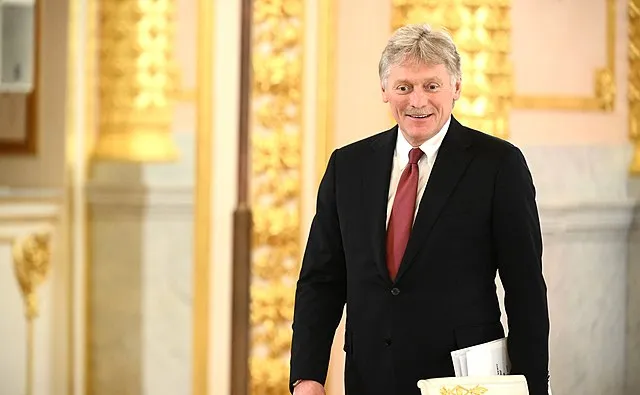
Kremlin spokesman Dmitry Peskov restated Russia's terms publicly on 13 May 2026, two days after the Mendel interview aired. Russia demands full Ukrainian withdrawal from Donetsk, Luhansk, Kherson, and Zaporizhzhia oblasts, including the substantial portions Russia does not currently control. Plus permanent renunciation of NATO membership. Plus recognition of Crimea as Russian.
No Ukrainian president constitutionally bound to defend territorial integrity could accept those terms.
Mendel frames Zelenskyy as the variable. The variable is Russia's terms—and they are terms any Ukrainian president would face.
On the 2022 Istanbul story, Mendel keeps pointing at Boris Johnson.
"They had all the agreement by positions about Donbas, about language, about many, many things. They agreed upon everything. And then Boris Johnson came." — Iuliia Mendel, on the 2022 Istanbul talks
The actual record is the Russian draft.
Welt am Sonntag and the New York Times published the leaked Russian terms in 2024. Russia's draft capped the Ukrainian peacetime army at 85,000 personnel against Ukraine's counter-position of 250,000. It limited Ukraine to 342 tanks against Ukraine's 800. It set a maximum missile range of 40 kilometres, against Ukraine's 280.
The security guarantees Mendel describes as the deal's protection for Ukraine required all guarantor states, including Russia itself, to consent before any military aid could be sent if Russia attacked again.
A force of that size, with guarantees Russia could veto, could not deter a second invasion. Minsk I and Minsk II, territorial concession plus frozen conflict, produced February 2022.
Boris Johnson didn't kill Istanbul. The Russian draft did.
Where does the money go? Ask the institutions that exposed it
"There is a scandal right now in Ukraine when the Minister of Energy was fired… He helped money launder 112 million dollars." — Iuliia Mendel
This is Mendel's headline evidence for cutting aid. A specific case. A specific minister. A specific dollar figure. A regime, she suggests, that is stealing from US taxpayers while pleading poverty.
The case is real. Her figure is high. According to Ukraine's National Anti-Corruption Bureau (NABU) and Specialized Anti-Corruption Prosecutor's Office (SAPO), the actual sum laundered is approximately $100 million.
What Mendel does not say is who found it.
NABU and SAPO launched Operation Midas publicly on 10 November 2025, after a fifteen-month investigation. The alleged ringleader is Timur Mindich, Zelenskyy's longtime business partner from Kvartal 95. Mindich fled Ukraine hours before searches.
Energy Minister German Galushchenko was dismissed on 19 November 2025 and detained on 15 February 2026 trying to leave the country.
Andrii Yermak, head of the Office of the President for years and Zelenskyy's closest political ally, resigned on 28 November 2025 after NABU searches at his home and office. On 11 May 2026, the day the Carlson interview aired, NABU and SAPO named him a suspect in a related money-laundering case. On 14 May 2026, a Kyiv court placed him under pre-trial detention.
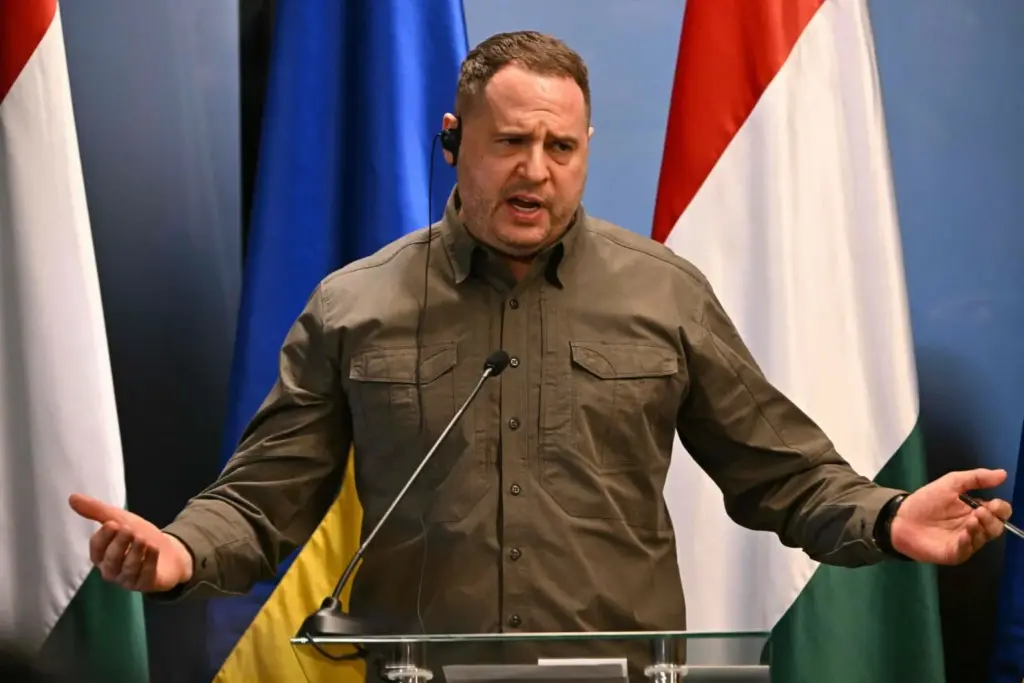
Every case Mendel cites as evidence that the regime is captured is a case that Ukrainian institutions found, named, and prosecuted.
A Ukraine being investigated by its own institutions is a Ukraine worth keeping in the fight.
Is this a dictatorship? Wartime measures and authoritarian capture aren't the same
Trending Now
"He is a dictator… The borders are closed now for four years, it's illegal." — Iuliia Mendel
Two claims, packaged together. Zelenskyy is a dictator. The closed borders are the legal proof. The conclusion she invites: not a democracy worth defending.
Both claims fall apart on inspection. Border closures for military-age men and postponed elections during wartime are constitutional measures, applied across democracies under attack. The United Kingdom postponed elections during World War II. The United States suspended habeas corpus during the Civil War. These are actions of states under attack, not of dictators.
The harder test is structural.
If Zelenskyy were a dictator, his closest political ally would not be in pre-trial detention this week. Andrii Yermak is. The case was made by Ukrainian anti-corruption institutions. The order was signed by a Ukrainian court. The president did not stop it.
That is not how dictatorships handle their inner circle.
A brief comparison clarifies what the alternative looks like. Alexei Navalny died in Russian custody in February 2024. Memorial-counted Russian political prisoners number approximately 800. Independent Russian media operate from exile. The system Mendel implies Ukraine is becoming is the system Russia already is.
A country whose anti-corruption institutions are arresting the president's closest ally during wartime is a country worth defending.
Is the war futile? Ukrainians want peace, but not on Russia's terms
"Where does he come from with these numbers? There are no such numbers." — Iuliia Mendel, on Zelenskyy's polling claims
Mendel goes beyond disputing Zelenskyy's specific figure that 90% of Ukrainians would not forgive him for ceding Donbas. She dismisses the field of Ukrainian wartime polling itself.
Ukrainian wartime polling on territorial concessions is published regularly by the Kyiv International Institute of Sociology (KIIS), the Razumkov Centre, and Rating Group. Each uses documented methodology. KIIS has asked the same baseline question since May 2022.
In its September–October 2025 survey, 54% of Ukrainians said the country should not give up any territory, even if the war continues longer. 71% opposed handing over Ukrainian-controlled territory to Russia.
A follow-up KIIS survey in late December 2025 asked specifically about Russia's plan—Ukrainian withdrawal from Donbas plus limits on its military. 74% called it categorically unacceptable.

Wartime polling has real limitations. Self-censorship under occupation, sampling difficulties with displaced populations, and the gap between stated preference and behavior under duress are all documented. War fatigue is real, too. Gallup found the share of Ukrainians who say Ukraine should fight until it wins has fallen from 73% in 2022 to 24% in 2025.
But "wanting peace" and "willing to accept Russia's terms" are different questions. Ukrainians have answered the second one consistently.
The "no such numbers" framing relies on the audience not running the check.
The visible alternative is Russian occupation. Russian authorities have deported an estimated 19,500 Ukrainian children. Russian aircraft bombed the Mariupol drama theatre while the word CHILDREN stood outside in giant letters. In Bucha, Russian troops left bodies in the streets.
That is what surrender looks like. Ukrainians have seen it, and they are answering accordingly.
Mendel's final appeal goes to Putin
In Russian, at the end of the interview, Mendel addresses Vladimir Putin directly. The transcript is worth reading carefully.
She tells the president of the country invading hers: "I am not a representative of NATO. I'm not a representative of the West. I don't work for Zelenskyy, I'm not your political opponent. I'm not a threat to you at all."
She describes what his army is doing in her home region of Kherson: a nurse who bled to death on the side of the road, hit by a Russian drone while walking home from work. Another nurse was killed while coming home from her grandson's birthday party. Old people are being evacuated, falling in the snow, in blood. The drones, she notes, post their own videos.
"One decree of yours, one decree of yours can stop this." — Iuliia Mendel to Vladimir Putin
Putin is recast as the man who can stop it. Thus, his crucial role in starting the war falls into the background, and the solution is centered on the perpetrator.
It is the only direct personal moral appeal in the interview's 96 minutes. It is delivered in Russian, which most of Carlson's audience cannot follow. And it is asked of the one person who, by Mendel's own account, is hunting old people with drones.
Russia agreed to 26 ceasefires with Ukraine between 2014 and 2020, while violating each of them. Russia's pattern can be characterized as ceasefare—pretending to sue for peace while continuing to wage war.
That is the interview's real argument: viewers come to see Kyiv and the West as obstacles to peace. In the meantime, Moscow, its aggression, and its demands recede from view.
This material was produced as part of a project by the Institute of Mass Information with the support of the Ministry of Foreign Affairs of the Netherlands. The content of this publication does not reflect the official position of the IMI or the Kingdom of the Netherlands.


