

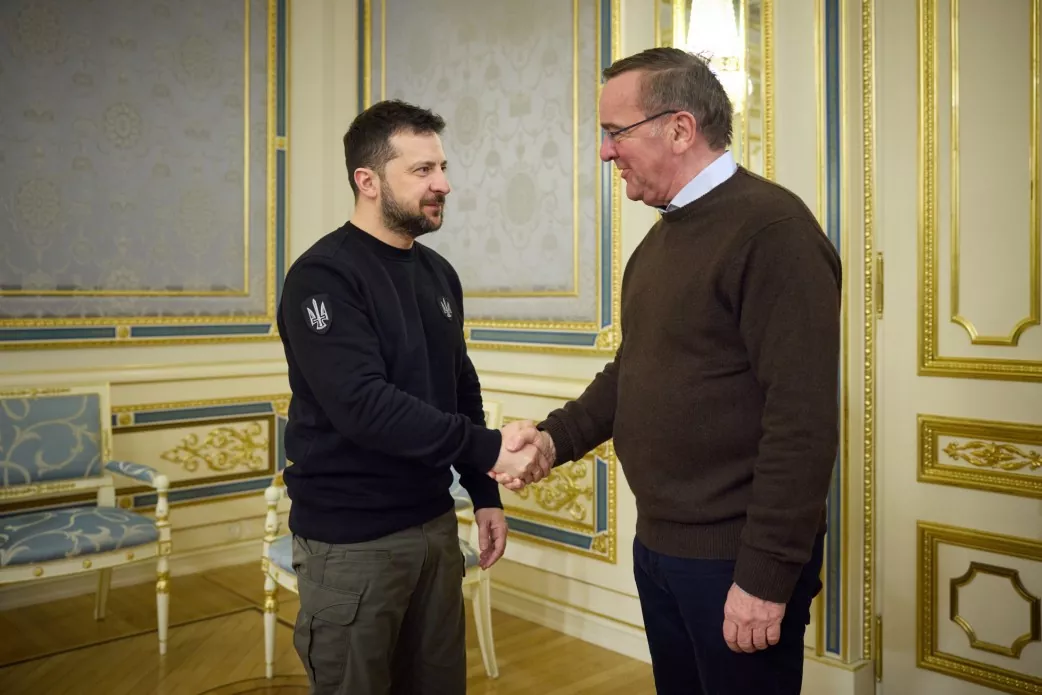
German Defense Minister Boris Pistorius arrived in Kyiv by train on Monday morning, 11 May. The unannounced visit focuses on joint weapons production with Ukraine. His trip was kept secret for security reasons.
Pistorius told dpa that Ukraine and Germany are strategic defense partners, producing an increasing number of joint projects.
The priority is co-developing advanced unmanned systems with deep-strike capabilities, particularly drones capable of striking Russian targets far behind the front. Berlin is also weighing whether to join Brave1, Ukraine's defense-innovation cluster.
Germany's army chief, Christian Freuding, has publicly acknowledged "significant gaps" in air defense, artillery, counter-drone systems, and electromagnetic warfare.
"Germany and Ukraine are strategic partners who both benefit from cooperation… The emphasis is on the joint development of state-of-the-art unmanned systems at all distances, especially in the deep strike zone." — Boris Pistorius, speaking to dpa on 11 May 2026
Germany's yawning capability gap
Berlin is racing to rearm after three decades of reaping the post-Cold War peace dividend and choosing butter over guns.
Germany's Defense spending will reach roughly €108 billion in 2026. Annual budgets are projected to climb to €152 billion by 2029. Pistorius has set that year as the Bundeswehr's deadline for facing a possible Russian assault.
Long-range strike is Berlin's biggest hole. European NATO members have not produced long-range missiles in decades. A six-nation joint project called ELSA aims to fix this. It involves Germany, France, the UK, Italy, Poland, and Sweden—but most systems will not arrive until the 2030s.
Pistorius also flew to Washington on Sunday to revive Germany's stalled bid for 400 US Tomahawk cruise missiles.
The two destinations capture Berlin's hedge: European strategic autonomy on one track, American hardware on the other.
Europe lines up for Ukrainian know-how
Pistorius's visit fits a pattern, not an exception. In February, the minister and President Volodymyr Zelenskyy launched the first joint Ukrainian-German drone production line on German soil. In March, Berlin financed 15,000 Ukrainian STRILA interceptor drones built to hunt Shaheds.
Last September, Germany committed €300 million to Ukraine's "deep strike" drone program. It marked a real shift. Berlin had previously donated from Bundeswehr stockpiles—now it invests directly in Ukrainian engineering.
Rheinmetall operates a joint armor production with Ukroboronprom in Ukraine. The German firm Quantum-Systems runs a drone factory there. The UK and Germany are jointly developing a 2,000-km "deep precision strike" weapon. Each agreement runs in the same direction—European money meeting Ukrainian engineering, refined under fire.
A French Institute of International Relations analysis in November concluded European defense can match Russia by 2030. The qualifier was clear: only if Ukraine holds the line long enough for Europe to catch up.
Read also
-
Black Sea grain war escalates: Ukraine knocked out most of Russia’s grain exports, and Russia is now sinking ships off Romania and Bulgaria
-
Ukraine’s military now orders supplies based on real front-line data, not guesswork, lawmaker says. Shift comes under new commander-in-chief
-
Posting strike videos online may help Russia tune its drones’ optical targeting. Moscow now pays people to film hits, Ukrainian adviser warns
This material was produced as part of a project by the Institute of Mass Information with the support of the Ministry of Foreign Affairs of the Netherlands. The content of this publication does not reflect the official position of the IMI or the Kingdom of the Netherlands.


