

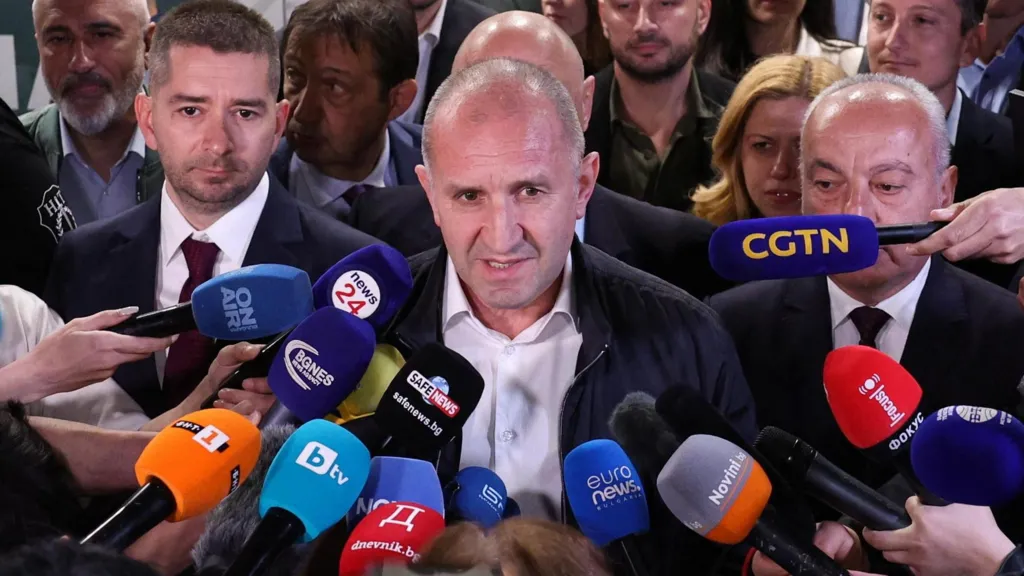
The Bulgarian parliament on 8 May approved the structure and lineup of a new cabinet headed by Rumen Radev, the former president known for pro-Russian statements, Nova.bg reports.
A total of 124 lawmakers — all from Progressive Bulgaria — backed Radev's candidacy and the proposed structure of the Council of Ministers. Seventy voted against, and 36 abstained. The newly elected prime minister, deputy prime ministers, and ministers were sworn in inside the parliament chamber shortly after the vote.
The candidacy was presented by the head of the Progressive Bulgaria parliamentary faction, Petar Vitanov, who delivered an emotional speech arguing that Radev's appointment marks the return of "normality in Bulgarian politics," together with the values of valor, honor, trust, and solidarity.
Velislava Petrova-Chamova was confirmed as foreign minister in the new cabinet, while Dimitar Stoyanov takes over the defense portfolio.
Presidential elections
This was Bulgaria's eighth parliamentary election in five years and the latest snap poll in a prolonged political crisis that has produced a series of short-lived governments. The vote followed mass protests in December 2025 — described by the BBC as the largest demonstrations in a decade — directed against corruption, demanding the restoration of the rule of law, and rejecting a draft budget that envisaged tax increases. The protests brought down the GERB government of Rosen Zhelyazkov.
Radev, 62, a former MiG-29 pilot and commander-in-chief of the Bulgarian Air Force, served as president from 2017 until January 2026, when he resigned to lead the new left-leaning grouping Progressive Bulgaria. The BBC has described him as "a pragmatic, somewhat pro-Russian leader, who has criticised EU sanctions, and called for constructive dialogue with the Kremlin."
Since 2022, Radev has repeatedly opposed the sale of Bulgaria's Soviet-era weapons stockpiles to Ukraine, arguing that such transfers prolong a war Ukraine cannot win. In the summer of 2023, he said Ukraine was insisting on continuing the war while "the bills for it are being paid by all of Europe," and later described a Ukrainian victory over Russia as impossible.
Trending Now
After casting his ballot in Sofia on 19 April, Radev called for "a democratic, modern, European Bulgaria" and said he hoped for "practical relations with Russia, based on mutual respect and equal treatment." In his victory speech, as reported by The Guardian, he said Progressive Bulgaria had achieved "an indisputable victory — a victory of hope over distrust, a victory of freedom over fear," adding that "Europe has become a victim of its own ambitions to be a moral leader in the world with new rules."
Radev's victory came one week after Hungary's 12 April election ended the 16-year rule of another EU opponent of Ukraine, Viktor Orbán. In early April, Politico reported that Bulgaria had asked the European Union for help countering Russian interference ahead of the vote.
Bulgaria has been an important supplier of ammunition and explosives to Ukraine via third countries, particularly neighboring Romania. In October 2025, Germany's Rheinmetall announced a €1 billion joint venture with the VMZ plant in Sopot to produce up to 100,000 155mm artillery shells a year, with a separate gunpowder plant also planned at the site; Rheinmetall holds a 51% stake. Radev took credit for inviting Rheinmetall CEO Armin Papperger to Bulgaria in March 2025. On a visit to the company's headquarters in Unterlüss in August 2025, he said: "Bulgaria is becoming part of the European defence ecosystem."
Read also
-
“A warning to companies that remain”: Russia takes control of Nestlé and Auchan’s assets – companies that stayed in Russia following the full-scale invasion of Ukraine
-
“I can travel back to Finland and be safe. That is a luxury”: Sanna Marin on the Russian strike that stopped her train from Kyiv
-
Ukraine put its own peace proposals on the table as two US envoys reached Kyiv for the first time


