

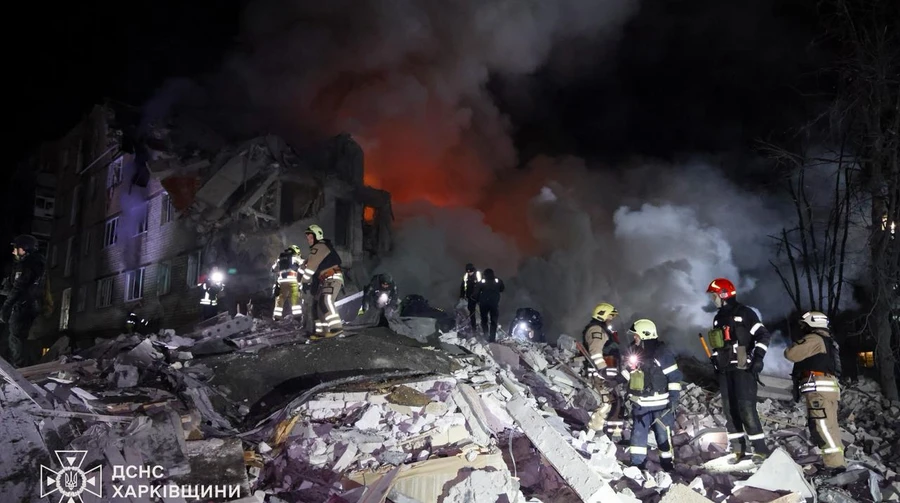
A ballistic missile strike on a residential building in Kharkiv's Kyivskyi district in the early hours of 7 March killed seven people, including a 13-year-old girl and a boy, and wounded at least ten others, according to Kharkiv Mayor Ihor Terekhov and regional administration head Oleh Syniehubov.
The first explosions were recorded at approximately 01:35. Terekhov confirmed a direct hit on the building shortly after: "Confirmed direct ballistic strike on a multi-story building in the Kyivskyi district. Significant destruction, fire, people may be trapped under the rubble."
Rescue operations unfolded over several hours. By 3 am, Syniehubov reported ten injured, including boys aged 11 and 6, and a 17-year-old girl. The strike destroyed the entrance section of one five-story building and damaged two floors of an adjacent structure, with rescuers warning that up to ten people — including a child — could be buried under the debris.
Bodies were recovered through the morning. By 07:50, eight bodies had been recovered as firefighters worked to contain a blaze covering 300 square meters. After 8 am, the regional administration announced two additional fatalities — the girl, 13, and a boy — bringing the confirmed death toll to seven.
The Kharkiv attack was part of a broader overnight assault across Ukraine. President Volodymyr Zelenskyy said Russia targeted energy infrastructure in Kyiv, Khmelnytskyi, and Chernivtsi oblasts, and railways in Zhytomyr oblast, with additional damage recorded in Dnipropetrovsk, Zaporizhzhia, Vinnytsia, Odesa, Poltava, Sumy, and Cherkasy oblasts.
In Kyiv, the strike on a critical infrastructure facility left nearly 2,700 buildings without heat, according to Mayor Vitali Klitschko. Of those, 1,905 were in the Pechersk, Dnipro, Holosiivskyi, and Solomianka districts. The remainder — buildings in Darnytsia and Dnipro districts — could not be reconnected because of critical damage to the Darnytska thermal power plant.
In Odesa oblast, a Russian strike on port infrastructure ignited a fire in vegetable oil storage tanks and damaged a grain warehouse, Vice Prime Minister for Reconstruction Oleksiy Kuleba said. "No casualties. Rescuers are eliminating the consequences," he said. A second port facility also sustained infrastructure damage.
Ukraine's Air Force recorded 509 aerial attack vehicles launched overnight. Of those, 472 were reported shot down or suppressed. Russia's strike package included 2 Zircon hypersonic missiles (none intercepted), 13 Iskander-M/S-400 ballistic missiles (8 intercepted), 14 Kalibr cruise missiles (11 intercepted), and 480 drones (453 intercepted). Nine missiles and 26 strike drones hit 22 locations; drone debris fell on five additional sites. The primary targets were Kyiv, Kharkiv, Zhytomyr, Khmelnytskyi, and Chernivtsi oblasts.
Zelenskyy called for continued international support in response to the strikes, saying Russia "has not abandoned attempts to destroy Ukraine's residential and critical infrastructure." He specifically referenced the PURL program and urged active engagement with the EU "to guarantee more protection for our people."
With 509 aerial attack vehicles recorded, the March 7 assault was the largest during the last weeks, surpassing the 2-3 February barrage in which Russia launched 450 drones and 71 missiles — its biggest aerial assault of the year at that point. That February attack had already left more than 1,170 high-rise buildings in Kyiv without heating and damaged a Kharkiv power plant.
The strike compounds an energy crisis that has made rolling blackouts a fixture of daily life across Ukraine since autumn 2025. Since early 2026, the situation has deteriorated further, with entire communities left without electricity for up to 14–16 hours a day, along with water supply, heating, and communications


