Dmitry Tymchuk’s Military Blog: Summary – September 16, 2014

Dmitry Tymchuk’s Military Blog: Summary – September 16, 2014

Brothers and sisters!

Here’s the Summary for September 16, 2014 (for previous summary, please see Summary for September 15, 2014).

The bad news:

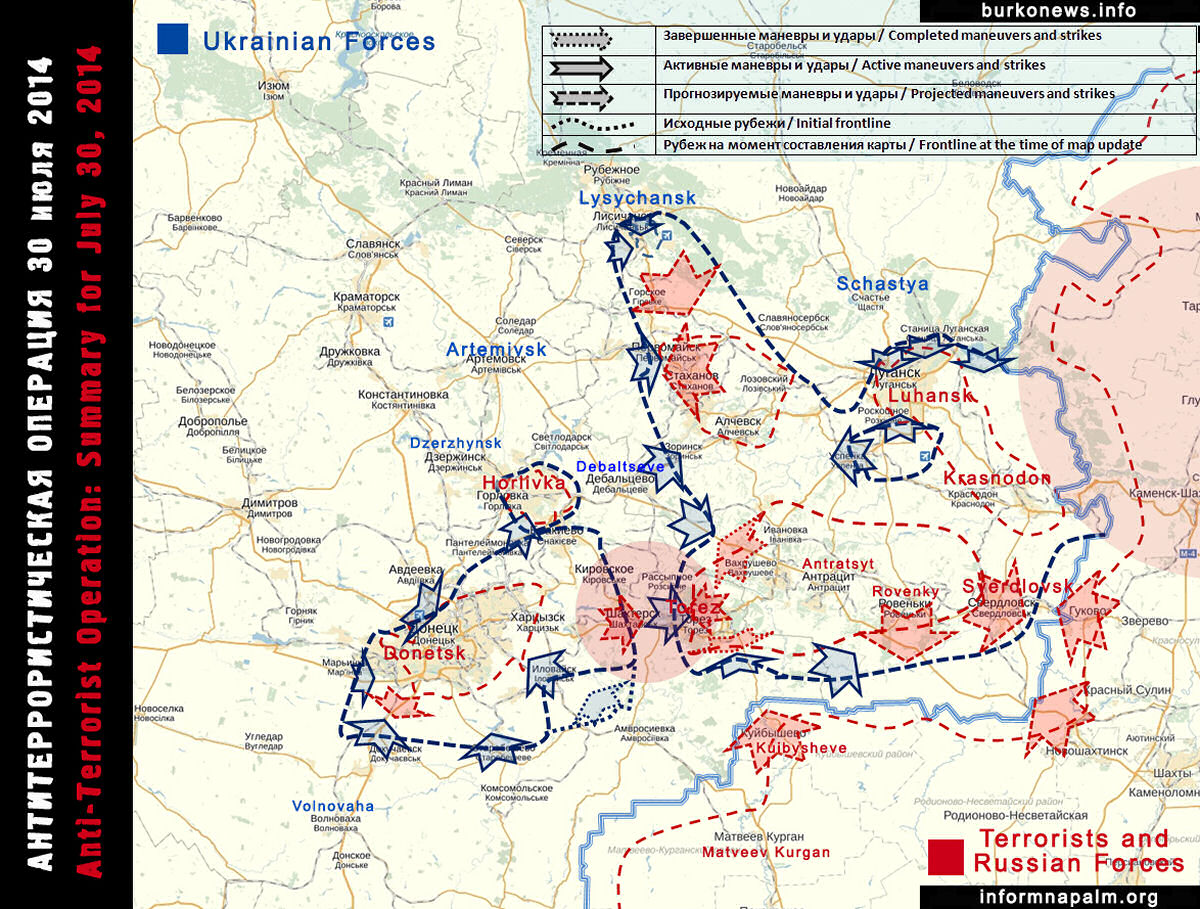
1. The DNR and LNR [Donetsk and Luhansk People's Republics] terrorist organizations announced the creation of the ‘united armed forces of novorossiya’ with a single ‘commander-in-chief.’

Of course, they can create even intergalactic forces of space marines, as the name ‘united armed forces’ definitely sounds too luxurious for this gathering of drug addicts and criminals. This is not the point. The point is that Russian soldiers in Donbas have obviously grown weary of ending up under the mortar fire of drunken mercenaries and dying from ‘friendly fire,’ therefore they have been pressuring their ‘associates’ through Moscow for quite a long time, so that the latter create single bodies of government over their gangs. The last straw was the mercenaries’ recent artillery attack on the Russian DRG [sabotage-intelligence group] near Debaltseve.

The creation of a single command for insurgents solves the issue of some sort of cooperation among the Russian-terrorist army. For us it is very bad, as in this case the effectiveness of the enemy is greatly increased.

True, it’s definitely uncertain whether the Donbas big daddies and the small criminal krill will accept the rules of the game in action, not words. Everyone there fancies themselves a prince and Clausewitz (if they are familiar with this character, which is doubtful in general).

2. Despite the agreements Russia signed with the EU and Ukraine on September 12, Russia intends to impose customs taxes on Ukrainian goods.

The Russian Ministry for Economic Development claimed the Russian government was to approve the order regarding customs taxes for Ukraine, and only then postpone its application, should Kyiv and Brussels keep their promise to defer the implementation of the free-trade zone section of the Association Agreement.

Well then, yet one more reason to become more convinced that we should make every possible effort for Russia, in terms of economic cooperation, to end up further away from us than Zimbabwe. Export and import dependence on Moscow can only be acceptable in terms of bulk-buying balalaikas and matryoshkas. Everything else is a crime against Ukraine’s economic security.

The good news:

1. The Verkhovna Rada voted for the resonant bills on the special status of some areas of Luhansk and Donetsk oblasts [regions] and for amnesty to the insurgents.

Local elections in the currently occupied districts are to be held on December 7, 2014, a special procedure for local self-government is introduced herein for three years, guarantees are given for the free usage of Russian and other languages, the state will finance the support of the socioeconomical development of these districts. People’s militia units will be set up here, by decision of local councils. The amnesty law prescribes exemption from liability to ‘members of armed formations’ and those who opposed the antiterrorist operation.

On one hand, these laws strongly smack of just handing over Donbas. On the other hand, it is an absolutely necessary step. It’s worth looking truth in the eye: we could have finished what we started and crushed the mercenaries into fine powder (which was where everything was headed), had Putin not sent hordes of his regular troops to Donbas. Ukraine turned out to be incapable of resisting this infestation. Of course, we can carry out general mobilization, put hundreds of thousands of our citizens at gunpoint, and flood Donbas with blood – but this is hardly the best option.

Personally, I thought and still think that the Donbas problem cannot be solved by peaceful means (theoretically, we can give Donbas ‘freedom,’ and then gradually and quietly tighten the bolts, but Russia will definitely not allow for this to happen). We need a different army for victory, which we have yet to create, but the good strong foundation of which has been laid during the current military action. Which is why the special status law is an ellipsis, but not the point (although, there are many questions in this regard – for example, about the financing of these territories). The most important thing is not to forget about this topic, citing economic hardship and other circumstances.

What is no less important is whether Kyiv’s gift will satisfy Moscow and the militants. This is another question…

In any case, while there are debates going on, it is necessary to swiftly create a fortified line of defense along the border of the occupied territories. It will not hurt in any case.

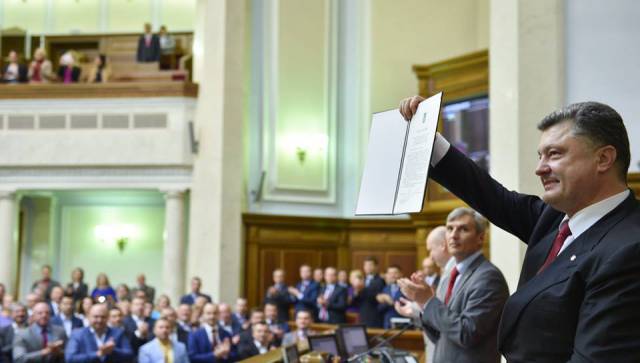
2. The Verkhovna Rada [Ukrainian Parliament] and the EU Parliament simultaneously ratified the Ukraine-EU Association Agreement.

Despite all the reservations – it is a strategic victory for Ukraine. This is where Maidan began. For us, the path towards this agreement became not only the fight between ‘good versus evil’ within Ukraine – the forces of light against Yanukovych’s dictatorship, but also with an external aggressor. None of the countries of the EU and their partners have given so much effort (and the lives of the best of their sons) for their choice and for a place within the European family.

But, we all understand perfectly well that the Agreement – is still far from [the membership of] Ukraine in Europe. The revolution within our minds is far from over. Separate thanks go to Putin – with his aggression he pushed many of our compatriots towards the EU much more powerfully than all the talk of democracy and European values put together.

read more

Dmitry Tymchuk, Head of the Center for Military and Political Research, Coordinator of the Information Resistance group
Translated and edited by Voices of Ukraine

To suggest a correction or clarification, write to us here

You can also highlight the text and press Ctrl + Enter

Please leave your suggestions or corrections here


    Leave a Reply
    Euromaidan Press

    We are an independent media outlet that relies solely on advertising revenue to sustain itself. We do not endorse or promote any products or services for financial gain. Therefore, we kindly ask for your support by disabling your ad blocker. Your assistance helps us continue providing quality content. Thank you!

    Related Posts

    February 11: The Russian proposal at the Summit in Minsk is unacceptable – president of Ukraine Poroshenko

    U.S., UK, Canada, Ireland, Australia, New Zealand, South Africa

    February 11 – The Russian proposal at the Summit in Minsk is unacceptable – president of Ukraine Poroshenko. Russia deliberately disrupts agreements.

    February 11 – 19 Ukrainian military were killed and 78 wounded as a result of shelling near the burial mound "Hostra Mogyla" close to Debaltseve and at other locations within ATO area, – informed the spokesman for the General Staff of the Armed Forces of Ukraine Vladyslav Seleznyov at a briefing on Wednesday morning.

    February 11 – In Donbas pro-Russian militants shelled the positions of Ukrainian troops 27 times on the night of February 11th. Most of the attacks occurred in the direction of Luhansk. 87 pro-Russian militants and 42 units of military equipment were destroyed in the last 24 hours (including 12 tanks, 14 multiple rocket launchers and 16 armored vehicles).

    February 11 – In Donetsk 6 people were killed and 8 wounded as a result of shelling at the bus station and entrance office of "Donetsk Metallurgical Plant".

    February 11 – President of Ukraine Petro Poroshenko spoke about a successful military operation at Debaltseve foothold: "Several successful operations were conducted yesterday at Debaltseve foothold. They allowed us to gain control over two municipalities and the contact line", – said Poroshenko.

    February 11 – "People's Republic of Luhansk" and "People's Republic of Donetsk" demand that Ukraine stops the ATO and are requesting autonomy and new elections, – as stated in a protocol draft handed over on Tuesday night by the leaders of the terrorists to the contact group in Minsk.

    February 11 – Russian Federal TV Station "Channel 5" has broadcast a story describing how quickly and easily Russian troops can enter European capitals and threatened the West with missile attacks. Show's authors vaguely disguised this information as campaign to hold "Victory Day parades" in the EU member-states capitals.

    February 11 – Russia implemented a direct military intervention during the battle at the city of Debaltseve, – stated Lieutenant General Ben Hodges, Commander of Allied Land Command (NATO).

    February 11 – Russian Foreign Ministry believes that border control issues should be should negotiated upon with the militants, which, in its turn, doesn't provide a solution to the problem, – stated Russia's Foreign Minister Sergei Lavrov.

    February 11 – Government is ready to establish martial law, should there be esalation of the situation in the east. This was stated by President Petro Poroshenko during a government meeting. Poroshenko emphasized that it is precisely "from the results of the summit that it will depend if we will be successful in stopping the aggressor by diplomatic means, or if we will switch into a very different course." I and the government, and Parliament are ready to make a decision to impose martial law in the entire territory of Ukraine," he noted.

    "In no way will I delay this decision, if the the irresponsible acts of the aggressor bring about a serious continued escalation of the conflict," he emphasized. "I am convinced that our country can protect itself and that every person will do whatever posssible in order to demonstrate that victory will be ours. However, I stress, that I am a president of peace, and thatn through army means, the situation in Donbas should not be decided," he added.

    Ukraine cannot be a buffer state

    Photo report from eastern Ukraine

    Help Ukraine seize this chance

    Economist Edward Lucas Attacks Russia's RT and Sputnik for "manufacturing lies" and those working there as "freaks and propagandists"

    Feature by BBC Monitoring on 9 February

    Russian state media have hit back strongly at British journalist Edward Lucas after he criticized them at the recent Munich Security Conference and suggested that journalists working for them should be ostracized. One top TV presenter went as far as to brand Lucas a "village idiot".

    At a panel discussion at the annual Munich Security Conference on 6 February, Lucas, a senior editor at The Economist and author of The New Cold War, accused the Kremlin's international media operations, RT (formerly known as Russia Today) and Sputnik (rebranded successor to the Voice of Russia) of "manufacturing lies".

    He said the people working for them were "freaks and propagandists", who should be the target of a campaign of ostracism, according to records of the discussion published by RT and Russian state news agency RIA Novosti.[1]

    "If anyone puts a CV on my desk and on that CV I see they worked for RT or Sputnik or one of these things, that CV is going into the bin," Lucas said. He added that people in the West were wrong to see working for the Kremlin's international media as a "first stage on the career ladder". "It's not, it's the last stage," he told the Munich conference.

    "Journalistic Joe McCarthy"

    Russian state media came back, all guns blazing, with Lucas even getting a whole slot to himself on state channel Rossiya 1's weekly current affairs news roundup Vesti Nedeli.[2]

    Outspoken host Dmitriy Kiselev, who is also director-general of Sputnik's parent company Rossiya Segodnya (which confusingly translates as Russia Today), hurled a whole fistful of epithets at Lucas – "odious British journalist", "hysterical Londoner" and even "village idiot" – while rubbishing his analysis of Russian politics and accusing The Economist of practising censorship.

    RT responded more primly, saying it was "absolutely outraged" by Lucas's "specious attacks", which, it said, were particularly "despicable" as several of its journalists were daily risking their lives to "report on stories nobody else dares to touch".[3]

    Sputnik also had Lucas in its sights, describing him in one article as a "journalistic Joe McCarthy" – a reference to the US senator who instigated a witch-hunt against Communist sympathizers in the 1950s.[4]

    Lucas himself appeared to revel in the backlash, responding to Kiselev in kind.

    "Better than a Pulitzer prize? i get prime-time abuse from vile Kremlin mouthpiece Kiselov," he tweeted.[5]

    He could also take comfort from the support of fellow Twitterati, who suggested he had got under RT's skin.

    US journalist Michael Weiss observed that Lucas had "figured out RT hacks' Achilles heel", while Times columnist Oliver Kamm said he had "badly wounded them".[6][7]

    Writer and Russia watcher Ben Judah also weighed in, saying Lucas had put the wind up RT. "Experts should refuse to appear on RT – or any other? disinformation channel", he added.[8]

    "Misinformation"

    RT and its supporters also entered the fray on Twitter.

    One of its contributors, Robert Bridge, accused Lucas of being "scared to hear another side of the story", while the channel itself suggested his attack on its journalists may have been provoked by recent criticism of The Economist on its show In The Now.[9][10]

    In The Now dismissed as "absurd" a claim by The Economist that Russian state TV "conceals" bad economic news from its viewers. It showed excerpts from top TV bulletins talking about the collapse of the rouble to prove the contrary. It also said that the story of the rouble's woes and the looming recession had been well covered in Russian newspapers. To suggest otherwise, it said, was to promote "misinformation".[11]

    It called its analysis of The Economist's coverage a "tutorial on how to write a propaganda article".

    But RT's criticism of The Economist was itself guilty of omission and distortion.

    For example, it made no mention of the fact that on the day in mid December when the rouble tumbled by some 10 per cent, Rossiya 1 main news had ignored this story altogether.

    Also, it illustrated its claim about the Russian press's economic coverage with screenshots not from leading newspapers but from news agencies and websites, one of them a little known business portal from the Volga republic of Tatarstan.

    The panel discussion at the Munich conference, which also featured NATO commander and US general Philip Breedlove and Norwegian Defence Minister Ine Eriksen Soreide, looked more broadly at the issue of hybrid warfare and the role played in it by different media organizations.

    According to a report by Judy Dempsey on the Carnegie Europe website, the participants said that one of the reasons why RT and its ilk have been able to make such an impact is the cutbacks at top Western international media, such as the BBC World Service and the Voice of America.[12]

    [1] http://rt.com/op-edge/230315-rt-responds-lucas-munich/

    [2] http://vesti7.ru/news?id=45745

    [3] See note 1

    [4] http://sputniknews.com/columnists/20150208/1017973545.html

    [5] https://twitter.com/edwardlucas/status/564531479263600642

    [6] https://twitter.com/michaeldweiss/status/564468359048486912

    [7] https://twitter.com/OliverKamm/status/564408994853572609

    [8] https://twitter.com/b_judah/status/564541740863193091

    [9] https://twitter.com/Robert_Bridge/status/564665181549391873

    [10] https://twitter.com/INTHENOWRT/status/564758039371472896

    [11] https://www.youtube.com/watch?v=2H5X3WYm_3U

    [12] http://carnegieeurope.eu/strategiceurope/?fa=58998

    Source: BBC Monitoring research 9 Feb 15

    P.S.: Please spread this appeal as much as possible.

    Тарас Возняк: Геополітична диспозиція Росії Путіна

    Однак це бачення загальної геополітичної ситуації. Виходячи з цього бачення світу і вибудовується реальна політика. Отож, як вона вибудовується?

    Маючи незначні ресурси, Росія Путіна пробує вибудовувати архітектуру Світового острова в опорі на Китай. Але не тільки – донедавна однією з опорних точок був Іран – однак, здається, Іран таки пішов на поступки Світовому острову в обмін на пом'якшення санкцій. Так само вона розраховує на латентну підтримку Франції та Німеччини.

    Але такий розрахунок на інших геополітичних гравців за відсутності власних ресурсів призводить до узалежнення від того ж Китаю, а також і від ЄС (основного споживача російського експорту). Розрахунок на Іран не виправдав себе – Іран пішов своїм шляхом – принаймні ситуативно – і російські сподівання його не надто цікавлять.

    Ця схема не враховує змін, що відбуваються у світі. Неоєвразійці зрозуміли, що світовий центр після ІІ Світової війни перемістився з Лондона до Нью-Йорка, однак неначе не зауважують, що на наших очах він переміщається до Лос-Анджелеса і Шанхаю – десь посередині. І тоді вага Китаю у євразійській конструкції, яку вони пробують вибудовувати, буде домінантною. Вони не зауважують переміщення центру ваги США з атлантичного на тихоокеанське узбережжя. На це слід реагувати і теж виходити на цей геополітичний простір.

    Однак, що ми спостерігаємо – цілком протилежну картину. Росія евакуйовується з перспективного Далекого Сходу та Сибіру. Там відбувається просто цивілізаційний занепад. Московія діє інерційно і далі зосереджується у самій Москві.

    Російська Федерація крайньо асиметрична:

    • ментально – і далі центрами є стара столиця Московського царства – Москва та Російської імперії – Санкт-Петербург;

    • демографічно – за Уралом мешкає 15% населення країни;

    • ресурсно – більшість ресурсів Росії – у Сибірі;

    • військово – головні військові ресурси спрямовані на Захід;

    • релігійно – надмірне фаворитизування православ'я призведе до значних проблем з ісламом, який динамічно поширюється в Росії;

    Якщо вдатися до метафор, то Московія вичерпується. Потрібно будувати власне Російську Федерацію, яка мусить мати інші геополітичні орієнтири. Можливо, режим Путіна – останній чи передостанній москвоцентричний режим в Росії. Можливо, майбутня геополітична орієнтація Російської Федерації мала б бути радше не на вичерпану "среднюю полосу", а на Сибір, Далекий Схід і навіть Арктику.

    Однак чи є політична воля так переформатовувати Росію? У режиму Путіна волі до цього немає. Він думає про дві речі – самозбереження і негайне збагачення. А тому він все ще мислить застарілими категоріями "повернення" Криму та виходу до Чорного моря.

    Якщо Росія не переформатується на Схід, то порожнечу, що утворюється так чи інакше заповнить Китай. Невдовзі питання може бути поставлене так – або Нова Росія, або Новий Китай. Здається, час Сполучених Штатів Сибіру, про які говорили сто років тому, минув – немає ресурсів. Можна сказати, що це футурологія. Так, звичайно. Але саме з такої футурології і витікають подальші політичні програми та дії.

    Тоді як потрібно готуватися до перенесення центру ваги країни на Північ, Схід і навіть на Далекий Схід:

    • головні ресурси Росії (нафта, газ, безпека) невдовзі будуть в Сибірі та Арктиці;

    • головна політична перспектива, з огляду на міграцію цивілізаційних центрів, на Далекому Сході.

    Тому Росії потрібне нове геополітичне мислення спрямоване на Арктику, Сибір і Далекий Схід. Можливо, саме на Далекому Сході постане новий симбіоз Китаю та Росії.

    Чи були спроби такого мислення про переформатування Росії? Звичайно були. Однак нічим не закінчилися. Російським "самодєржцям" комфортно жити в Москві і визискувати країну за Уралом. Що в результаті веде до стагнації і неуспіху цього формату Росії.

    Чи є в Росії досвід зміни формату? Звісно є. І завжди він здобувався як відповідь на зовнішні виклики:

    • Петро І переформатував цивілізаційно відстале Московське царство у Російську імперію;

    • Лєнін, з огляду на поразку у І Світовій війні, переформатував Російську імперію у СССР;

    • Ґорбачов-Єльцин, з огляду на цивілізаційну відсталість, технологічну революцію 1980-х і поразку у "холодній війні", переформатували СССР у відносно демократичну РФ І;

    • Путін, з огляду на інформаційну революцію, зміну технологічних платформ 2000-х переформатовує РФ І у авторитарну РФ ІІ.

    Таким чином ми бачимо якийсь неадекватний геополітичний зсув РФ ІІ – авторитарної Росії третього президентства Путіна. Вона не реагує на зовнішні виклики і не пробує ввійти у світ в адекватному до викликів часу форматі, а неначе виходить з нього. Замість того, щоб прориватися і переорієнтовуватися до нових перспектив – на Тихий океан, Росія самоізолюється, повертається до регресивних форм суспільних відносин, будує чистої води автократію. Зрештою, така реакція для Росії теж характерна. Лєнін у 1917 р. завів країну у комуністичну ізоляцію, Сталін 1945 р. у "холодну війну". Путін заводить Росію у ексКҐБістську ізоляцію.

    Що є причиною такої неадекватної поведінки Путіна? І чи впливає на його політику російська еліта чи російський народ?

    Як правило російські "самодержавці" змінюють державну конструкцію з огляду на якусь політичну чи геополітичну катастрофу. Російська імперія трансформувалася в СССР, а СССР – в Російську Федерацію. Однак нафтовий бум 2000-2013 рр. приніс зовсім іншу якість ресурсів. Єльцин виживав усі 1990-ті. Натомість Путін, отримавши такий ресурс, почав діяти традиційним російським трибом – прирізувати території та збільшувати кількість "руських" (Чечня, Абхазія, Південна Осетія, Крим, Донбас). Саме тому у 2000-х ожило неоєвразійство, з'явилася концепція "Русского мира".

    І неоєвразійство, і "русский мир" помруть тільки тоді, коли у російських "саможєржцев" заберуть нафто-газовий акселератор – коли остаточно впаде і попит, і ціни на енергоносії.

    Тому на найближче майбутнє, піклуючись тільки про збереження режиму, будучи звичайними мародерами, мислячи за інерцією і насправді не переймаючись стратегічним майбутнім Росії, Путін чи його прямі спадкоємці будуть зацікавлені у:

    • збереженні монополій на нафто-газових ринках;

    • прив'язці своїх клієнтів до нафто-газової залежності;

    • утримуванні цін на нафту та газ;

    • блокуванні енергетичної революції;

    • збереженні Російської Федерації ІІ (третє президентство Путіна) як корпорації її вузького елітного прошарку;

    А тому на міжнародному рівні режим Путіна скоріш за все поставив перед собою такі завдання:

    • розколоти ЄС по кількох лініях (ФРН contra Південна Європа, ФРН+Франція contra Центрально-Східна Європа так званого "санітарний поясу");

    • якщо не повністю позбавити суб'єктності, то хоча б підпорядкувати собі "санітарний пояс" між РФ та її сателітами та ФРН (Фінляндія, Естонія, Латвія, Литва, Польща, Чехія, Словаччина, Угорщина, Румунія, Болгарія, Словенія, Хорватія, Боснія і Герцеговина, Чорногорія, Сербія, Македонія, Греція, Молдова, Україна, Грузія, Вірменія, Азербайджан);

    • відтіснити Велику Британію з будь-яких європейських проектів, включно з ЄС;

    • ізолювати США, знеохотити їх до участі у європейських справах;

    • будь-якими силами втягнути КНР у спільні геополітичні проекти;

    • спробувати знову спровокувати ірансько-американське протистояння або скористатися американськими уступками, які укладалися при перемовинах з Іраном;

    • активізувати залучення невизначених країн у форматі співпраці БРІКС (BRICS – Brazil, Russia, India, China, South Africa) які до 2050 року неначе мають стати чотирма домінуючими економічними системами світу;

    • активізувати фронт протистояння США (Ємен, Газа+Західний берег Йордану, Ліван, Сирія, Ірак, Грузія, Україна, Молдова);

    • змінити світову систему безпеки за своїми лекалами у наближеному до путінсько-дуґінського виконання.

    Ads are disabled for Euromaidan patrons.

    Support us on Patreon for an ad-free experience.

    Already with us on Patreon?

    Enter the code you received on Patreon or by email to disable ads for 6 months

    Invalid code. Please try again

    Code successfully activated

    Ads will be hidden for 6 months.