


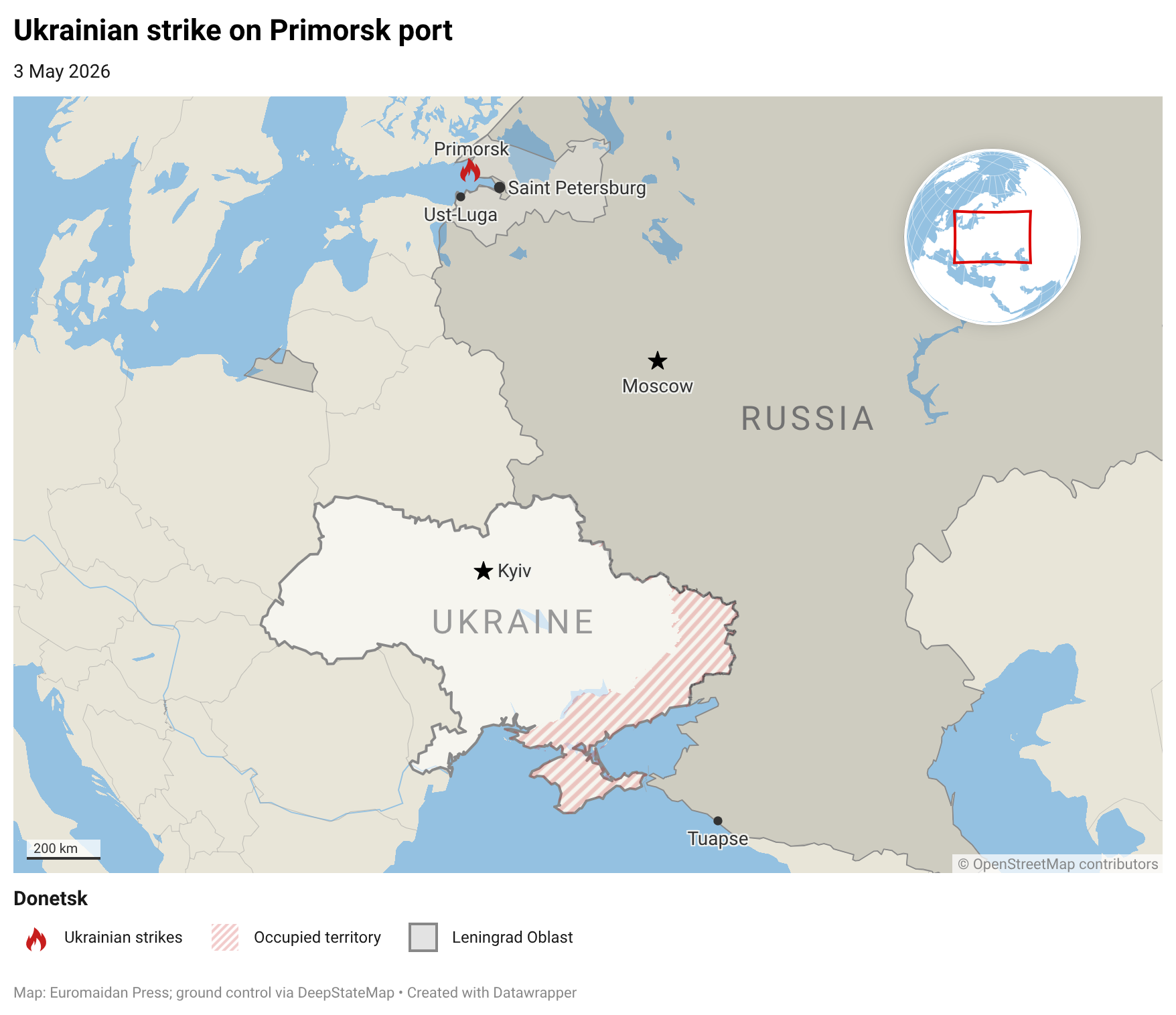
Ukrainian drones struck Russia's largest Baltic oil export terminal at Primorsk overnight on 2-3 May 2026, igniting fires that NASA satellites confirmed at the port — Leningrad Oblast governor Aleksandr Drozdenko later acknowledged the strike, calling Primorsk "the key target" of the attack. The strike ends nearly a month of relative quiet at Primorsk and follows the fourth consecutive Ukrainian drone strike on Rosneft's refinery and oil export complex in Tuapse on the Black Sea coast on 1 May.
Russia's two largest Baltic oil export ports, Primorsk and Ust-Luga, together handle about 2 million barrels of Russian crude per day — roughly 40% of Russia's seaborne oil exports.Both lie roughly 900-1,000 km from the Ukrainian border. Ukraine's deep-strike campaign on Russia's oil infrastructure has pushed Russian refinery output to multi-year lows.
What happened overnight
Ukrainian Telegram monitoring channel Exilenova+ shared early-morning footage of a Liutyi-looking strike drone flying through a residential area of Leningrad Oblast in dark skies, captioned simply: "Leningrad Oblast." Another monitoring channel, Supernova+, posted footage at 03:56 showing a fire in a field and an apparent anti-aircraft engagement, with the channel commenting that air defenses were active in the region and "the ports are under attack."
Around 08:00, Exilenova+ followed up with the same drone footage and a fire in a field, captioned:
"Night patrol over Leningrad Oblast. They say it found violations at the Primorsk port."
NASA FIRMS satellite fire-detection data showed fresh active fire signatures at the Primorsk oil terminal on the morning of 3 May.
Authorities running "downed" drone count, then the Primorsk admission
Governor Drozdenko issued four drone-count updates starting at 03:52 Moscow time, with the figure climbing from 35 to 43 to 51, then to 59 — and finally to "more than 60" by 08:48, when he posted a fuller statement acknowledging that the Primorsk maritime trade port had been the "key target" of the overnight attack, that a fire had broken out at the port as a result of the strike, and that no oil-product spill had been recorded. He did not detail the extent of the damage.
Pulkovo Airport in St. Petersburg shut down operations under the Russian "Carpet" plan — a standard procedure during drone threats — with restrictions also applied at Pskov airport.
A small-craft ban in Leningrad ports
A local outlet MR7 reported on 1 May that Leningrad Oblast authorities had banned small craft from the waters of the Primorsk, Vyborg, and Vysotsk ports for the entire navigation season, from 30 April to 1 October 2026. The ban — covering yachts, motorboats, catamarans, and jet skis — was signed on 28 April by the captain of the Vysotsk seaport, MR7 says. Drozdenko had said earlier in the week that Leningrad Oblast was "no longer just a border region but a front-line region" and that "port infrastructure objects are of interest to the enemy."
A month off, then back on the target list
Primorsk had taken the longest pause among Russia's three most-targeted oil export terminals. Ukraine's last confirmed strike on Primorsk landed on 5 April, igniting a fire at the tank farm. Ust-Luga's last confirmed strike was on 7 April. The Tuapse Rosneft complex on the Black Sea has been under sustained renewed Ukrainian fire since 16 April, with a fourth strike hitting on 1 May.

Ukrainian drones 4–0 Tuapse oil: refinery ablaze again after fourth strike last night
Earlier strikes on Primorsk in March-April destroyed at least eight 50,000-cubic-meter tanks — roughly 40% of the terminal's storage capacity. Estonian intelligence estimated that the route carrying 40-50% of Russia's petroleum product exports — through Ust-Luga and Primorsk — had been halted by the March campaign.


