ISW: Russia lost ground in Ukraine in April 2026 — first net loss since the Kursk incursion of August 2024

The think tank assessed Russian forces lost control of 116 square kilometers in April, with the rate of advance steadily declining since November 2025.
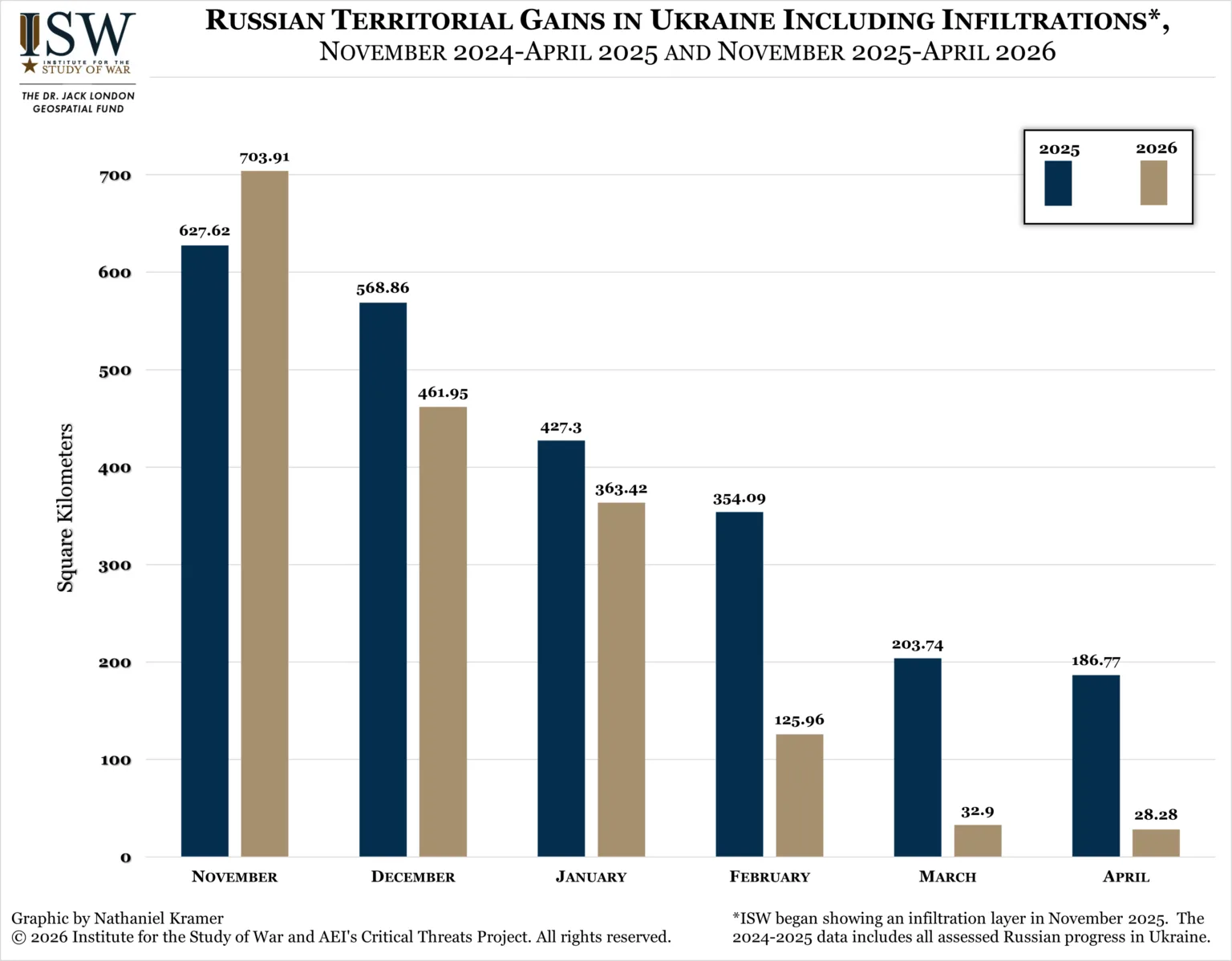
isw russia lost ground ukraine 2026 — first net loss since kursk incursion 2024 · post bar chart comparing month-by-month russian territorial gains including infiltrations across 2024-april 2025 2025-april gains-including-infils-from-november-april-in-2024-2025-and-2025-2026-1536x1198
: Bar chart comparing month-by-month Russian territorial gains in Ukraine — including infiltrations — across November 2024-April 2025 and November 2025-April 2026. Source: ISW
ISW: Russia lost ground in Ukraine in April 2026 — first net loss since the Kursk incursion of August 2024

Russian forces in Ukraine suffered a net loss of 116 square kilometers of controlled territory in April 2026 — the first such loss since Ukraine's August 2024 incursion into Russia's Kursk Oblast — the Institute for the Study of War (ISW) reported on 2 May. The Russian rate of advance has been steadily declining since November 2025, with the average daily Russian gain across the first four months of 2026 falling to 2.9 km² — down from 9.76 km² per day in the same period of 2025.

ISW credits a compounding set of pressures: Ukrainian ground counterattacks, Ukrainian mid-range strikes, the February 2026 block on Russia's use of Starlink terminals In Ukraine, and the Kremlin's throttling of Telegram. Existing Russian military problems have been exacerbated by each of those pressures, ISW notes.

Russia's slowing tempo on the ground in Ukraine has been visible in independent battlefield mapping for months, with the same pressures — Ukrainian deep strikes, drone interdiction of Russian logistics, and Ukraine's expanding own deep-strike industry — eroding the offensive calculus the Kremlin built around brute mass. Every month, Russian forces' failure to convert manpower losses into territorial gain widens the gap between what the Kremlin claims about the war.

A 925 km² gap, year over year

ISW assessed Russian forces seized 1,443.35 km² between November 2025 and April 2026 — against 2,368.38 km² over the same six months a year earlier, a year-on-year drop of about 925 km².
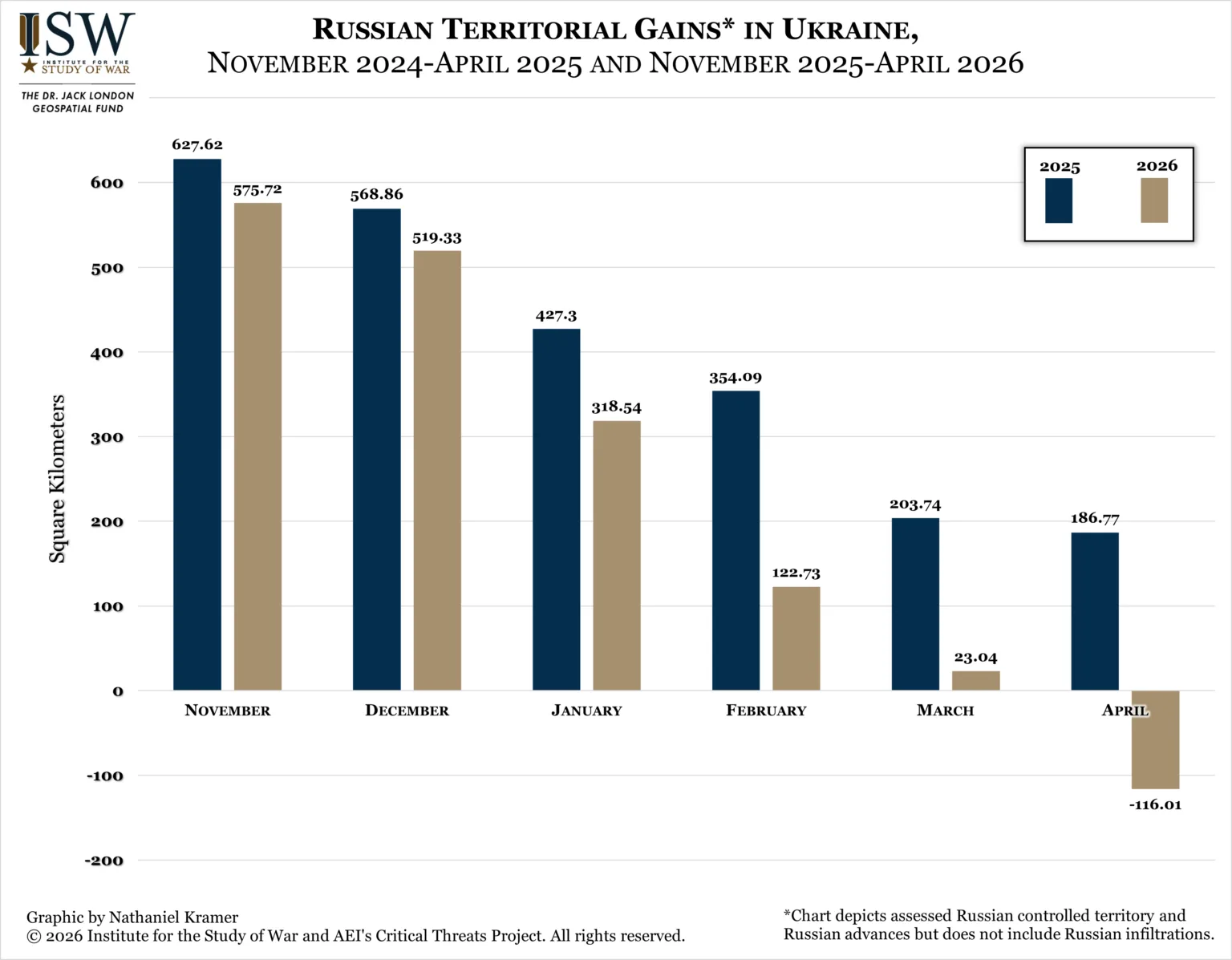
isw russia lost ground ukraine 2026 — first net loss since kursk incursion 2024 · post bar chart comparing month-by-month russian territorial gains excluding infiltrations across 2024-april 2025 2025-april 11601
Bar chart comparing month-by-month Russian territorial gains in Ukraine — excluding infiltrations — across November 2024-April 2025 and November 2025-April 2026, showing a net Russian loss of 116.01 km² in April 2026. Source: ISW

The Institute flagged that the comparison is complicated by a Russian shift toward infiltration tactics through 2025, with small Russian groups penetrating into Ukrainian-held "gray zones" rather than seizing terrain outright. Including infiltrations, Russia's net April figure is 28.28 km² gained — but only because infiltrations papered over the 116 km² controlled-territory loss.
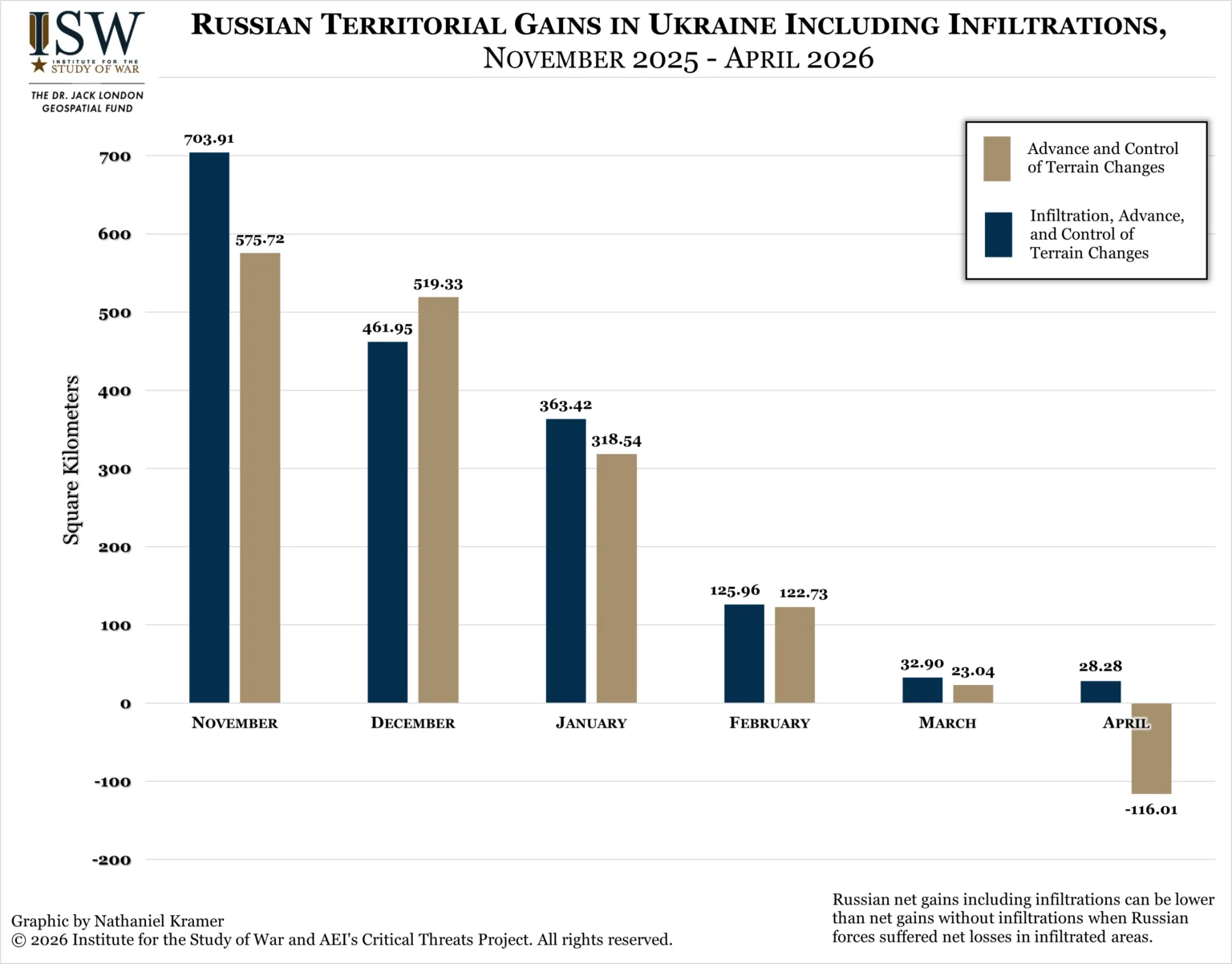
isw russia lost ground ukraine 2026 — first net loss since kursk incursion 2024 · post bar chart russian advance control terrain changes alongside infiltration over 2025-april infiltrations driving 2828
Bar chart showing Russian advance and control of terrain changes alongside infiltration, advance, and control of terrain changes over November 2025-April 2026, with infiltrations driving a 28.28 km² net positive figure even as advance-and-control showed a 116.01 km² net loss in April. Source: ISW

"The Kremlin uses Russian infiltration tactics in part to exaggerate Russian control of terrain"

That is ISW's direct framing in the 2 May assessment, with the think tank noting that Russian forces "do not control these infiltration areas, which are often collocated among Ukrainian positions in contested 'gray zones.'"

The Russian playbook, ISW writes, uses these incursions "in part to create the perception of continuous Russian advances across the front and to support Kremlin cognitive warfare efforts to exaggerate Russian successes."

Caveats: weather and methodology

ISW noted that part of the slowdown may be seasonal — eastern Ukraine's winter of 2025-2026 was about three degrees Fahrenheit (1.67°C) colder and significantly wetter than the previous winter, with rasputitsa mud degrading mechanized movement. In past years, Russian forces have stepped up advances in May and June as the ground dried out — whether that pattern returns in 2026 is unclear.

The think tank also said it had refined some area calculations in its mapping data, with no effect on previously assessed trendlines, and shifted to month-end-to-month comparisons going forward.

To suggest a correction or clarification, write to us here

You can also highlight the text and press Ctrl + Enter

Please leave your suggestions or corrections here


    Euromaidan Press

    We are an independent media outlet that relies solely on advertising revenue to sustain itself. We do not endorse or promote any products or services for financial gain. Therefore, we kindly ask for your support by disabling your ad blocker. Your assistance helps us continue providing quality content. Thank you!

    Related Posts

    Ads are disabled for Euromaidan patrons.

    Support us on Patreon for an ad-free experience.

    Already with us on Patreon?

    Enter the code you received on Patreon or by email to disable ads for 6 months

    Invalid code. Please try again

    Code successfully activated

    Ads will be hidden for 6 months.