

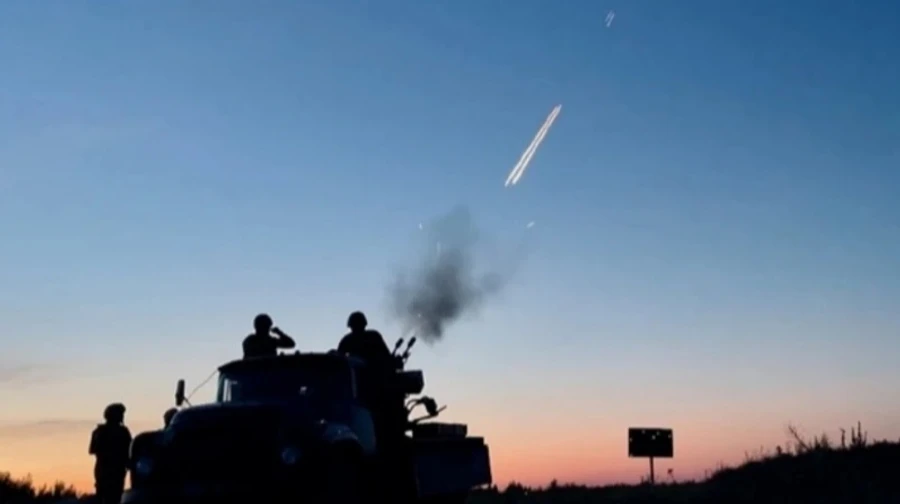
Ten countries launched a coalition in Paris on 13 July around Freya, a Ukrainian-made interceptor meant to shoot down Russian ballistic missiles at a fraction of a Patriot's cost. President of Ukraine Volodymyr Zelenskyy told the meeting he hopes to see Freya working within a year. Its maker does not expect to intercept a ballistic missile until the end of 2027.
Ukraine shoots down four out of ten Russian ballistic missiles. Only the American Patriot reliably kills them, Ukraine burns through about 60 of those interceptors a month on what its Air Force calls a "starvation ration," and there is one company on Earth that builds them.
What Freya is
It is not a new weapon. Kyiv arms maker Fire Point is converting a ground-attack ballistic missile it already builds into an interceptor, reusing the airframe of a Soviet-era missile Ukraine's air force has flown for decades.
Freya's shot costs around $700,000. A Patriot interceptor costs $3.8 million—more than five times as much. The idea is a missile cheap enough to fire at everything Russia launches.
It is also slower than its target, a Russian Iskander comes down at roughly 2,100 meters per second; the Freya tops out near 2,000 meters per second. It does not win a chase. It gets to the right piece of sky first and waits.

A missile alone is not an air defense system. It needs radar to see the incoming missile, radar to steer the interceptor, and a command center to run the intercept. Ukraine is buying it all in Europe: Fire Point has signed a memorandum with Germany's Hensoldt for the detection radar—its CEO says the radar gap is now closed—while firms in Denmark, Italy, and Norway remain candidates for the rest.
The part nobody has
What turns a rocket into an interceptor is the seeker—the eye that finds a missile falling at six times the speed of sound. Fire Point wants it from Germany's Diehl Defense. There is a cooperation agreement, signed in April. As of the company's last public account, there was no supply contract.
The plan is to start serial production of missile bodies in August, at up to three per day, and to store the airframes until German seekers arrive. Ukraine will spend the autumn filling a warehouse with half-finished missiles. Diehl has published no delivery schedule.
The Freya air defense system could take down Russian ballistic missiles. Can Ukraine build it?
The missile itself works, the first flight test reached 25 km—Patriot's altitude—and steered mid-flight. It has still never met a ballistic missile.
What Paris did and didn't do
The coalition produced a declaration and a flagship project, but no money for either. Marc DeVore, a St Andrews scholar of arms production, told Euromaidan Press he would be "very happy" if Freya were truly operational by December 2027, and is "fairly doubtful" about December 2026. Intercepting ballistics, he noted, is harder than anything Ukraine has already mastered—drones included.
Read also
-
From making interceptors to guarding sky: Ukrainian drone maker gets its own private air defense unit and will pay for it from weapon sales
-
Russia burned 628,000 new school textbooks in Kharkiv at the peak of back-to-school season
-
Ukraine wants to aim Starlink at Russian targets—and build a version Elon Musk can’t switch off


