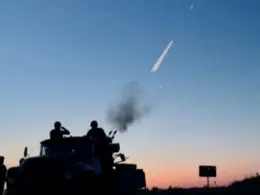
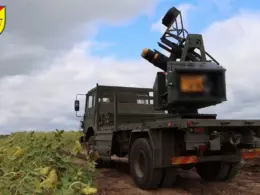
Thirteen European countries and the office of the NATO secretary general met in Kyiv on 12 May to launch what President Volodymyr Zelenskyy called an "anti-ballistic coalition"—a coordinated push to manufacture in Europe the missile defenses Europe currently doesn't make at scale.
The meeting, held at the level of national security advisers, marks a shift from bilateral talks to multilateral commitment on a problem that has haunted Ukrainian air defense for the entire war: the American Patriot system armed with PAC-3 interceptors remains Ukraine's primary shield against Russian ballistic missiles, and the United States produces too few of them for everyone who needs them.
"We are gradually advancing the issue of producing anti-ballistic systems in Europe—we are forming an anti-ballistic coalition," Zelenskyy said in his evening address. "It is worth doing this, and now we are closer to results than ever before."
The math European armies are trying to fix
Russia produces roughly 70 ballistic missiles per month, many going directly from factory to launch site. In January 2026 alone, Russia launched 91 ballistic missiles at Ukraine—the highest monthly total since the start of the war. Over the past winter, Russia fired more than 700 missiles at Ukraine, a significant share of them ballistic, Air Force spokesman Yurii Ihnat reported in late April.
Annual global production of the PAC-2 GEM-T and PAC-3 MSE interceptors that Patriot systems use against ballistic threats sits at around 850–880 missiles, according to Oslo University missile expert Fabian Hoffmann. That figure barely exceeds the lower-end estimate of Russia's annual ballistic missile output—before counting demand from US forces, Taiwan, Gulf states, and the air defense of Israel and US bases in the Middle East against Iranian strikes.
"Patriot missile production has been a bottleneck in US capabilities," St Andrews College military scholar Marc DeVore told Euromaidan Press in March. "The disconnect between supply and demand does mean that the US government has quite a bit of power in deciding whom to prioritize."
Ukraine's batteries are now running on what Ihnat called a "starvation ration." Roughly 80% of Ukrainian territory remains exposed to ballistic threats, Defense Minister Mykhailo Fedorov said in February when he first floated joint production consortia. The European alternative—the Franco-Italian SAMP/T with Aster 30 interceptors—has some anti-ballistic capability, but production is "comparatively tiny," according to US open-source analyst John Ridge. France and Italy have supplied Ukraine with two SAMP/T batteries, against roughly 10 Patriot systems from Western partners.
From consortium talks to coalition
The 12 May meeting builds on groundwork laid over the past four months. In February, Fedorov said he had discussed with Zelenskyy "the creation of joint consortiums with partners to produce anti-ballistic missiles faster." In April, Germany and Ukraine signed a strategic partnership that included financing "several hundred" PAC-2 GEM-T missiles to be produced at a Raytheon-MBDA Deutschland facility in Schrobenhausen, Bavaria, Euromaidan Press reported.
What changed on 12 May was the format. Thirteen countries plus the office of the NATO secretary general, meeting at national security adviser level, made the coalition a multilateral undertaking with NATO political backing rather than a series of bilateral deals. Ukrinform reported that Zelenskyy framed the moment as a structural opening: Ukrainian positions "at the front, in our long-range sanctions, and in our joint results with partners—are the strongest they have been in years."
The official list of participating countries has not been disclosed. Zelenskyy told Ukrainian broadcaster Marathon in April that the European anti-ballistic system "would need to be built by April 2027."
The strikes the coalition is meant to address
On the same day Zelenskyy announced the coalition, he also reported that Russia had resumed strikes after three days of "relative silence" that Ukraine had proposed. Russian forces continue daily drone and aviation-bomb attacks across the country. Kherson, Zelenskyy said, has effectively become a Russian drone "safari" against civilians—a pattern he had asked the Air Force commander and Prime Minister Yulia Svyrydenko to address with additional interceptors, electronic warfare systems, and crews.
Ukraine responded the same day with long-range strikes on Russian gas industry infrastructure in Orenburg region, more than 1,500 kilometers from the Ukrainian border. "We proposed quiet," Zelenskyy said. "Unfortunately, after relative quiet for three days, again Shahed strikes, again aviation bombs. Frontline activity remains high. So we respond."
Zelenskyy also proposed bilateral drone deals with European countries on 13 May and said he hopes a €90 billion European support package launches in early June.
What the anti-ballistic coalition has not yet specified is timeline, production targets, financing structure, or how it will navigate the US State Department approvals that govern licensing of Patriot components and missiles. European defense manufacturer MBDA, which now produces Patriot missiles in Bavaria under joint venture with Raytheon, has flagged those approvals as the main constraint on genuine European independence. Whether 13 countries and the office of the NATO secretary general can collectively build around that constraint—by April 2027 or any other date—is the question the coalition was formed to answer.