


Moscow’s missile massacres are deadly. However, the scalability ceiling may be lower than Russian messaging suggests, at least in the short to medium term. The upper limits of these attacks are dictated by bottlenecks in production and launch platform availability.
Russia’s Foreign Ministry last week promised “systematic strikes” against the Ukrainian capital, accompanying the threat with a massive barrage of over 90 missiles and over 600 drones, killing two people in Kyiv and injuring over 80. Ten days prior, Russia hit Ukraine with 56 missiles and over 700 drones, killing 24 people in Kyiv.
Russia’s attacks on Ukraine have been steadily growing in volume since 2024 and are hitting new records. Inexpensive one-way attack drones constitute the vast majority of their mass.
Yet as Ukraine gets better at dealing with Shaheds, the Russians are increasing missile production, Federico Borsari, a defense fellow at the Center for European Policy Analysis, told Euromaidan Press.
The Russians are especially focused on ballistic missile capabilities, given the global dearth of ballistic interceptors, which is especially acute for Ukraine. Yet while Russia’s ability to inflict damage with missiles remains formidable, analysts question how quickly the Kremlin can increase production of its missile arsenal and unleash it against Ukrainian cities.
"No radical increase in the use of missile weapons in proportion to production has been observed,” wrote Mykola Bielieskov, a research fellow with the National Institute for Strategic Studies.
"It is also unlikely that the Russian Federation will be able to target all current capabilities only at Kyiv, no matter how hard they try.”
How many missiles does Russia have?
According to the General Intelligence Directorate (GUR), Russia can produce just over 300 missiles per month. That includes:
Ballistic missiles
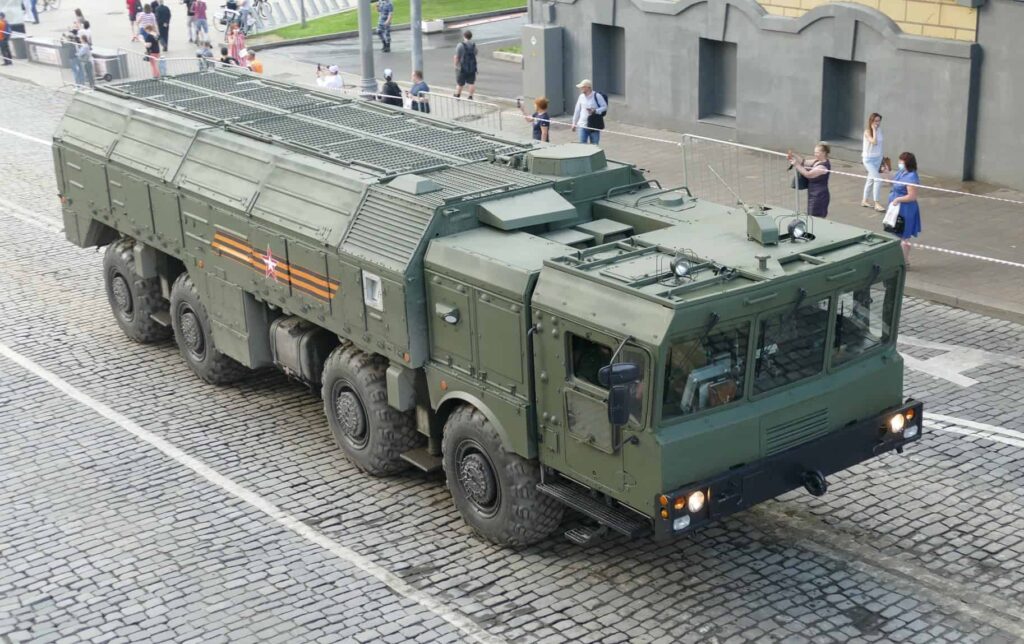
- Iskander-M ballistic missile — up to 60 units
- Kinzhal air-launched ballistic missile — up to 10 units
Cruise missiles
- Kh-101 air-launched cruise missile — up to 70 units
- Kalibr sea-launched cruise missile — up to 25 units
- Iskander-K cruise missile variant — up to 10 units
Repurposed anti-ship and other missiles
- Kh-35 air-launched missile — about 20 units
- Kh-69 air-launched missile — up to 5 units
- Kh-32 air-launched cruise missile — up to 8 units
- Oniks anti-ship cruise missile — up to 5 units;
- Zircon hypersonic cruise missile — up to 3 units
- RM-48U strike missiles — up to 40 units
- Kh-29/31/35/58/59 — up to 50 units
Russia also acquires short-range ballistic missiles from North Korea.
Furthermore, Russia has stockpiles within each category. GUR estimated in early May that there are up to 460 Kalibrs, up to 230 Zircons, up to 200 9M723 Iskanders, up to 120 Kh-101s and up to 100 Kinzhals in reserve.
While the Russians need to maintain reserves in case NATO countries get really serious, they can dip into them if they want to do the occasional oversized barrage on Kyiv or other cities.
Production bottlenecks
Can Russia significantly increase these production numbers? They are certainly trying. US open source analyst John Ridge expects that the threat ”will escalate as Russia continues to expand production of both ballistic missiles and cruise missiles.”
While Russia produces more cruise missiles per month, evidence suggests (and many observers agree) that Moscow is trying to shift emphasis towards its ballistic arsenal.

However, there’s likely a ceiling on how much Russia can boost its production rates, at least in the short to medium term.
“It will be difficult for the Russian Federation to increase the production of these weapons many times over, both due to financial constraints and a lack of qualified personnel,” Bielieskov wrote.
There are tradeoffs to be made. Justin Bronk, a Senior Research Fellow for Airpower and Technology at the Royal United Services Institute told Euromaidan Press that “there are many common parts and even entire electronic printed circuit board sections that are used on both certain cruise missile and certain ballistic missile types.”
“So in some cases an attempt to increase output of one will result in a decrease in possible production output of the other in any given month/period.”
Ballistic missiles are more expensive
Ballistic missiles generally cost more than cruise missiles—the components and engineering requirements are more demanding. It’s likely that shifting towards ballistics means a smaller output in absolute numbers. However, this may be worthwhile for Moscow, as Ukrainian air defense is less likely to shoot them down due to the global shortage of Patriot interceptors.
Defense Express estimated relative costs in 2022. In that analysis, if a Kalibr or the Iskander-K cruise missile cost up to $1 million, a more advanced Kh-101 cruise missile could cost up to $1.2 million, while a 9M723 ballistic Iskander would cost up to $2 million and an Oniks would cost up to $3 million.
Estimating the actual costs is harder but possible by looking at Russia’s procurement orders during the full-scale invasion. These would put Iskander-Ks at roughly $1.5 million, Kalibrs at around $2 million, and Kh-101s at up to $2.4 million per unit.
Ballistic missiles are pricier. The Kolomna Machine Building Design Bureau’s orders for ballistic missiles in 2024-2025 suggest that 9M723 Iskanders with cluster and high-explosive warheads are worth around $3 million per unit, though there are versions with cheaper warheads in the mix.
Launch platform bottlenecks
Production costs aren’t the only bottleneck on Russian missile strikes. Launcher availability is finite. This is especially true for seaborne and airborne platforms.
Sea
Trending Now
Ukraine has been whittling down and harassing the Black Sea Fleet over more than four years. For example, the frigate Admiral Makarov was struck multiple times, starting in 2022—an April attack took out its launchers, according to the Ministry of Defense.
The Askold, a Karakurt-class corvette and a Buyan-class corvette were put out of action in fall 2023. Missile corvette Ivanovets followed suit in January 2024. A Karakurt-class corvette, Tsiklon, was destroyed in Crimea in May 2024. A Buyan-class corvette was hit but not destroyed in 2025.

Ukraine also took out a submarine, the Rostov on Don in 2023 and damaged a Varshavyanka-class sub in December. Retired Ukrainian navy officer and war analyst Pavlo Lakiychuk told Euromaidan Press that subs are the most treacherous seaborne Kalibr launch platforms because it’s impossible to predict where their missiles will be coming from.
Most recently, Exilenova+ reported a 7 May strike on a naval base in Kaspiysk on the Caspian Sea, hitting a small Karakurt missile boat. Lakiychuk said that Caspian flotilla vessels aren't actively used for missile strikes on Ukraine but very well could.
All these attacks mean the Black Sea Fleet and the Caspian flotilla have fewer platforms to launch Kalibr missiles, Bielieskov said. Lakiychuk took a more cautious tone, pointing out that some ships, especially missile frigates, have not been damaged beyond repair and have lived to terrorize another day.
Air
Air platforms also come with their own limitations. Ukraine took out multiple Tu-95 and Tu-160 strategic bombers during 2025’s Operation Spiderweb, and continues to hunt Russian aircraft. Over the weekend, the Unmanned Systems Forces reported destroying two Tu-142 maritime patrol planes adapted from the Tu-95.

But wear and tear is an even bigger problem than Ukrainian drones. The remaining Tu-95s and Tu-160s are wearing out to the point where most can carry only one fourth to one-sixth of their maximum payload, Lakiychuk said. “If you equip them with their full array of missiles, they might not complete the flight.”
“The Russian Long Range Aviation fleet can surge but at a cost of reducing the overall life expectancy remaining for the Tu-95MS(M) fleet, for which there is currently no viable replacement,” Bronk said.
This entropy is also affecting MiG-31s, Russia’s key platforms for launching Kinzhal ballistic missiles. Defense Express wrote that serial production stopped in 1993 and while Russia had up to 150 airframes in storage, many of them were likely used for parts. The limiting factor is their engine, which can only do 300 flight hours between overhaul cycles.
“The bottleneck on launch capacity on any given day is the number of available MiG-31K launch aircraft,” Bronk added.
Ground
Russia has fewer problems with ballistic missiles launched from ground-based platforms. Bronk said that Iskander-M systems for launching 9M720 and 9M723 are “more plentiful in terms of potential launch capacity than the missiles to fire from them.”
This may change if Ukrainians can step up their game hunting Russian transporter erector launchers (TELs), as they appear to be doing. Over the weekend, Robert “Madyar” Brovdi, commander of the Unmanned Systems Forces reported that Ukrainian drones took out an Iskander launch vehicle at a military airfield in Taganrog.
Earlier, in February, Ukrainian Flamingo missiles hit a Russian Iskander factory, destroying an electroplating and stamping shop, according to analysts from the CyberBoroshno OSINT project.
“For some systems like the Iskander, TELs are now under threat from Ukrainian middle strike drones more than in the past,” Borsari said.
“So it is possible that Russians are taking extra care now and limit as much as possible the exposure to Ukrainian drones, which can impact the frequency of use.”
He added: “That said, I think that Russian forces still retain a fairly good amount of launch platforms for missiles.”
Peaks and troughs
Ukrainian residents know this better than most. From their point of view, no matter what bottlenecks Russia has, the chance of being blown up or having your home destroyed is always hanging overhead. After the May 24 mass strike, Ukraine’s Recovery Ministry said it received about 1,000 applications for housing compensations in Kyiv alone.
As Ukrainian blogger Oleksandr Kovalenko with Ukrainian outlet Informatsyinyi Sprotyv, who tracks Russian attacks, wrote on his Telegram account: no one should ignore air alert warnings.

That said, the numbers of missiles recorded over the past several months doesn’t show a linear increase. Rather, Moscow seems to go through peaks and troughs in how many missiles it fires at Ukraine.
February was one such peak. Close to 300 missiles were used, including a record 121 ballistic missiles (including North Korean KN-23s), as well as over 130 cruise missiles including Kh-101s, Kalibrs, and Iskander cruise variants.
March and April were tamer in comparison. Russia fired less than half of that amount of ballistic missiles and roughly half as many cruise missiles during each.
And then came May. It would appear that the Russians either had time to build up their missile stockpiles, as in the first three weeks and change, over 150 missiles were used, primarily on May 14 and May 24. The number of ballistic missiles as a percentage of the total soared.
Most of the cruise missiles were reported shot down. Only a minority of ballistic missiles were dealt with, according to Kovalenko.
All of the above suggests two things.
The first is that for all of Lavrov’s threats of decimating Kyiv’s high-value targets, the Russians are constrained by reality. Most likely, the truly big mass missile strikes will have to be spaced apart, with time to build up. In between, Russia will continue to hammer away at Ukraine with thousands and thousands of Shahed drones.
The second is that once the big attacks do hit, they are going to kill people, many of whom are civilians—without anti-ballistic defenses, Ukraine will have limited options to stop them. While they are certainly not going to raze Kyiv to the ground in a storm of fire, damage will be sustained and people will die.
Read Also
-
Belgium’s 10 F-16s bring Ukraine’s promised fleet to about 100 jets. Fewer than 40 are flying, as Russia’s jet drones run them ragged
-
Turkey’s Korkut guns now shoot down Russian drones over Ukraine. Almost half of the jet-powered Shaheds still get through
-
Russia just accidentally crashed its first Tu-95 bomber in 11 years. Its missiles will keep striking Ukraine anyway


