


- Ukraine has a new deep strike drone
- The Bravo has an unusual shape for a drone, with a blended wing and body
- The shape confers greater efficiency, and thus greater range and payload, at certain speeds
Ukraine's latest deep strike drone is one of a kind. The Triada Robotics Bravo features a "blended wing body" design that's rarely seen on a drone. The special platform maximizes lift and minimizes drag, helping the drone fly farther for a given speed and payload than a conventional "tube and wing" drone can do.
A stubby jet drone appeared fleetingly in a video shot from the ground during a strike on the Ufa refinery cluster in Bashkortostan on 2 August, more than 1,700 km from the Ukrainian border. Ukrainian forces hit the three Bashneft plants at Ufa on 1, 2, and 5 August.
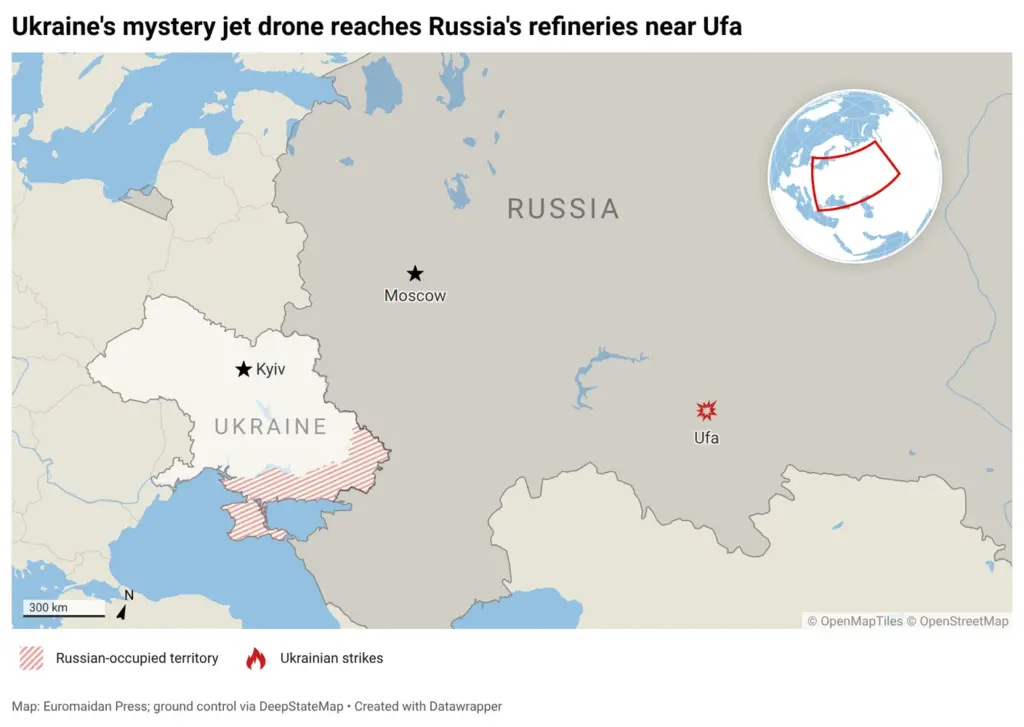
No official body has identified the aircraft in the footage. Online observers compared the silhouette to the American F-117 Nighthawk; the outline is also consistent with the renders Triada publishes of the Bravo. The clip runs a few tenths of a second.
Everything that has reached that deep into Russia until now has been propeller-driven, plodding along at less than 200 km/hr. A jet Bravo cruising at 600 km/hr covers the same 1,700 km in under three hours instead of nine and a half. That is the difference between an air defense network with all morning to work out where a drone is going and one with a couple of hours.
Exactly what the drone in the video was aiming for, and whether it struck its target, is unclear. But that's not stopping Russian observers from panicking. "Shooting down a drone is practically impossible," one Russian blogger moaned.
It's untrue. Motoring along at 600 km/hr—Triada claims around 800 km/hr in the final phase of flight—the jet-propelled Bravo is neither the fastest Ukrainian deep strike munition nor the slowest. If Russian air defenses can take down 950 km/hr Fire Point FP-5 Flamingo cruise missiles, they can take down Bravos, too. Detecting one is a separate question: Triada says the Bravo's composite airframe reduces its radar cross-section.

But invulnerability surely wasn't the main goal when Kyiv-based Triada Robotics designed the Bravo over the past couple of years. Efficiency was the objective. Which is probably why the firm chose the blended-wing-body arrangement for the one-way explosive drone, which it lists at around 174,000 euros—roughly $200,000.
The blended shape "provides many different aerodynamic benefits over conventional aircraft design," Oliver Johnson and Sam Dakka wrote in a 2019 article in International Journal of Aviation, Aeronautics and Aerospace.
Most drones, like most manned aircraft, have the same layout: a tube-shaped body and separate wings jutting from the body. These tube-and-wing aircraft are the easiest to conceptualize and the most straightforward to assemble, as the fuselage and wing can be built independently and attached during production.
The problem is drag, especially at the junctures between body and wing. A draggier airframe suffers a range and speed penalty compared to a less draggy airframe.
Alternative shapes
There are alternatives to tubes and wings. Flying wing aircraft such as the US Air Force's B-2 and B-21 stealth bombers, both built by Northrop Grumman, are all wing—and have neither an identifiable fuselage nor horizontal or vertical stabilizers. They look like boomerangs.
Trending Now
At subsonic speed, that shape is less draggy than a tube and wing shape is, and thus more efficient for long-range flight. At the same time, a flying wing's lack of sharp angles reduces its radar reflectivity. In short, it can be very stealthy and hard to detect on radar.
The downside of a flying wing is that it's unstable and requires sophisticated flight controls to keep it in the air.
A blended wing body shape is a kind of compromise between a flying wing design and a tube and wing design. There's a fuselage and a wing and stabilizers, but the fuselage and wing blend into each other. A blended wing body isn't as stealthy as a flying wing is, but it's easier to control.

Ukraine’s AI drones hammer Russian supply lines. Russia’s $10,000 drone just got the same kit
And it's still less draggy than a tube-and-wing type. "The improvements increase the overall lift to drag ratio providing a higher performance aircraft saving 27% fuel burn per passenger mile that of the modern conventional configuration," Johnson and Dakka wrote.
That benefit is apparent in the Bravo's performance specifications. The drone reportedly ranges 2,000 km with a warhead of 100 to 200 kg and AI-assisted targeting, flying as high as 5,000 m. It's unclear how the Bravo navigates, but it's probably via some combination of satellite and inertial systems.
It's an impressive set of stats. A $50,000, propeller-driven Fire Point FP-1 ranges slightly farther—2,300 km—but the FP-1 cruises at just 180 km/hr and packs a 60-kg warhead. The Bravo is more than three times as fast and carries at least half again as much explosive, and possibly triple, while still flying far enough to reach deep inside Russia.
Yes, the Bravo costs four times as much as the FP-1 does, probably in part because of the jet propulsion, but that could change if Triada Robotics can scale up production. Co-founder Artem Veselov has said the company aims for a first pre-series batch of 100 by the end of the year. For now, the Bravo is a rarity. But it may become much more common in the sky over Russia in the coming months.
Read Also
-
In Ukraine’s Vivaldi offensive, nobody rides in the BTR-60s. Bulgaria’s old troop carriers go into Russian bunkers packed with mines
-
Ukraine’s tanks are fighting from kilometers back. A 1960s Soviet model does that nearly as well
-
Ukraine’s Swedish radar planes have flown inside Russian missile range for six months. None has been shot down.


