The Russians can’t actually boost the production rate of their expensive ballistic missiles like the Iskander-M and the Kinzhal by much. So they’ve found a work-around: a more than twofold increase in production of converted air defense missiles to lob at Ukraine during mass strikes, the General Intelligence Directorate (GUR) told Ukrainska Pravda.
The Ukrainian Air Force files these RM-48U missiles under “ballistic threats,” together with Iskander-Ms and Kinzhals, because they all follow a ballistic trajectory and are very fast. That is where the similarities end. The RM-48U packs a payload that’s several times smaller, has at most half the range of an Iskander-M, and is highly inaccurate.
During Russia’s latest strike on Ukraine, which used a record number of ballistic weapons, a significant portion were likely RM-48Us. Despite their 150-170 kilogram high-explosive fragmentation warheads, these missiles seem to have a similar role to decoy Shaheds: meant to saturate and overload air defenses with ballistic targets, to allow more big missiles to get through. And if they kill some people, that’s a bonus.
The problem is that these modified air defense weapons can only be shot down by the same weapons Ukraine needs for Iskander-Ms and Kinzhals: PAC-3 interceptors for Patriot batteries or the Aster-30 interceptors for the SAMP/T air defense systems. And these interceptors are in very short supply.
As a result, while the destructive potential isn’t great, more RM-48Us in the sky will make it even harder for Ukraine to protect against missile barrages.
The solution is twofold. For one, Ukraine needs more ways to deal with ballistic threats. This will require more production in allied countries, as well as homegrown programs like Fire Point’s project to turn the FP-7 into a Patriot-like interceptor, to the electronic warfare system, purported to be able to “jam” ballistic missiles and make them miss their targets.
And secondly, more sanctions need to be applied to the Russian enterprises that contribute to its missile program. According to GUR, a dozen of these companies remain sanction-free.

A destructive “decoy”
President Volodymyr Zelenskyy has stated that Russia manufactures 120 ballistic missiles per month. Multiple publications cited GUR’s statement that Russia can launch 100 ballistic missiles each month and still maintain a stable supply in reserve.
However, the picture is a little more complicated. When it comes to true exquisite missiles, the Russians are stymied by a fixed supply of common parts, including printed circuit boards, which are needed to produce both ballistic and the cheaper, easier to make cruise missiles.
GUR’s statement to Ukrainska Pravda said that Iskander-M production has remained flat, up to 60 missiles per month and 700 planned in 2026, “same as last year.” The air-launched Kinzhals are being made in even smaller quantities, at up to 10 units per month, with 60 planned to be built in 2026.
However, GUR also stated that RM-48U production went from 200 in 2025 to a projected 480 in 2026, with a build rate of up to 50 per month.
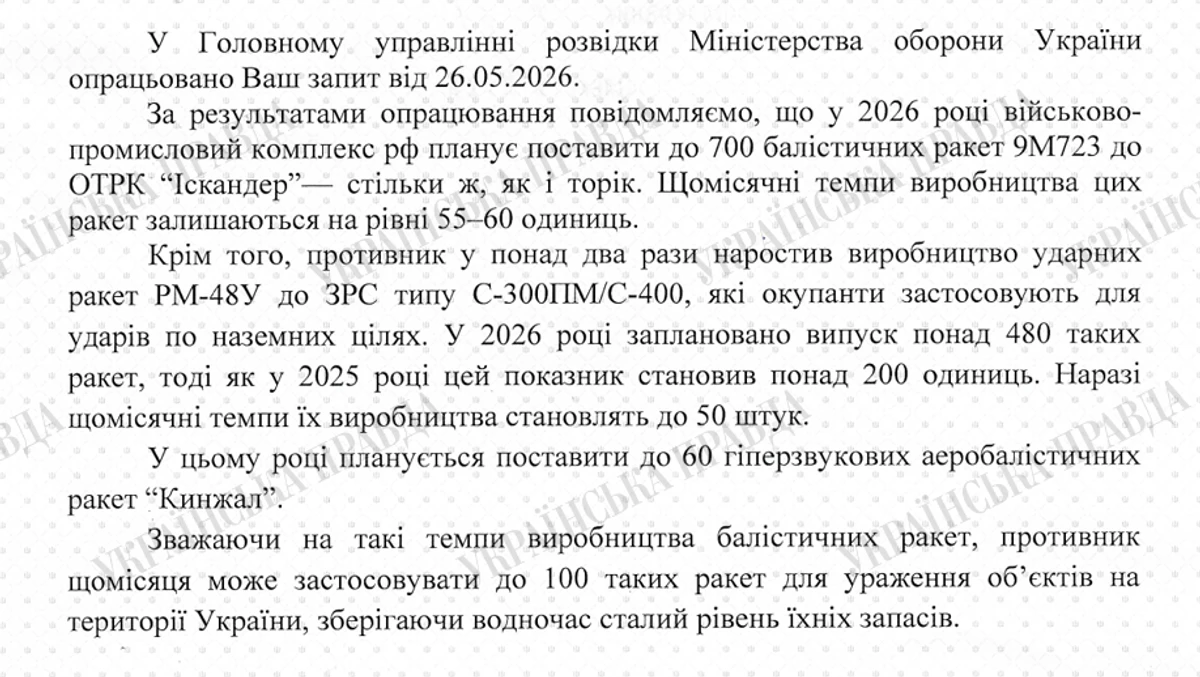
These are missiles adapted from 48N6 air defense SAMs meant to be launched out of the S-300PS/PT and S-400 air defense launchers, but converted into surface-to-surface weapons.
This missile “fulfils a supplementary role for the Russians alongside purpose-built ballistic missiles like the 9M723,” said Justin Bronk, a Senior Research Fellow for Airpower and Technology at the Royal United Services Institute.
“They present incoming ballistic missile-like targets for Ukrainian air defenders and force them to either ignore them and risk civilian casualties or use scarce Patriot PAC-3 or SAMP/T Aster 30 missiles to defeat them.”
Trending Now
The RM-48Us do not have correction, are rather inaccurate, and their warhead is not designed to destroy well-hardened targets, experts said. In spite of this, during strikes on densely populated areas, with low accuracy, civilians and civilian objects become the victims of this class of missile, especially in cities closer to the front lines.
Air defense shot down 92% of drones, 53% of missiles in May
This tactic is not new. Russia made extensive, similar use of old 5V55 surface-to-air missiles as improvised ballistic weapons. Ukraine did the same with its own 5V55s at various points of the full-scale invasion, especially during the opening phase.
The difference is now Russia’s ever-escalating campaign of drone and missile bombardments of Ukrainian cities, with each month setting new records by the number of weapons used. According to the Ukrainian Air Force, Moscow launched a total of 8,361 long-range weapons in May, including 8,150 drones and 211 missiles.

Nevertheless, Ukraine’s Defense Ministry is claiming to be holding firm and climbing towards its target of 95% of all weapons intercepted.
According to their May figures, they came close, with 92% interceptions, including 91.73% for drones and 53% for missiles.
During strikes, Ukrainian armed forces regularly report shooting down the majority of Russian cruise missiles headed their way. The ballistic missiles remain the biggest problem.
Iskander-M component producers remain unsanctioned
While there are several initiatives under way to increase Ukraine’s anti-ballistic arsenal, these may take years to unfold, given the difficulty and cost of ramping up interceptor production. The US, as the biggest producer, only makes 550 PAC-3 MSE interceptors per year, with a goal to raise production to 2,000 in the coming years.
There is another alternative: to choke off Russia’s missile production through additional sanctions. The main company building 9M723 Iskander missiles is Konstruktorskoye Bureau Mashinostroyeniya, which has been sanctioned by many countries for years.
However, of the 44 component developers for the Iskander-M listed on GUR’s website, 12 are not sanctioned by any country other than Ukraine. These include:
- Ural Factory RTI: makes rubber materials, some of which are used in missiles
- Factory named after Morozov: makes solid fuel for Iskanders
- PSB Technologies: makes modules for producing the EW-resistant Kometa antennas
- Pantes: also makes modules for producing the EW-resistant Kometa antennas
- Metalist Plant: makes accelerometers for missiles’ internal navigation systems
- Moscow Sapfir Plant: makes optics, including photo diodes for missiles
- Televidenie Research Institute: makes optical cameras for controlling missiles
- OKB Planeta: makes microstrips for circuit boards
- Almaz Fazotron: makes electronics that go into missiles
- Research Institute of Electronic Instruments: makes automatic control systems
- Tri-D: makes specialized fabrics, some of which are used in missiles
- Penzenskiy Factory of Precision Instruments: makes onboard control instruments
Read Also
-
Russia just accidentally crashed its first Tu-95 bomber in 11 years. Its missiles will keep striking Ukraine anyway
-
In Ukraine’s Vivaldi offensive, nobody rides in the BTR-60s. Bulgaria’s old troop carriers go into Russian bunkers packed with mines
-
Ukraine’s tanks are fighting from kilometers back. A 1960s Soviet model does that nearly as well