


Russians are mounting more Pantsir short-range air defenses onto tall buildings in Moscow in preparation for Ukrainian deep strikes on the capital.
Footage surfaced online showing a helicopter airlifting a Pantsir onto a roof against the backdrop of a cloudy sky, with raindrops visible. The fact that they’re doing this in inclement weather suggests a degree of urgency, likely provoked by recent Ukrainian attacks.
Unmanned Systems Forces staff recently told Euromaidan Press that Ukrainians have raised their opportunities to strike at a scale and coordination that could slip through the cracks of even the most heavily-defended city in Russia.

The Pantsir in the footage looks like an SMD-E model, which removes the twin 30-mm autocannons and can be equipped with a dozen 57E6 short-range missiles or 48 TKB-1055 mini-missiles, for when the sky is filled with incoming weapons such as drones. The Russian armed forces started receiving this system in September 2025.
This version of the Pantsir has a smaller mass and volume and thus, a better fit for tall buildings, Defense Express wrote.
Moscow is also ringed with Pantsir systems on dedicated towers, with OSINT analyst Mark Krutov counting more than 100.
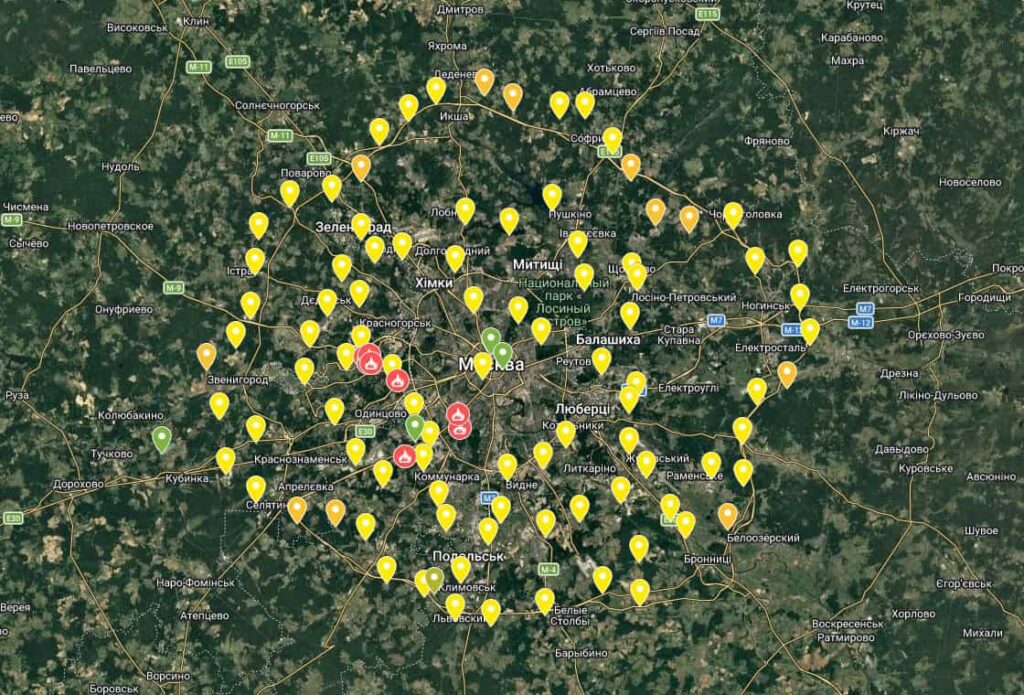
However, every system deployed to defend Moscow is a system that cannot be deployed elsewhere, possibly opening windows of opportunity for Ukraine to strike.
Tochnyi reported in March that confirmed strikes on S-300 and S-400 batteries, Tor and Pantsir short-range systems, and their attendant radars, have “eroded Russia’s ability to maintain coherent air defence coverage across its southern military districts and the occupied territories.”
Trending Now
Each degraded node is not just a destroyed platform but “a gap in the sensor-to-shooter chain that Russian doctrine requires.” The cumulative effect is a “progressive hollowing out of Russian anti-access/area denial coverage at a pace that production and repair struggles to offset.
Meanwhile Ukrainian attacks are growing in volume, range, and sophistication. Ivan Kirichevskyi, a soldier with the 413th Unmanned Systems Regiment, said that as far as the top-used FP-1 and An-196 Lyutiy drones are concerned, Ukraine has reached production volumes "comparable to or perhaps even exceeding the Russian Shaheds."
That doesn't mean that Ukraine's air campaign is going to be easy. Russian air defense is effective enough to shoot down the large majority of Ukrainian weapons.
It is also evolving. The Russians have recently introduced the ZAK-30 Citadel point defense cannon, which mounts 30-mm autocannons with controllable airburst capabilities. These may pose a very real threat to FP-1 and Lyutiy drones, Defense Express wrote.
Read also
-
This is the fancy new F-16 Ukraine could get. It’s not what its pilots need most.
-
One year of Ukrainian arms exports, and industry has questions: how much army gained, where Berlin office is, who joins joint ventures
-
Ukraine’s answer to Russia’s jet Shaheds: a jet drone named Bars, built to strike Russia and now turned around to hunt them


