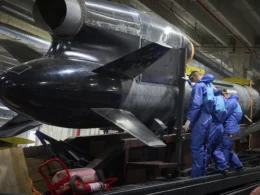
- Ukrainian drone-maker Fire Point is arming some of its FP-1 and FP-2 one-way attack drones with underwing unguided rockets
- The most coveted target: a Russian supply train hauling multiple tanker cars full of fuel
- One rocket-armed drone could blast an entire train—up to eight times the damage per strike
Ukrainian drone-maker Fire Point is arming its FP-1 and FP-2 one-way attack drones with underwing unguided rockets. Co-founder Denis Shtilerman's dream target: a Russian supply train hauling multiple tanker cars full of fuel bound for Russian field armies.
With eight rockets plus its own on-board warhead, an FP-1 or FP-2 could blast the entire train instead of taking out just one car. "That is exactly where it will be effective," Shtilerman told Ukrainian news outlet NV. "When a train with a bunch of tanks is caught, it will justify itself the first time."
The upgrade arrives as Ukraine's counterlogistics campaign accelerates. Ukrainian drone strikes on Russian supply lines doubled between February and March, and were on track to double again between March and April, the most recent month for which good statistics are available.
"Strikes against storage facilities, particularly ammunition depots, as well as fuel infrastructure and rail networks, form over a quarter of total activity," Ukrainian analysis group Tochnyi noted. "The intensity of attacks on munitions storage aligns with observed reductions in Russian artillery usage, while fuel-related targeting suggests a parallel effort to constrain mechanized operations by disrupting supply chains behind the front and most importantly politically on the home front."
Fire Point builds thousands of FP-1s and similar FP-2s every year at a cost of around $50,000 per drone. The FP-2s carry bigger warheads—up to 200 kg—but less fuel than the FP-1s. The remote-controlled drones, which connect to their operators via satellite or mesh radio, are the preferred munitions for Ukrainian drone units conducting medium-range strikes on Russian air defenses and hardened targets such as headquarters in Russian-occupied Ukraine.
The FP-1s and FP-2s have been buzzing over occupied Ukraine and adjacent Russian oblasts for more than three years now, but they didn't get their own underwing armament until this spring. The first video of an FP-1/2 firing S-5 rockets appeared online in early May.
A remote operator can trigger the rockets. But there's also a built-in algorithm that allows an FP-1/2 to fire its rockets automatically, Shtilerman revealed.
Trending Now
Clearing paths through air defenses
The rockets' current main purpose is to lob a few of the 5-kg S-5s at Russian air defenses protecting the FP-1/2's primary target, clearing a path for the drone and its own internal shaped-charge warhead, which weighs up to 200 kg depending on the drone model.
"Worms, lube up—now you've got candies in the rear, too," the 414th Separate Unmanned Strike Aviation System Brigade quipped. "Especially MANPADS mobile groups and machine gunners guarding air defense elements." The 414th is one of several units that fly FP-1s and FP-2s. A MANPADS is a "man-portable air defense system"—a shoulder-fired surface-to-air missile, the likes of which Russian forces deploy around high-value targets.
But the same S-5 rockets could wreak havoc on train cars full of fuel. The S-5 has armed Russian and Ukrainian warplanes and helicopters for decades. The munition is abundant in Ukraine, especially now that Ukrainian helicopters only rarely operate along the front line owing to the danger from missiles and interceptor drones.

A video the Ukrainian Unmanned Systems Forces posted on Monday depicts at least two FP-2 strikes on Russian trains in Donetsk Oblast in Russian-occupied eastern Ukraine. Two tanker cars burned. Now imagine that the FP-2s that blasted those trains could've fired eight rockets before slamming themselves into their targets.
Imagine potentially eight times as much damage per strike.
Read Also
-
One year of Ukrainian arms exports, and industry has questions: how much army gained, where Berlin office is, who joins joint ventures
-
Ukraine’s answer to Russia’s jet Shaheds: a jet drone named Bars, built to strike Russia and now turned around to hunt them
-
Belgium’s 10 F-16s bring Ukraine’s promised fleet to about 100 jets. Fewer than 40 are flying, as Russia’s jet drones run them ragged