


- Ukrainian drones struck a refinery in Omsk, Siberia, 2,500 km from the Ukrainian border
- The strike involved a new variant of the Fire Point FP-1 drone
- The big-wing drone reportedly ranges as far as 3,400 km
Around seven Ukrainian drones motored more than 2,500 km on Monday to strike, for the first time, a refinery in Omsk in southwestern Siberia. It was one of the deepest Ukrainian drone strikes on Russian soil in the 53 months since Russia widened its war on Ukraine—the first time the war had reached beyond the Ural Mountains to a Siberian plant.
The Omsk refinery accounts for roughly 10% of all Russian oil refining and, by various estimates, more than half of the Siberian Federal District's motor fuel, making it one of the country's most valuable. The daytime raid damaged two distillation units at the sprawling facility that process a combined 50,000 tons of oil every day. On Tuesday, the Omsk facility suspended sales on the Saint Petersburg International Mercantile Exchange.
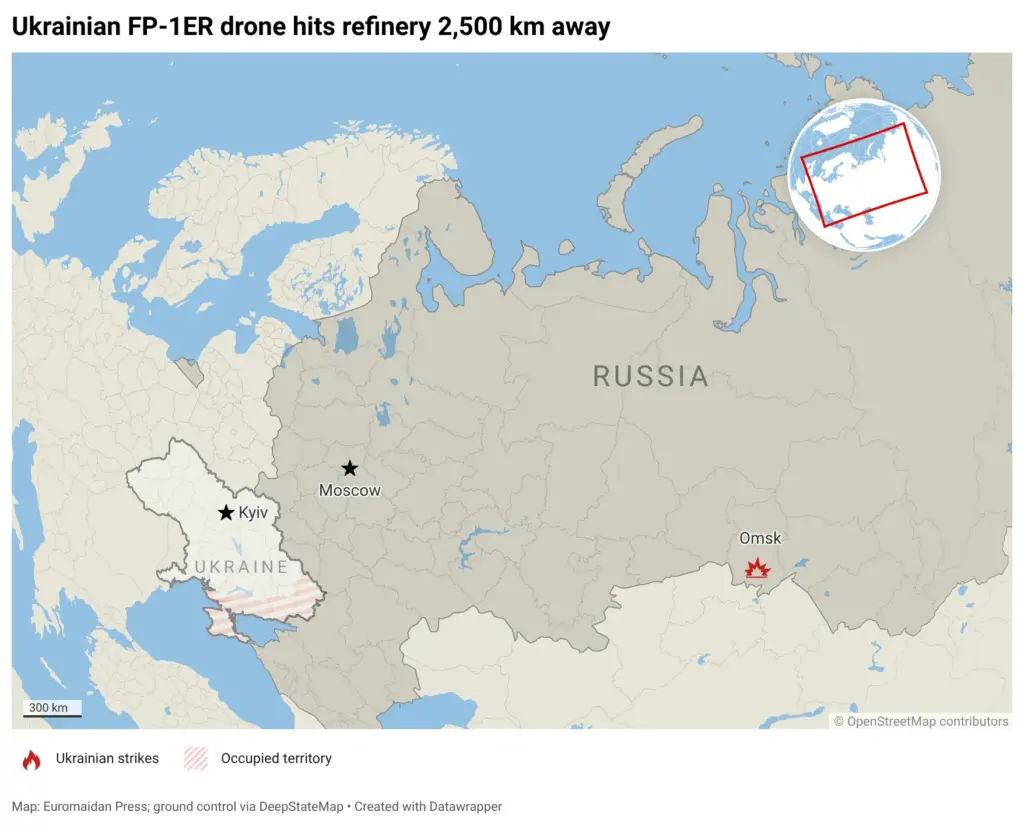
It was a powerful blow against the Russian economy. And it was all thanks to a new Ukrainian drone type: the Fire Point FP-1 Extended Range. The new drone ranges a startling 3,400 km, according to Fire Point designer Denys Shtilerman. That's more than three times as far as the original FP-1 model.
Eagle-eyed observers, scrutinizing video of the Monday strike, quickly spotted the key difference between the FP-1(ER) and the original FP-1.
The FP-1(ER) has larger wings. "The wings are longer and shaped differently than the previous model ... and reportedly hold extra fuel tanks," Canadian drone expert Roy noted.
That bigger wing likely adds to the drone's $50,000 unit price in its basic configuration. But it's well worth the cost. Ukraine does possess other deep-strike munitions with similar range, including the Fire Point FP-5 cruise missile, but those are probably much more expensive than the FP-1(ER).
Ukrainian forces might be able to buy several FP-1(ER)s for the cost of one $500,000 FP-5. Fire Point claims it produces 300 FP-1s and similar FP-2s every day.
The cheap, low-flying FP-1(ER) got through where the pricier, higher-flying FP-5 recently could not. On 4 July, Russian forces sortied a rare Beriev A-50U radar plane, spotted a clutch of FP-5s streaking toward targets deep in Russia, and shot them all down.
An A-50U and a Sukhoi Su-57 stealth fighter reportedly hunted for the Omsk-bound drones, too. It was a special and, on paper, formidable aerial defense. "This is the first instance I have seen of both platforms present in the same location," wrote Michael Bohnert, an analyst with RAND in California. But the drones got through anyway.

Trending Now
Early warning
The Russians likely had ample warning the drones were coming. "The FP-1 drones are slow and would have taken hours to reach Omsk," Bohnert pointed out. "Unless A-50 and Su-57 aircraft were overhead 24/7 (incredibly unlikely given how few), it means these FP-1 would have been tracked for several hours to enable aircraft to get airborne."
The tiny drones apparently flew low enough to disappear on radar screens. To all but the very best radars, low-flying aircraft are indistinguishable from the surrounding terrain. The A-50U and Su-57 themselves flew lower than usual in a bid to get a lock on the FP-1(ER)s, but even that didn't work. "To fly this low highlights how difficult these drones must be to detect," Bohnert wrote.
The FP-1(ER)'s new wings are evident in videos from Omsk, but other aspects of its design remain a closely held secret. Early FP-1s suffered from a lack of explosive firepower owing to their anemic 60-kg warheads. Fire Point recently tweaked the FP-1 to accommodate a 105-kg warhead.
It's not clear how heavy the FP-1(ER)'s warhead is, but the damage at Omsk points to the 105-kg version. Adding explosive payload tends to weigh on a drone's range, but the bigger wing and its more capacious built-in fuel tanks clearly compensate for the added warhead weight, and then some.

10% of Russia’s refining, half of Siberia’s fuel: the Omsk plant just lost its 2,500-km protection
The other mystery is the FP-1(ER)'s guidance. It's possible that Fire Point drones and missiles combine inertial and satellite guidance. But the satellites can be jammed, and self-contained inertial systems tend to lose accuracy over time and distance.
That the FP-1(ER) can fly thousands of kilometers and still accurately strike a pinpoint target speaks to the increasing sophistication of Ukrainian drones and missiles. The FP-5 has also grown steadily more accurate as Fire Point refines it. The FP-1(ER) may benefit from the same work.
Refineries are tough targets, and the Russians work hard to repair them after drone and missile strikes. The Omsk refinery may be back in business soon. But the Monday raid is unlikely to be a one-off.
Ukraine now has a low-cost deep-strike drone that can fly low enough to evade the best Russian air defenses. There's every reason to believe the Ukrainians will hit Omsk again. And again. And again.
Read Also
-
One year of Ukrainian arms exports, and industry has questions: how much army gained, where Berlin office is, who joins joint ventures
-
Ukraine’s answer to Russia’s jet Shaheds: a jet drone named Bars, built to strike Russia and now turned around to hunt them
-
Belgium’s 10 F-16s bring Ukraine’s promised fleet to about 100 jets. Fewer than 40 are flying, as Russia’s jet drones run them ragged


