


- Russian authorities have closed the M-14 highway, Russia's main route from Rostov-on-Don to occupied Crimea, to civilian traffic. The reason: Ukrainian drones are hitting Russian supply trucks along the route at a near-daily clip.
- Ukraine's middle-range drone strikes more than doubled between February and March — and Russian forces lost ground in Ukraine in March and April, during what should have been Moscow's spring offensive.
- The same M-14 was a Russian "drone safari" killing ground in August 2025—until Ukrainian engineers strung anti-drone nets along the Mykolaiv-Kherson stretch.
On 22 May, Vladimir Saldo, Russia's installed governor of occupied Kherson Oblast, signed a decree suspending traffic on the section of the M-14 highway running through occupied Kherson to the Dzhankoi checkpoint in northern Crimea — reportedly because Ukrainian drones are hitting Russian supply trucks along the route at a near-daily clip.
It didn't happen overnight. Ukrainian middle-range drone strikes — those traveling as far as 200 km — more than doubled between February and March, according to a recent tally by analysis group Tochnyi. The M-14, Russia's main path from Rostov-on-Don in southern Russia to Russian-occupied Crimea, and the H-20 highway branching off the M-14 in Mariupol and winding north into Donetsk Oblast, are the main focuses of the campaign.

Ukraine wrapped the occupied south in three layers of drones. Russian trucks are burning
Ukrainian drones are organizing themselves into three concentric zones: FPVs near the gray zone out to around 20 km, AI-assisted Hornets and B-2s pushing over the middle ranges as far as 150 km, and the heavier Fire Point FP-1s and FP-2s reaching as deep as 200 km. The M-14 and H-20 sit squarely inside the middle and outer rings — putting every Russian supply convoy between Mariupol, Donetsk Oblast, and the Crimean approaches into sustained reach.
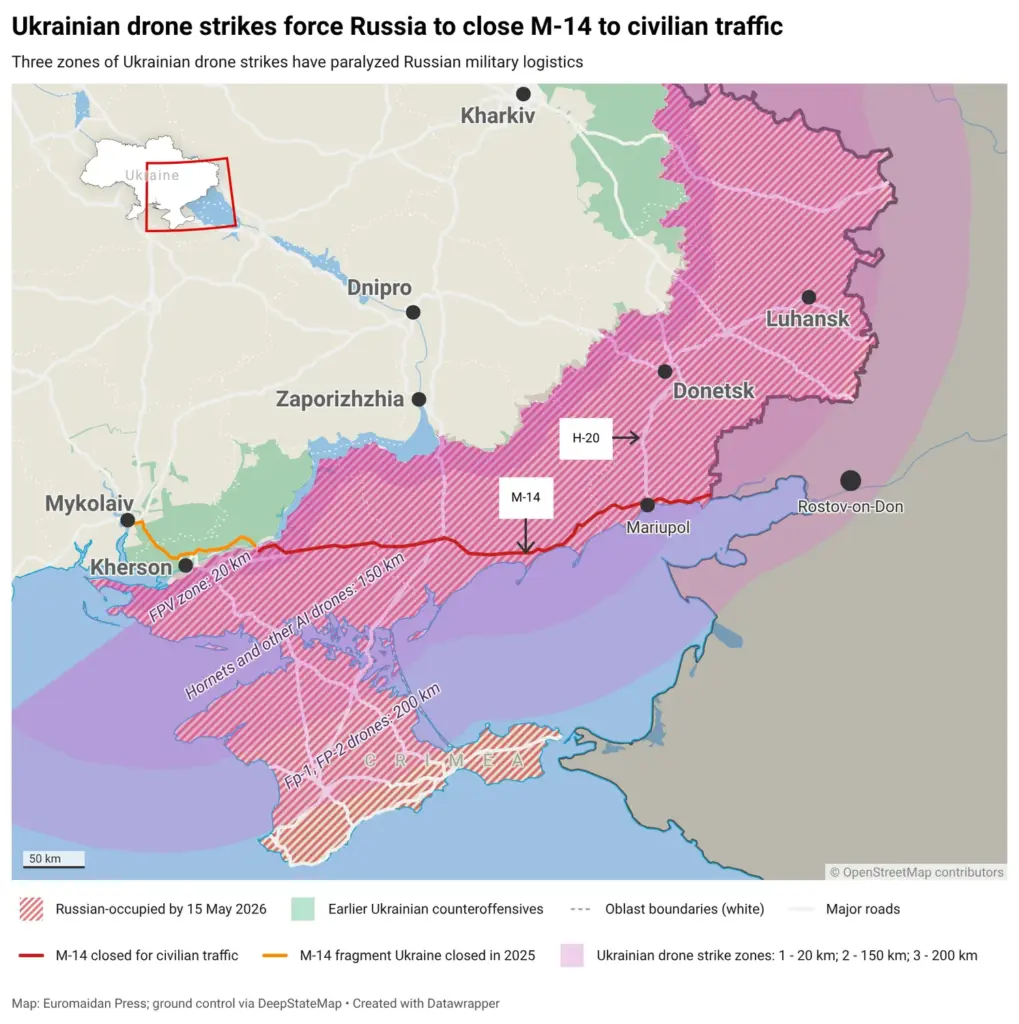
We don't know how many Russian trucks and vans travel the main supply routes in southern Ukraine every day, shuttling supplies and reinforcements between logistical hubs and front-line regiments. But Ukrainian drone pilots are hitting potentially dozens of them. It's unclear just how much strain those losses are placing on Russian regiments, but it's not none. It's telling that Russian forces overall lost ground in Ukraine in March and April, at the same time Russian forces are usually advancing as part of their traditional spring offensive. And it's evident Ukrainian commanders are looking for opportunities to attack.
It's apparent the Russians are preparing to reinforce their air defenses along these roads. Perhaps by deploying more radio jammers, gun teams and missile launchers. Perhaps by installing anti-drone nets over the roads. Perhaps both.
Hornet, B-2 and other AI-assisted drones are now so thick in the sky over the M-14 and H-20 that the drones sometimes glimpse each other in their forward-looking cameras.
"The surest path to achieving this is pushing the 'sanitization zone' for enemy logistics closer to Russia itself and occupied Crimea," the Ukrainian 1st Azov Corps stated. The corps' drone pilots are responsible for many of the raids along the H-20.
There are enough drones in the air that they not only hit Russian supply trucks, they have also struck the trucks the Russians send out to fetch damaged and destroyed supply trucks. Ukrainian drones recently observed one of these double-tap strikes somewhere on the road to Crimea.
50 blasted trucks
One observer scrutinized three recent 1st Azov Corps video montages and counted strikes on around 50 Russian trucks. The videos may depict several days of strikes, so it's hard to calculate a daily strike rate. But it's worth noting that the 1st Azov Corps isn't the only Ukrainian formation droning the M-14 and H-20.
The emergence of a Ukrainian middle-range counter-logistics campaign took many observers by surprise. "Mid-range logistics genocide arrived without notice, as the result of long-term systemic work," mapper and analyst Vitaly mused.
Trending Now
As recently as late 2025, some critics accused planners in Kyiv of neglecting middle-range strikes in favor of short-range drone raids targeting Russian infantry in the disputed gray zone.
"The drone war is not about the number of killed today," wrote Ryan O'Leary, an American who once led a volunteer company fighting for Ukraine. "It is about controlling the space tomorrow. Ownership of the depth means control of movement, logistics, [surveillance], communication and decisions in the sector, not just in the trench."
"Ukrainian drones are still optimized for destroying infantry, not for changing sectors," O'Leary stressed in his now-deleted post on social media. "This creates cool videos, but delivers weak strategic effect."
The middle-range strikes, which ramped up shortly after O'Leary wrote his missive, are delivering strong strategic effect. "In some directions, Ukrainian units are potentially setting the conditions for future tactical offensive operations by disrupting Russian logistics and targeting [drone] crews," wrote Dmytro Putiata, a Ukrainian drone operator and expert who co-founded the Two Marines analysis group. "This could lead to additional offensive operations before the end of the spring."
Indeed, some Ukrainian units are already looking for opportunities to exploit the apparent strain on Russian troops. Ukraine recaptured more ground than Russia took in February for the first time since Ukraine's August 2024 Kursk incursion, and Russia continued losing ground through April. Drones drove some 96 percent of Russia's March casualties.
On 22 May, the Ukrainian 3rd Army Corps counterattacked north of Lyman, aiming to relieve the pressure on the twin free cities of Sloviansk and Kramatorsk in eastern Ukraine's Donetsk Oblast.
The kill zone, flipped
The M-14 has been here before. In August 2025, the same highway, on its Ukrainian-controlled stretch between Kherson and Mykolaiv, was a Russian "drone safari" killing ground for civilians. Russian FPV drone operators hunted minivans, ambulances, and lone drivers on the road until Ukrainian authorities briefly restricted civilian traffic on 27 August 2025.
Within days, Ukrainian forces deployed anti-drone nets along the highway. By 3 September, not a single Russian drone had reached the road. The UN later classified Russia's drone campaign on Kherson civilians as a crime against humanity. The Russian-controlled segment of the same M-14, for now, has Saldo's decree.

Read Also
-
Russia still parks its best bombers in the open. Ukraine has spent a year knocking out the air defenses that were supposed to protect them
-
Russia is losing the Black Sea grain war it started. Its answer is to sink civilian ships off Romania and Bulgaria
-
Russia is back at Dobropillia a year after it failed there. Now it’s the southern jaw of a pincer on Donbas’s last big free cities


