


- The Russians' latest anti-drone innovation is a bright green nylon net
- The net could protect vehicles by catching incoming first-person-view drones
- It's promising enough as a drone countermeasure that the Ukrainians are using nets, too
On 11 November, the Russian 8th Combined Arms Army deployed several BMP-3 infantry fighting vehicles for an attack across the disputed gray zone a few kilometers east of the village of Toretske, which lies astride one of the main road routes toward the free city of Kramatorsk, 25 km to the north.
Kramatorsk and neighboring Sloviansk are Russia's main near-term objectives as its wider war on Ukraine grinds through its 57th month. The Russians are trying everything to advance along the roads to Kramatorsk. For their BMP assault on 11 November, they piled every possible anti-drone protection atop the 21-ton, 10-person vehicles.
That included, on at least one BMP, a bright green nylon net like a fisherman's net. The net gave the tracked fighting vehicle an odd, mossy appearance as it sped up the road under the cover of a thin winter fog. But there was a method to the madness. As the outermost layer of add-on protection that also included a metal cage and hundreds of metal spines, the netting served a useful purpose. It could catch incoming first-person-view drones before they struck the vehicle underneath all that extra armor.
The netting didn't actually save that BMP on 11 November. The Ukrainian 93rd Mechanized Brigade spotted the approaching Russian vehicles and struck them with FPV drones, eventually defeating the attack. But it's apparent from the Ukrainian brigade's video montage of the clash that it took repeated FPV strikes to immobilize the BMP. The net may have helped delay the inevitable.
Wider adoption
The best sign that a net is viable protection against FPV drones is that Ukrainian crews are using them, too. A Getty photo that circulated on 13 November depicts a captured Russian T-80U tank in Ukrainian service with the defenders of Kramatorsk. The 46-ton, three-person tank wears all the same add-on anti-drone measures as the ill-fated Russian BMP: a metal cage, metal spines, and, on top of everything else, a bright green net.
It's the latest example of some seemingly awkward Russian anti-drone innovation actually proving its worth before Ukrainian forces start using it, too. The Russians bolted metal shells onto some of their tanks; soon the Ukrainians did, too. The Russians added spines to the shells; so did the Ukrainians. Now nets may proliferate, too.
Trending Now
The additions aren't meant to be foolproof. They're meant to blunt a barrage of FPVs, hopefully buying time for a vehicle to dash across the gray zone and shepherd infantry to new positions on the far side. A vehicle doesn't have to survive an assault across the gray zone in order to accomplish its mission. It only has to survive long enough. Add-on anti-drone protections can add critical minutes to that lifespan.
Those BMPs that attacked east of Toretske on 11 November didn't make it across the gray zone. But a column of Russian vehicles that attacked two days later in the same area did make it across. Darting across the gray zone under the cover of an unusually thick winter fog, that column reached the village of Hruzke on the Ukrainian side of the gray zone. The Russian infantry dismounted and spread out, seeking new positions that could help nudge the gray zone north toward Kramatorsk.
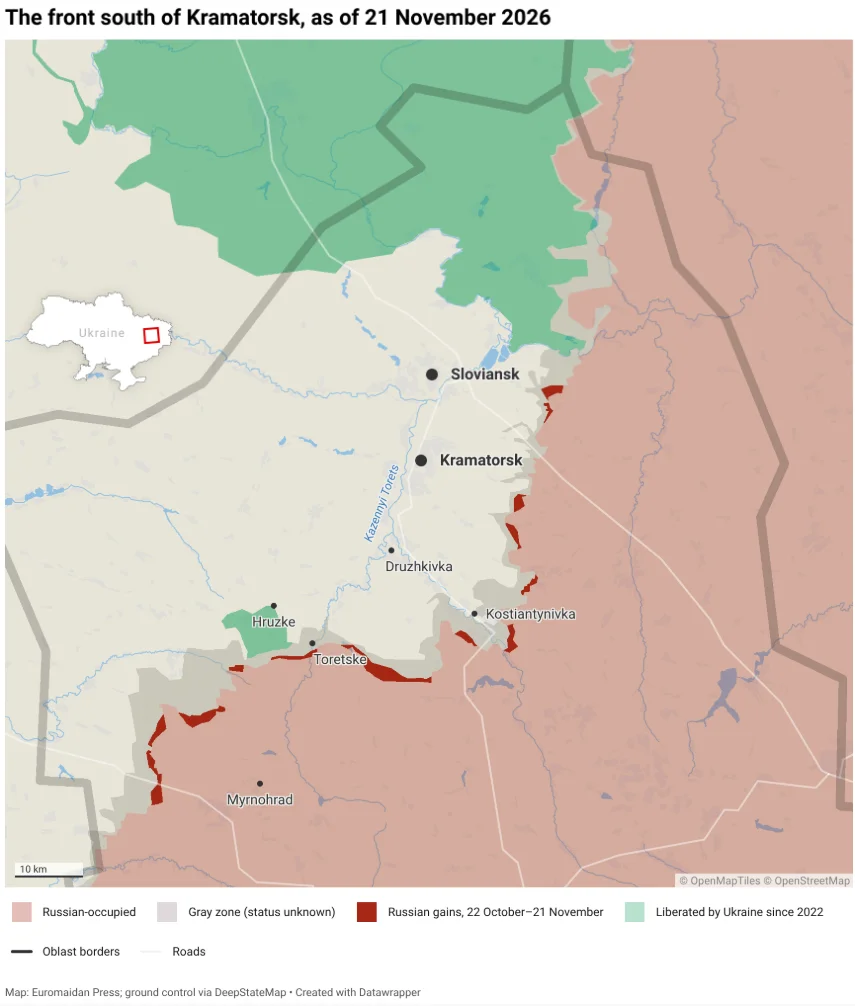
As the weather improved on 14 November, mapper Vitaly scoured social media for evidence of Russian gains. "No [Ukrainian] positions were lost," he reported. But he cautioned that "some" of the Russian infantry who rode into battle under the previous day's fog "may still be hiding behind the line."
By the reduced standards of the mostly positional fighting south of Kramatorsk, that's as close to a tactical victory as the Russians have achieved in many weeks. We don't know whether the vehicles that got across the gray zone on 13 November were wearing nets. But we should expect more vehicle crews on both sides to include nets among their anti-drone protections. Anything that can stop a few drones is worth trying.


