


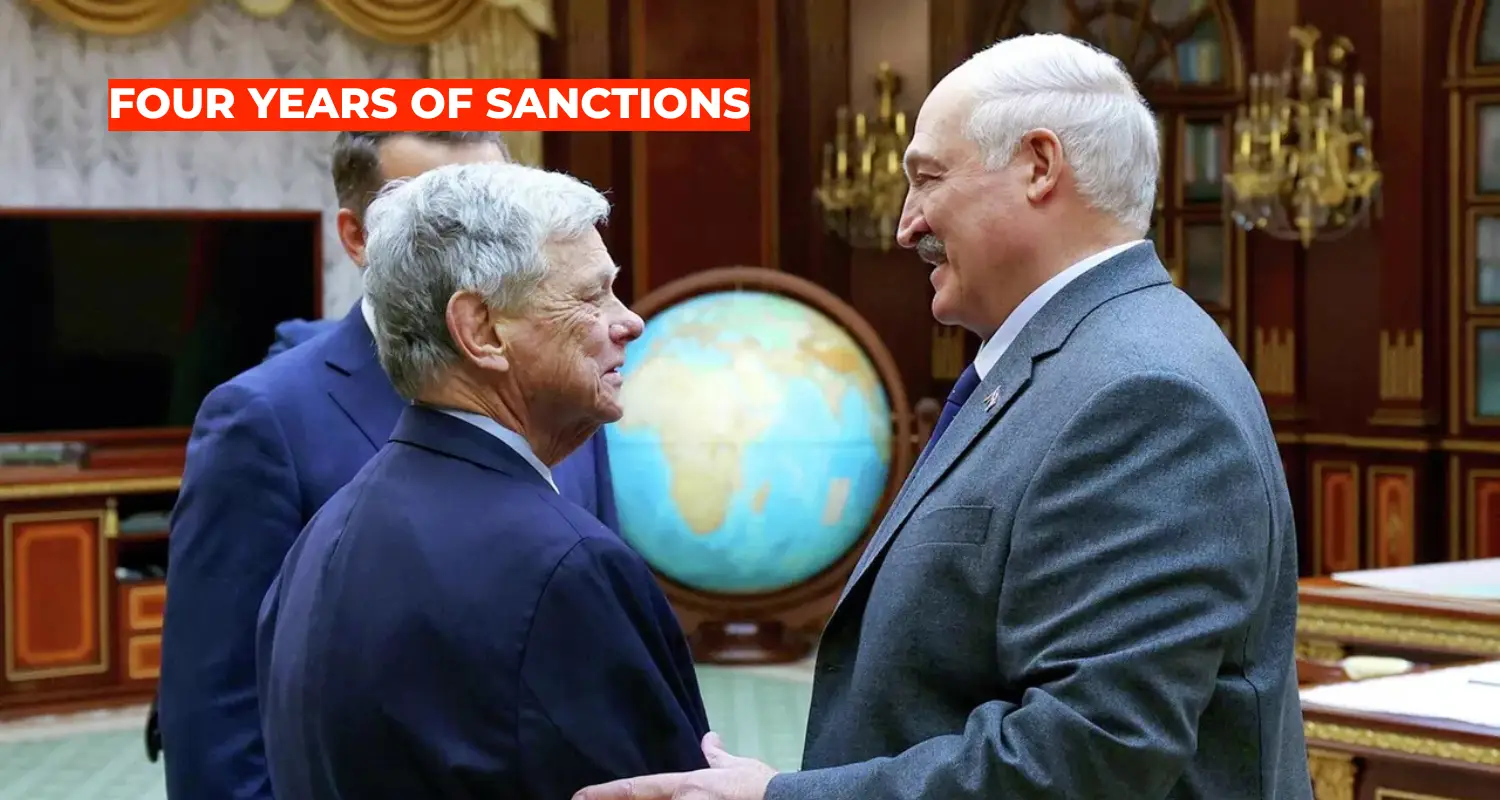
US President Donald Trump publicly called Aliaksandr Lukashenka his "friend" on Sunday, thanking the Belarusian dictator after a multi-country deal freed three Polish citizens from Belarusian detention and two Moldovans from Russian detention. Among those released was journalist Andrzej Poczobut, holder of the European Union's top human rights honor.
"Thank you to President Aliaksandr Lukashenka for his cooperation and friendship. So nice!" Trump wrote on Truth Social, crediting his Special Envoy John Coale.
The friendship language tracks a year-long pattern. Roughly 500 prisoners have walked out of Belarusian jails since the Trump administration opened talks with Minsk. Several rounds of US sanctions relief have put Belarus's state airline, potash giants, and most of its financial system back in the dollar economy — including, in March, a state bank that Belarusian defectors have documented as financing the 152mm artillery shells Russia fires at Ukraine.
The greeting also marks an escalation in tone. When Trump first called Lukashenka in August 2025 — only the second time in 31 years of his rule that the Belarusian leader had spoken to an American president — he described him as "the highly respected President." Nine months later, "highly respected" has become "friend."
Who walked out
Poczobut, a correspondent for the Polish newspaper Gazeta Wyborcza and a leader of Belarus's Polish minority, had been serving an eight-year sentence since 2021 on charges widely seen as politically motivated. He was awarded the Sakharov Prize, the EU's top human rights honor, while in prison. Polish Foreign Minister Radek Sikorski described him as a symbol of the Belarusian fight for freedom.
The deal also freed Grzegorz Gawel, a Carmelite friar from Kraków, and a Belarusian national who had worked with Polish intelligence services. Polish officials did not publicly identify the intelligence officer. Poland sent three people in the other direction as part of the arrangement, foreign-ministry officials told reporters. Two Moldovan citizens were released alongside them — from Russian, not Belarusian, prisons. That is the part of the announcement that suggests Lukashenka is now functioning as Moscow's broker as well as his own.
According to the human rights group Viasna, 848 political prisoners remained in Belarusian jails as of 7 May, before Sunday's release. New arrests continue: Viasna recognized 51 additional people as political prisoners in January 2026 alone.
The Hermitage archaeologist Ukraine wanted to try is back in Russia—Kyiv calls it a propaganda gift to Moscow
The White House offer
A meeting with Trump is on the table. Coale told the Financial Times in March that internal discussions about inviting Lukashenka to the White House or to Mar-a-Lago had been ongoing "for several months." Lukashenka himself said Trump had invited him to Florida. No date is set.
If it happens, it would be Lukashenka's first official US visit and a diplomatic prize the 71-year-old has chased for decades — particularly since the fraud-marred 2020 election that the previous Trump administration refused to recognize.
What three rounds did not touch
Since September 2025, the US and Belarus have engaged in a series of prisoner-for-sanctions exchanges in which Washington gradually eased sanctions in return for the release of political prisoners. None of the sanctions rollbacks have affected the Belarusian conduct most directly tied to the war in Ukraine.
Belarus still hosts Russian Shahed drone relays. President Volodymyr Zelenskyy, announcing Ukraine's February sanctions package against Lukashenka's inner circle, said the relays "correct and coordinate" attacks on Ukrainian energy infrastructure. Russian tactical nuclear weapons remain on Belarusian soil — the first such deployment outside Russia since the Cold War. In December 2025, Russia stationed its Oreshnik intermediate-range ballistic missile system at the Krichev-6 base in eastern Belarus, putting most of Europe within strike range from launchers under Russian command.
Trending Now
And then there is Belinvestbank.
The state bank, freed by US Treasury general license in March, has — according to an investigation by the Belarusian defectors group Belpol — provided loans to Belarusian state enterprises producing components for 152mm artillery shells and 122mm rockets. These are the rounds Russian forces use daily against Ukraine. The same bank, Belpol documented, finances Integral, a microelectronics maker whose chips have been pulled from Russian cruise missiles striking Ukrainian power infrastructure. It also finances a newer ammunition facility near Slutsk whose own loan records list Russia as the primary market.
“A direct investment in ammunition flying across the border”: Belarusian defectors warn US sanctions relief is funding Russia’s war
The charm offensive
Lithuania's defense ministry, in its 2026 annual threat assessment, concluded that Belarus uses prisoner releases to charm the West while continuing to act as a Russian instrument of intimidation against neighboring states. Sviatlana Tsikhanouskaya, the exiled opposition leader who won the 2020 election by every credible independent count and lost it by Lukashenka's official one, said in December that the dictator "hasn't changed his policies, his crackdown continues, and he keeps on supporting Russia's war against Ukraine."
The Carnegie Endowment's Belarus analysts noted after Trump's first call with Lukashenka that the Belarusian leader appears to be playing some sort of intermediary role between Trump and Putin — Coale himself said the US had used Lukashenka to convey messages to Moscow. Trump's August call came hours before his summit with Putin in Alaska. Sunday's deal — in which Moldovans walked out of Russian detention as part of a Lukashenka-brokered exchange — suggests the channel is still live.
What "friend" buys
Around 500 political prisoners were released over the past year. A Sakharov laureate at home with his family in Poland. These are real outcomes, and the Belarusian opposition has thanked the Coale team for the work.
Andrei Padniabenny and Valiantsin Shtermer will not be in the next batch. The two political prisoners died in Belarusian custody in 2025 of unknown causes, according to Human Rights Watch. Pastor Aleh Loika, still in prison, is in deteriorating health. The bank that funds the shells is back online.
So is the friendship.


