

Belarus released three Polish nationals and two Moldovans at the border on 28 April. Russia got back Alexander Butyagin, the archaeologist Ukraine had charged with looting Crimea—six weeks before he was due in a Ukrainian courtroom.
The five freed include Andrzej Poczobut, the Gazeta Wyborcza journalist held more than 1,800 days in Lukashenka's prisons, and Grzegorz Gaweł, a 27-year-old Polish Carmelite monk who faced up to 15 years on espionage charges over Belarus's Zapad-2025 nuclear war games. The five sent the other way include Alexander Butyagin, the Hermitage Museum archaeologist; Nina Popova, a Russian citizen Moldova said had been acting against it; and—from a parallel Moldova-Russia trade—a former deputy head of Moldova's intelligence service convicted of selling state secrets to the Belarusian KGB.
Poczobut: 1,800 days for "inciting ethnic hostility"

Poczobut, a Gazeta Wyborcza correspondent and a leading voice for Belarus's Polish minority, was arrested in March 2021 amid the crackdown that followed the 2020 protests. A court sentenced him to eight years in 2023 for "inciting ethnic hostility" and "undermining national security"—charges Poland, the EU, and human rights groups called politically motivated. The European Parliament awarded him the 2025 Sakharov Prize.
"Andrzej Poczobut is free! Welcome to your Polish home, my friend", Polish Prime Minister Donald Tusk wrote on X.
He called the swap "the finale of a two-year-long intricate diplomatic game, full of dramatic twists" and credited Polish services, diplomats, and prosecutors "as well as the tremendous help from our American, Romanian, and Moldovan friends."
Gaweł: a monk, the KGB, and the Zapad-2025 nuclear war games

Belarusian KGB officers detained Gaweł, a Krakow-based Carmelite monk who had taken his perpetual vows just months earlier, in the town of Lepel on 4 September 2025. State television aired footage of the arrest and accused him of obtaining a copy of a classified document about "Zapad-2025"—the joint Russian-Belarusian exercises that include the Russian nuclear weapons now stationed on Belarusian soil. He was charged under Article 358, which carries up to 15 years; because the alleged material concerned nuclear deployments, human rights groups raised the prospect that the death penalty was theoretically available. He had been held incommunicado, without confirmed access to a lawyer or to Polish consular staff. Belarus's Viasna human rights centre recognised him as a political prisoner. Polish authorities called the case a fabricated provocation.
Ukraine criticizes release of Butyagin
Butyagin headed the Hermitage Museum's Northern Black Sea Region Classical Archaeology Sector. From 2014 onward—after Russia annexed Crimea—he led the Myrmekion expedition near Kerch every year, digs Ukrainian prosecutors say lacked permits from Kyiv. His teams stripped roughly two metres of the cultural layer at the site: the stratified soil that holds artefacts and evidence of ancient habitation. Ukraine's Security Service estimated the damage at over $4.8 million.
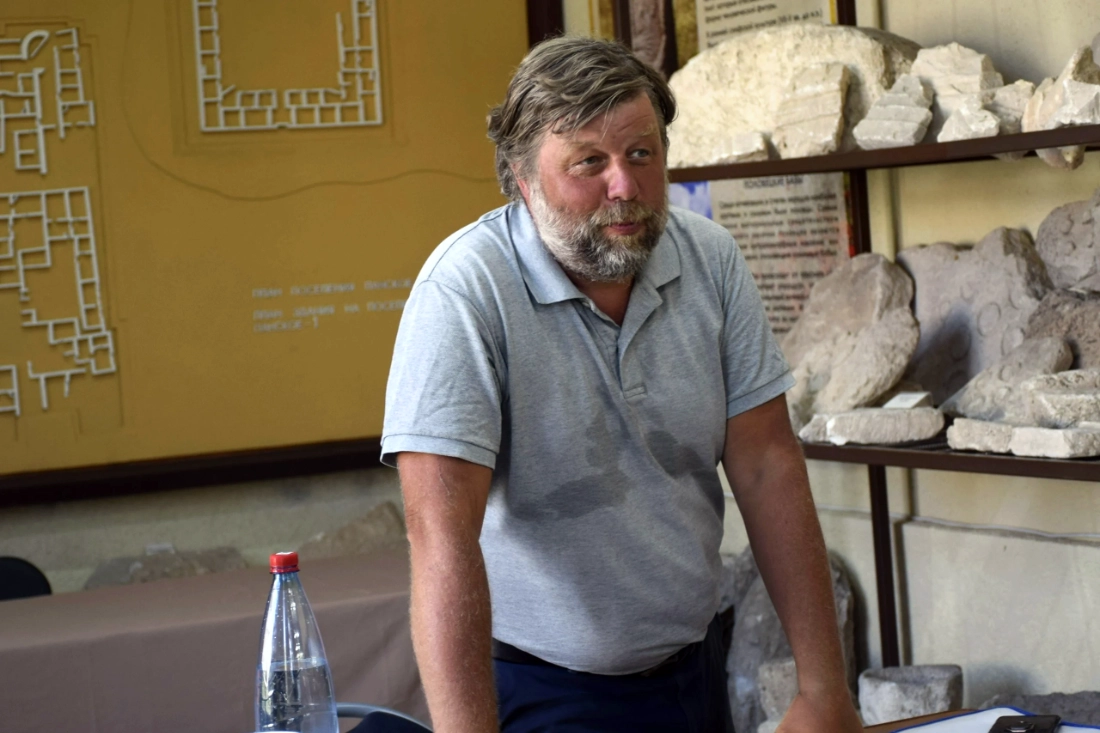
Poland extends detention of Hermitage archaeologist wanted by Ukraine for Crimea looting
Polish security agents detained him at a Warsaw hotel in December 2025 as he passed through after a lecture in the Netherlands. The Warsaw District Court approved his extradition to Ukraine on 18 March. Ukraine's Foreign Ministry welcomed the ruling. His lawyer appealed.
Ukraine reacted with regret to the decision of Poland to release Butyagin.
"Ukraine has learned with regret that, despite a previous entirely fair ruling by a Polish court, Russian citizen Alexander Butyagin, who is reasonably suspected of committing a crime on Ukrainian territory—in particular, removing cultural valuables from Crimea—was ultimately not extradited to Ukraine," Foreign Ministry spokesman Heorhii Tykhyi told journalists.
"It is obvious that the Russian side will cynically use this political and legal episode to justify the occupation of Crimea and the exploitation of Ukraine's temporarily occupied territory by Russian citizens," Tykhyi added.
Butyagin is far from a unique case. A May 2025 human rights report identified seven Hermitage employees conducting unauthorised excavations across occupied Crimea, including at the UNESCO site of Chersonesos and the Genoese fortress at Balaklava. Russia's Foreign Ministry called the case against Butyagin "absurd" and demanded his return.
Trending Now
A second trade sends a former Moldovan intelligence chief to Belarus
Running alongside the Polish-Belarusian exchange was a parallel two-for-two trade. Two officers of Moldova's Intelligence and Security Service (SIS), held in Russia, came home. In return, President Maia Sandu pardoned Alexandru Bălan, a former deputy SIS director extradited from Romania to Moldova in April and convicted of treason for selling state secrets to the Belarusian KGB. Bălan is now on his way to Belarus. From 2016 to 2019—before he was allegedly recruited—he had served as Moldova's liaison officer at Ukraine's General Staff.
Romanian prosecutors had separately charged Bălan with meeting Belarusian intelligence officers in Budapest in 2024 and 2025, part of what the Czech intelligence service BIS describes as a Belarusian KGB network running through central Europe.
The fifth person sent east was Nina Popova, a Russian citizen Sandu said had been "acting against the Republic of Moldova." Russia's FSB confirmed her release alongside Butyagin's and described her as the wife of a Russian soldier serving with Moscow's forces in Transnistria—the breakaway sliver of Moldova where Russian troops have been stationed since 1992.
"For our country this is a gain that cannot be measured by a simple mathematical equation," Sandu wrote. "We brought home two citizens who work for the Republic of Moldova, in exchange for two detainees who worked against it."
Five Coale swaps in a year. Each paired with US sanctions relief.

This is at least the fifth Belarus swap Trump's special envoy John Coale has brokered with Lukashenka in twelve months. Each was paired with a US sanctions concession or a step toward normalisation.
Coale framed today's deal as evidence "we are not always at war, as the world thinks." He said in a statement on X that the United States would not stop "until we get every last one" of the roughly 800 to 900 political prisoners still held in Belarus, and thanked Lukashenka for his "willingness to pursue constructive engagement with the United States."
It remains to be seen whether any sanctions are going to be lifted as part of this prisoner swap.
The Lukashenka regime is still arresting dissidents
The broader pattern is hard to ignore. While individual prisoners regain their freedom, the system that put them behind bars remains firmly in place. Belarus continues to host Russian forces and missile systems, and arrests of regime critics have not stopped.
Human rights groups report hundreds still imprisoned on political charges, with new sentences handed down even as high-profile swaps unfold. For Lukashenka, these exchanges appear less a sign of change than a calculated tool—trading human lives for diplomatic concessions while maintaining the same repressive course at home and strategic alignment with Moscow.
Read also
-
“Now it’s your turn”: US envoys planned to show Moscow a refinery pause and a diesel deal, then ask for something back, a source tells Reuters
-
“A warning to companies that remain”: Russia takes control of Nestlé and Auchan’s assets – companies that stayed in Russia following the full-scale invasion of Ukraine
-
“I can travel back to Finland and be safe. That is a luxury”: Sanna Marin on the Russian strike that stopped her train from Kyiv


