
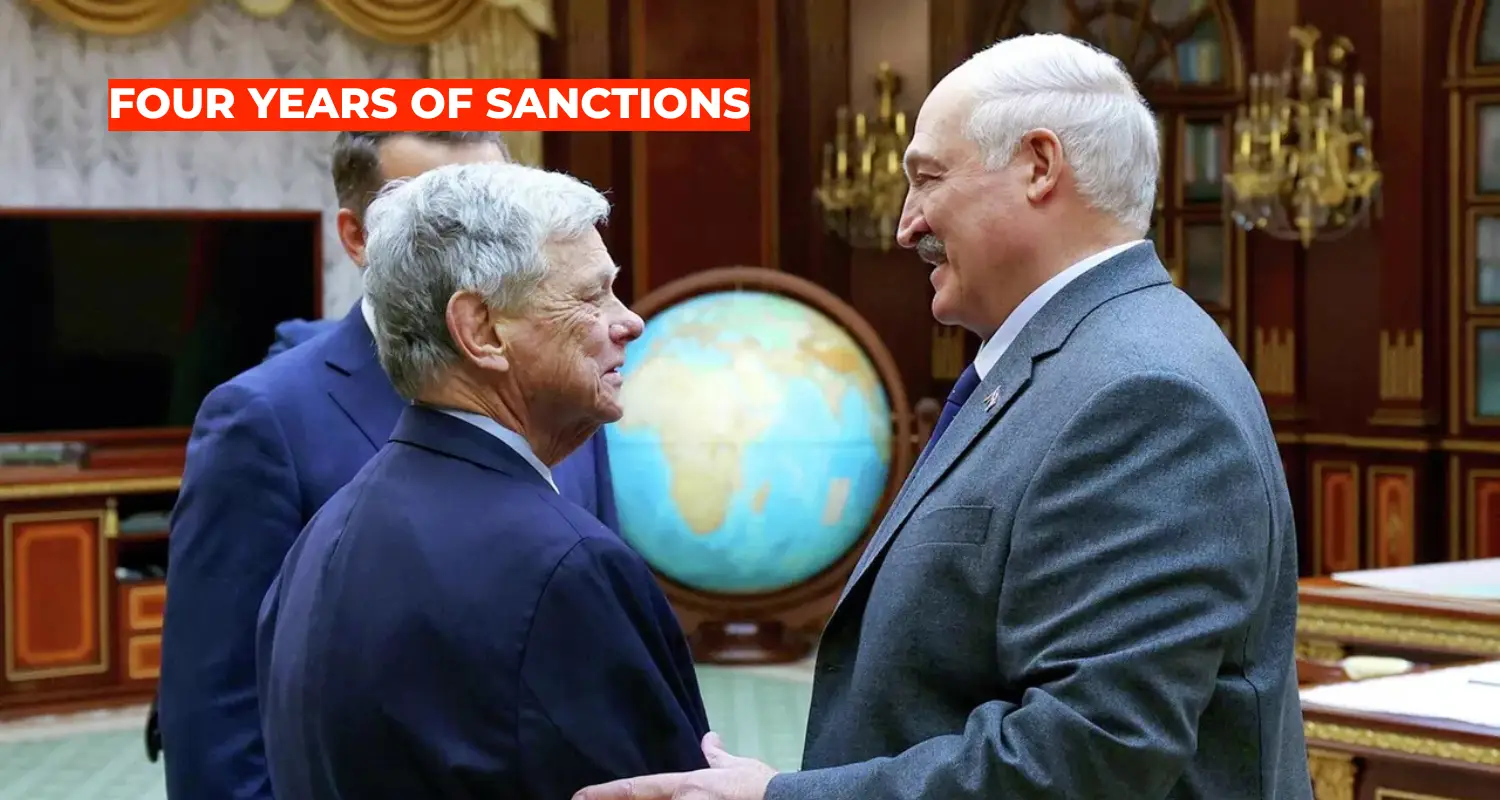

Every time that the Lukashenka regime releases some of its many hundreds political prisoners, we witness scenes of jubiliation, of course. In Belarus, you can land in prison for decades just for carrying the wrong flag or poster.
But we rarely hear about the other side of the coin, the hidden costs of the US making such deals with the Belarusian dictator, who has already been in power for more than 30 years. All of such deals are based on a cynical bribe of the regime, namely the softening of the sanctions in return for geopolitical influence.
Since September, the US has four times softening its sanctions against Belarus, the latest round was on 28 April.
Today, in exclusive interviews with Euromaidan Press, Belpol, a group of former Belarusian security officers who defected after the 2020 crackdown, explains that sanctions relief "is a direct investment in the production of ammunition flying across the border." Lukashenka is getting back the financial tools he needs to sustain both his own system—and his contribution to Russia’s war effort.
Read our four years of sanctions series
-
“Now it’s your turn”: US envoys planned to show Moscow a refinery pause and a diesel deal, then ask for something back, a source tells Reuters
-
“A warning to companies that remain”: Russia takes control of Nestlé and Auchan’s assets – companies that stayed in Russia following the full-scale invasion of Ukraine
-
“I can travel back to Finland and be safe. That is a luxury”: Sanna Marin on the Russian strike that stopped her train from Kyiv
What has been lifted, and when
In September 2025, Washington lifted sanctions on the Belarusian state airline Belavia. Minsk released 52 political prisoners. Trump's envoy John Coale, during his first trip to Minsk, told reporters that Washington wanted to "normalize relations" and that the move was "only the beginning."
In December 2025, the US granted limited sanctions relief to three Belarusian potash producers. Belarus released 123 prisoners, including Nobel Peace Prize laureate Ales Bialiatski, opposition figure Maria Kalesnikava, and former presidential candidate Viktar Babaryka.

Potash, a potassium-based fertiliser, is one of Belarus’s most important exports. Belarus produces around 20% of the global production of potash. Before sanctions, it generated three billions in revenue - amounting to no less than 4% of GDP - and was shipped through the Lithuanian port of Klaipėda on the Baltic Sea. With the sanctions, That route was cut off in 2022, forcing Belarus to rely on longer, more expensive routes through Russian ports.

Potash: the irreplaceable mineral behind Belarus’s prisoner deals
In March 2026, the biggest round yet: the US Treasury's Office of Foreign Assets Control fully removed Belaruskali, the Belarusian Potash Company, and their Ukrainian subsidiary Agrorozkvit from the sanctions list, and authorized transactions with Belinvestbank and its affiliates. The Development Bank of Belarus and the Belarusian Finance Ministry came off the sanctions list as well. Minsk released 250 prisoners, including journalist Katsyaryna Andreyeva.
Trump's envoy John Coale called it "a significant humanitarian milestone." Belarusian self-proclaimed president Aliaksandr Lukashenka called it part of a "big deal" still being negotiated, which he said may include a $3 billion mine sale to US investors and a visit to Washington.

250 Belarusians freed after Washington lifts sanctions on banks and potash – regime calls it “humanitarian”
Roughly 838 political prisoners remain behind bars in Belarus, according to human rights group Viasna. New arrests continue.
What Lukashenka gains
Igor Kuley, a journalist with the Belarusian Investigative Center, told Euromaidan Press the regime's gains come on several tracks at once.
The first is diplomatic: the restoration of Lukashenka as someone Washington talks to. After five years of near-total isolation following the fraudulent 2020 election, the self-proclaimed president is again receiving US envoys, proposing bilateral deals, and being quoted in the American press.
Each round reinforces that pattern. Kuley describes the US approach as a deliberate drip-feed:
"The lifting of sanctions is like a part of a puzzle. The US wants to stay in the negotiation process so that Lukashenka doesn't get everything all at once and wouldn't lose his interest in further negotiations."
The second track is operational. A team member from Belpol, a group of former Belarusian security officers who defected after the 2020 crackdown, explained in a written interview with Euromaidan Press that removing restrictions on the Finance Ministry and state banks frees resources the regime previously spent on grey-scheme workarounds.
"Huge expenses on circumvention manoeuvres in settlements" disappear, the Belpol representative wrote; the released capacity then goes to "both its own survival and help to the partner-neighbour — the Russian Federation, which is solving its tasks on our territory, including military ones."
The third track is export revenue. The US removal of Belaruskali and the Belarusian Potash Company from the sanctions list does not automatically restore Belarus's largest pre-war export outlet — EU sanctions remain in force, and Lithuania has not reopened the port of Klaipėda — but it changes the economics of trade with buyers in Brazil, China, and India.
Those countries are already Belarus's biggest remaining customers, but have extracted steep discounts over the past three years as compensation for secondary-sanctions risk. With that risk gone, Belpol argues, the discounts vanish.

Kuley notes that transhipment through Russian ports such as St. Petersburg and Ust-Luga still eats up "almost all the profit" because of distance and what he called corruption in Russian ports; nitrogen fertiliser trade through these routes, he said, has been running at an overall loss.
However, Belpol emphasizes that the price recovery more than covers the higher transport costs. The RFE/RL assessment of the March round reached a similar conclusion to Belpol: US markets are only theoretically open to Belarusian potash, but existing buyers can now pay market price.
The bank that helps finance Russia's shells
One of the institutions benefiting from sanctions relief is Belinvestbank—a state bank now able to operate with far fewer restrictions after being covered by a US Treasury general license in March. According to an investigation by Belpol, the bank plays a direct role in financing companies linked to Russia’s war effort.
It has provided loans to Belarusian state enterprises producing components for 152mm artillery shells and 122mm rockets—the same types of munitions Russian forces use daily against Ukraine.
Trending Now
Belpol says a Belarusian government document lists multiple companies receiving this financing. Among them are industrial firms such as Legmash, the Minsk Bearing Plant, and the Minsk Tractor Works. The document reportedly details both the scale of funding and how it is distributed.

The bank is also linked to a newer ammunition facility near the town of Slutsk, whose primary market, according to its own loan records, is Russia. In addition, Belinvestbank finances the microelectronics company Integral, a supplier to dozens of Russian defence enterprises. Chips produced by Integral have been found in Russian cruise missiles used in strikes on Ukrainian infrastructure.
Kuley framed what the bank's delisting means for Ukrainian targets:
"The lifting of these sanctions against Belinvestbank would make it easier for Belarus to make payments for certain components. Belarus is very engaged in providing weapons to Russia."
The Odesa scenario
Since Lithuania shut down transit through the Baltic port of Klaipėda in 2022, Belarus has been forced to reroute shipments through Russian ports—an option that is slower, more expensive, and far less profitable. Finding an alternative has become a priority for Minsk—and increasingly, for Washington as well.

US envoy John Coale has urged Lithuania to reopen talks with Aliaksandr Lukashenka and restore transit. Vilnius has refused.
A second option is being floated quietly: transit through the Ukrainian Black Sea port of Odesa. Kuley told Euromaidan Press he considers the possibility real:
"It wouldn't be difficult for the Americans to agree with the Ukrainians for transhipment to go through, say, the port of Odesa. Everyone would be interested in this, especially if, as rumours say, the Americans acquire Nezhinsky GOK — the second-largest potash enterprise in Belarus."
Lithuanian analyst Vytis Jurkonis reached the same conclusion in December, telling LRT that Odesa transit could align US, Belarusian, and Ukrainian interests — revenue for Kyiv, an American stake in port security, an export outlet for Minsk.
What makes it far-fetched is the politics, not the geography. Ukraine spent February 2026 expanding sanctions on Lukashenka and his inner circle over Belarus's role hosting Russian Shahed drone relays used to strike Ukrainian cities. Asking Kyiv to open its largest Black Sea port to the same regime's fertiliser exports would be a reversal.
Ukraine has not indicated it is considering it. The question is whether it will be asked to.
Lukashenka still firmly on Russia’s side
Nothing in the three rounds of relief has touched the elements of Belarusian policy that actually affect Ukraine on the battlefield.
Belarus still hosts Russian Shahed drone relays. President Volodymyr Zelenskyy, announcing Ukraine's February sanctions package, said these relays "correct and coordinate attacks" on Ukrainian energy infrastructure and civilian targets. Russia deployed the Oreshnik intermediate-range missile system on Belarusian soil in November 2025. Belarusian territory continues to host Russian tactical nuclear warheads, the first such deployment outside Russia since the Cold War.
The Lithuanian Defence Ministry's 2026 annual threat assessment concluded that Belarus uses prisoner releases to charm the West while acting as a Russian tool of intimidation against European states. Sviatlana Tsikhanouskaya, the exiled opposition leader, told the AP after the December round that Lukashenka "hasn't changed his policies, his crackdown continues, and he keeps on supporting Russia's war against Ukraine."
What this means for Ukraine
The US strategy appears to be based on a simple calculation: limited concessions can produce tangible humanitarian results. Prisoner releases are politically visible, immediate, and measurable. Sanctions relief is gradual and reversible. By keeping the process incremental, Washington may hope to maintain leverage over Minsk and prevent Belarus from moving even closer to Moscow. But the approach also carries risks.
A Belarusian state bank documented as funding shell and missile-component production can now clear dollar transactions without compliance friction. Components from Southeast Asia needed for drone guidance systems become cheaper to procure. A state whose territory Russia uses as a launchpad for daily strikes on Ukraine gains renewed hard currency. The Finance Ministry, no longer under US restrictions, can allocate that currency without detours.
Each round of sanction relief signals to Minsk — and to Moscow — that the strategy of trading prisoners for resources works, and that incremental concessions can extract progressively larger packages. The Belpol representative described what this means operationally:
"Access to finance allows faster modernisation of the shops of Belarusian factories, where chassis for Russian missile systems are assembled. The Ministry of Finance gets the chance to patch budget holes without cutting spending on the punitive apparatus and logistical support for Russian troops."
The people freed in recent months should never have been jailed. Their release is real and significant. But so is the trade behind it.
With each round of sanctions relief, Belarus regains part of the financial system it needs to function—and to support Russia’s war. The fighting hasn’t changed. What has changed is how easy it is to finance it.


