

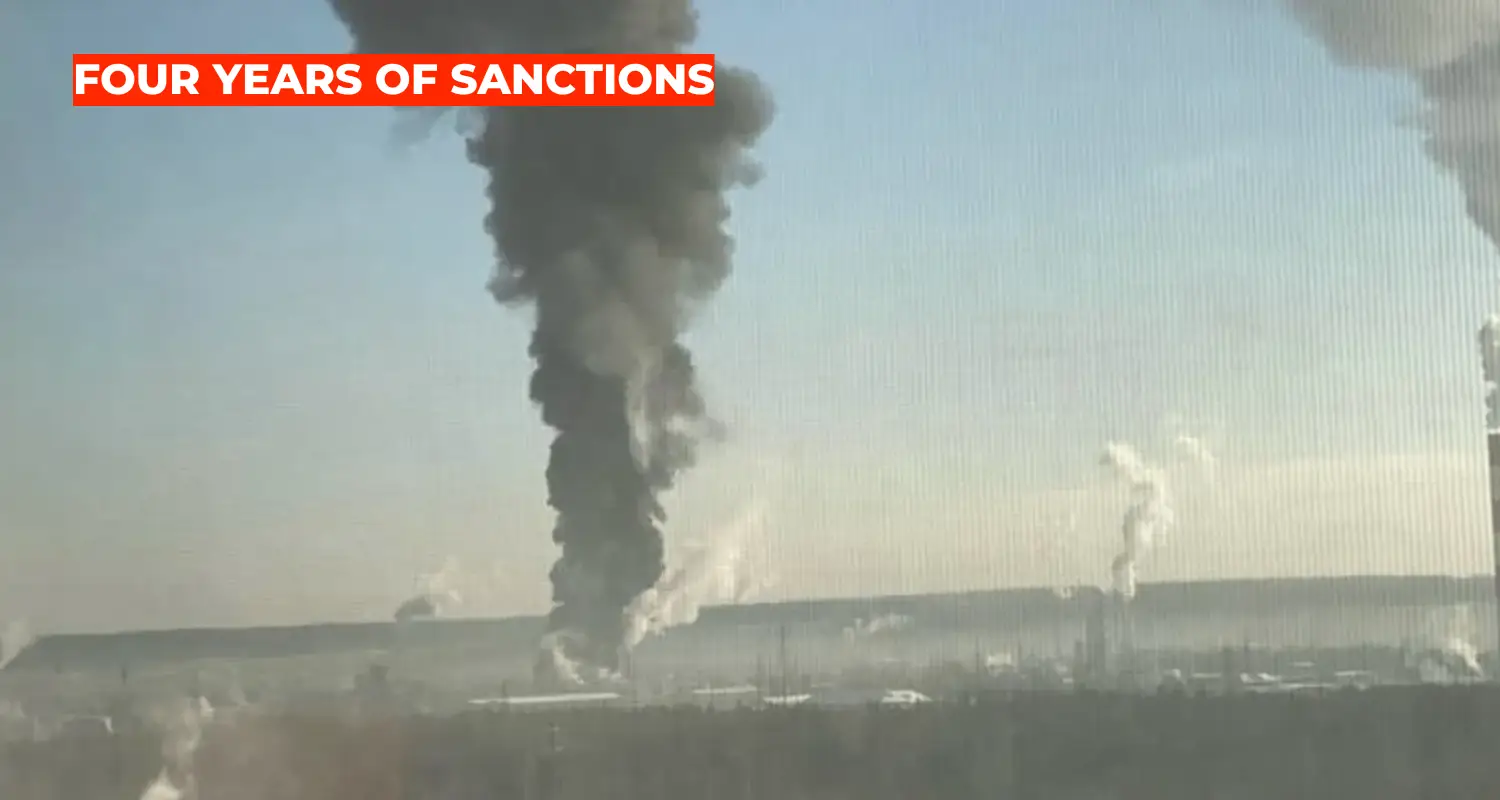
Washington shattered Transatlantic unity, caused an indefinite global oil and gas shortage, then waived crude oil sanctions on Russia. This is great news for Moscow’s war machine.
The Europeans appear to be holding the line, last week imposing a 20th sanctions package, targeting Russian oil, banks, military industry, and trade. However, there is evidence these measures were watered down. There are still loopholes and enforcement gaps big enough to drive a shadow fleet through, civil society monitors, EU officials, and former diplomats say.
With the Kremlin constantly figuring out ways to evade sanctions, while trying to divide allies and chip away at their united front, this year is a critical point for the ability of sanction-imposing countries to keep Russia’s economy suppressed.
While experts said there is still enough political will to go after Russia, it is now civil society, journalists, and other investigators that have the growing burden of uncovering and pointing out Russian entities and their foreign counterparties for sanctions to be applied.
“We have a situation when we have to fight for existing sanctions (instead of fighting) to increase them,” said Olena Pavlenko, president of Ukrainian think tank DiXi Group.
"I have to say… that Ukrainian attacks on Russian refineries have had more impact on Russian profits in the oil and gas sector than (Western) sanctions, which I think effectively means that the sanctions regime is still quite weak."
Washington’s waivers
Earlier this month, the US Department of the Treasury's Office of Foreign Assets Control (OFAC) extended for another month an existing sanctions waiver of Urals crude oil volumes already on the high seas. This went against what US Treasury Secretary Scott Bessent had said 48 hours previously — that the administration of US President Donald Trump would not do an extension.
“Their comments and actions are so erratic as to not add up to a coherent or predictable policy,” said Bennett Freeman, a former US Deputy Assistant Secretary of State and co-founder of the advocacy organization Business4Ukraine. "I hate to impute motives, but it's clear that the overriding motive is personal and political."

He believes that US sanctions on Russia are unlikely to be lifted wholesale, as in spite of Trump’s public comments, there is sufficient desire among Democrats and some non-MAGA Republicans to keep the pressure on. Indeed, the US has, over the past several months, stopped and arrested some Russian vessels.
Nevertheless, the fracturing of the united Transatlantic front makes enforcement harder and harder. Pavlenko pointed out that smaller countries take cues from bigger ones on when to crack down on Russian ships.
“That's where we have a big bottleneck because a lot of times everyone has relied on the US for enforcement,” said Valeriya Melnichuk, an international strategy consultant.
Whether or not Moscow’s economic lifetime is allowed to expire in May, “the bigger concern is the long term impact that this Russia sanctions waiver by the White House has on the overall efficacy of the Transatlantic sanctions infrastructure,” said Benjamin Schmitt, a senior fellow at the University of Pennsylvania.
“Any creation of loopholes in this increasingly restrictive sanctions regime put in place by Transatlantic democracies can undermine alliance cohesion to hold Russia to account for the humanitarian misery it is inflicting on the Ukrainian people.”
EU’s 20th sanctions package
Last week, the EU announced its 20th sanctions package on Russia, delayed by opposition from the recently outvoted former Hungarian Prime Minister Viktor Orban. The announcement included 36 designations on Russia's oil sector, including “exploration, extraction, refining, and transportation,” including “emerging players.”
Another 46 vessels are now banned from accessing ports and maritime services, bringing the total number to 632. There are mandatory due diligence checks on tankers and bans on transactions with Russian ports at Murmansk and Tuapse.

EU’s 20th sanctions package hits 20 Russian banks, 46 shadow fleet tankers, and crypto platforms
The package also prohibits dealing with 20 Russian banks and four financial institutions in other countries, including a Kyrgyzstan platform where Kremlin-backed stablecoin A7A5 is traded. The EU tightened restrictions on Russian crypto asset providers.
Furthermore, the package designated 58 military-industrial entities in Russia and 16 entities in China, United Arab Emirates, Uzbekistan, Kazakhstan, and Belarus. Another 60 entities are "subject to tighter export restrictions” on goods that can be used for the military.

Finally, the EU banned the export of computer numerical control machines and radios to Kyrgyzstan, which Russia often uses as a middleman, and imposed import restrictions on some metals and minerals.
“Russia’s war economy is under growing strain, while Ukraine is getting a major boost. We must keep up this pressure until Putin understands his war leads nowhere,” Kaja Kallas, High Representative for Foreign Affairs, said in a statement.
Reductions and shortcomings
While acknowledging these steps, Ukrainian civil society disputed the EU’s description of the sanctions as far-reaching and “strategic.”
DiXi Group head Pavlenko referred to the package as a “very tactical decision” meant to minimize harm for European companies. Hanna Hopko, a former MP in Ukraine’s parliament, now a civil society leader, said there’s a “lack of strategy” for the future of Russia among European allies, adding that the sanctions policy is “very fragmented” and “incremental.”
There are signs that the provisions were softened. For example, Brussels was looking to impose a maritime service ban on all Russian oil products, which would lock Russian vessels out of the EU. Instead, the 20th package requires prior agreements in the G7, as well as a coalition consisting of the G7 countries, EU member states, and Australia for this step to be implemented.
Trending Now
Also, while the package targets Kyrgyzstan, the original draft reportedly listed companies in other countries, including Georgia and Armenia. These were removed from the final version.

A high-ranking EU official who works on sanctions policy told Euromaidan Press that sanctions announcements are regularly more flash than substance.
"Often the politicians and EU ambassadors frustrate us, the people who work in the commission and actually have to formulate the sanctions,” said the official, speaking on condition of anonymity because they are not authorized to talk to the press.
“Often the politicians just agree at the surface level, but do not discuss the details, the steps of implementation of the sanctions. Are they at all feasible? And that is one of the reasons why often the sanctions do not work — they are just headlines on an EU communique."
Still, EU countries have stopped some Russian vessels at sea. The UK has done little with enforcement. In March, Prime Minister Keir Starmer announced that sanctioned Russian tankers, which regularly move through UK waters, would be boarded. Around 300 shadow fleet vessels reportedly transited in or near the UK between January and March 2026, in spite of Starmer’s earlier vows to take action.
While some Russian vessels altered course after the March announcement, Russian vessels are still going through the Dover Strait, escorted by Russian warships. So far, no boarding actions have taken place.
“It's not like ‘we’re gonna stop the Russian shadow fleet and do it.’ No, no, no,” Hopko said. “Like the UK recently. There was a very PR announcement by politicians, but naval forces never stopped any undeclared ships.”
Divide and conquer
Sanctions work when there is a united front between countries applying and enforcing them. Freeman, the former diplomat, expects the US to remain a major source of unpredictability under the Trump administration. This is a problem as the US is by far the biggest economy, with the most outsized impact, and the greatest ability to enforce.
But even setting Washington to one side, there are cracks and reluctance among other allied states to penalize Russia, especially in the atmosphere of a global energy crunch. Many countries are reluctant to hurt their own companies and domestic consumers. Within the EU, states have different levels of concern about Moscow.
“I think there's still political will, but it is a question of how the elections are going to go in France, in the UK, in Italy in the next few years,” Melnichuk said. “So, we are going to have this dwindling attention.”
“The issue is that the Russian threat is perceived differently in different member states of the EU,” Hopko added. “Belgium, which is the second largest buyer of Russian LNG, is sitting on almost 200 billion euros in Russian sovereign assets.”
Even in France and Germany, which signed strategic partnerships with Ukraine, Russia has a reach, especially in the nuclear sector. For example, France’s Framatome hopes to produce nuclear fuel in Germany based on Russia’s Rosatom license. Rosatom is a lever for Russia to acquire sensitive technology, multiple Russia analysts say.
“It's an elephant in the room because everyone in among Western countries, EU and US, are afraid to touch the nuclear topic,” Pavlenko said. “Russia is using Rosatom and other nuclear companies to bypass sanctions.”

Russia’s nuclear sector remains unsanctioned, helping turn Ukraine’s nuclear sites into war zones – Zelenskyy
All of this is in line with Russia’s well-practiced strategy of dividing and conquering geopolitically — playing states against each other, using their special interests and dependencies within the political and business spheres. And where bribes fall short, they threaten, Hopko said.
“They are threatening, showing some cases where people were assassinated. Remember the Russian drones near the Belgian airports. They are signaling that, look, if you dare to attack us… we know your vulnerable points that we will use to attack you.”

Growing need for independent research and advocacy
Multiple observers agree that civil society, researchers, and journalists will have a bigger role to play in discovering which Russian and foreign entities need to be sanctioned. Sometimes allies cannot keep up and at other times, they’re willing to sweep problems under the rug, unless they are widely publicized.
“It's a challenge to keep up and stay ahead and that's what we're trying to do to the extent possible for Ukraine. How do you do that? Through basic research,” Freeman said.
Melnichuk added that investigations must be combined with political campaigns and diplomatic pressure.
“And then also picking our battles and picking what sectors we have under-investigated or have been underexplored — for example the financial sector… there's still room for maneuvering there in terms of what more can be done with crypto payment systems, what do we do about gold.”
“So maybe now (it’s a matter of) being more strategic about what the pressure points are. Not the information we have to go after the companies that we have knowledge of, but rather what will be the most disruptive action.”


