

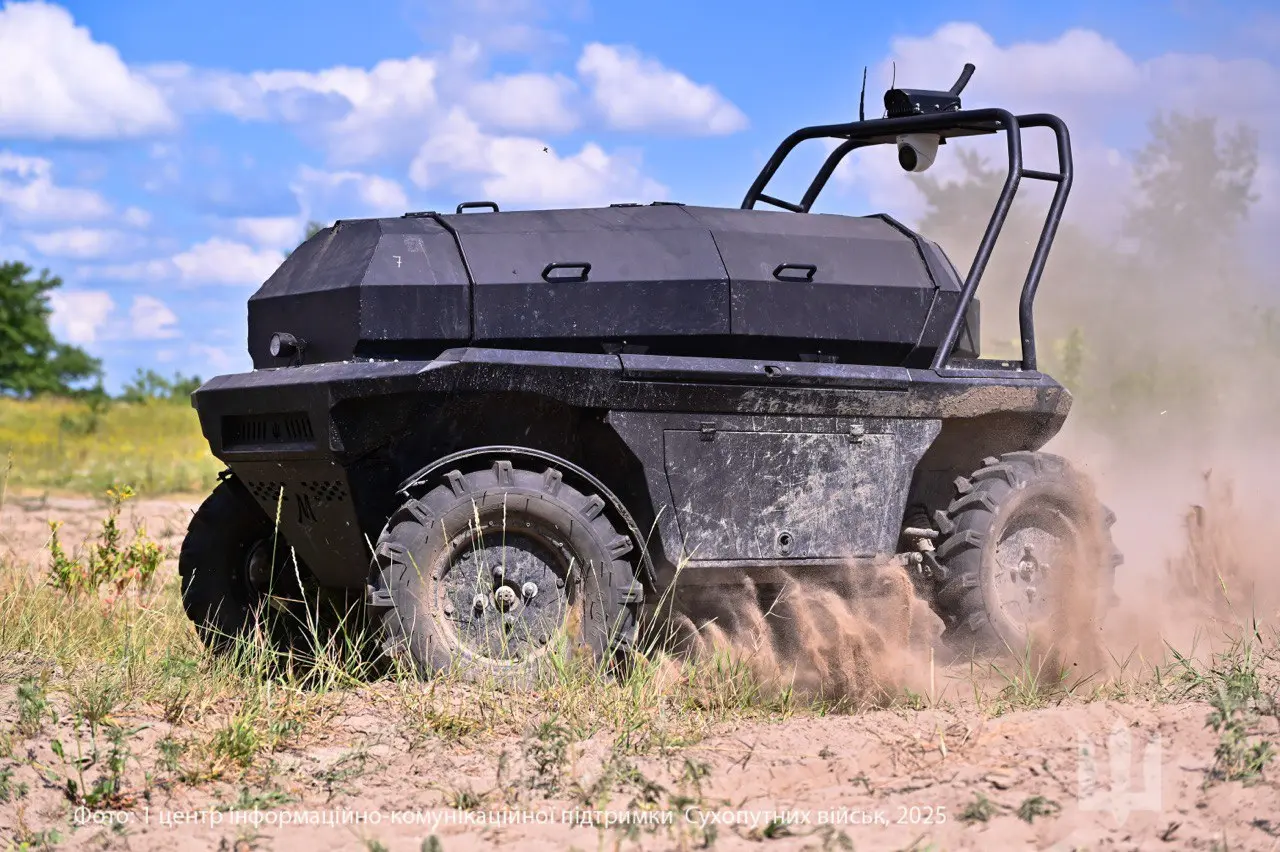
Evacuating the wounded from the front lines presents a serious and persistent problem when Russian FPV drones are in the sky. Uncrewed Ground Vehicles, conventional vehicles, and basic manpower all have notable drawbacks on modern Ukrainian battlefields.
It’s why Ukrainian forces are testing new approaches, like a multicopter UAV. TSN journalist Yulia Kyriienko posted the video of the test on her Telegram channel. It shows a heavy, six-propeller drone with a stretcher mounted on the stand underneath. It lifts a man playing the role of a wounded soldier into the air, then sets down again.
Kyriienko wrote that the tech is being explored as an alternative when there is a shortage of UGVs available for casualty evacuation (casevac).
Ukrainian service members who spoke to Euromaidan Press ultimately judged it to be a niche solution: fine to have as an option but unlikely to be a mainstay. A flier of that size would need serious air cover from Russian FPV drones to complete its missions, not unlike the uncrewed ground vehicles it would be replacing. It’d also be vulnerable to enemy and friendly small-arms fire and the weather.
"Today, the lifespan of the Vampire (Ukraine's premier heavy bomber UAV) is about 10 flights,” said Callsign Electric, a drone expert with the 93rd Brigade. “How long will this thing survive, with a person on board?”
Andrei Kushniarou, commander of the 108th Battalion DaVinci Wolves said that trying to use UAVs in this role is “quite logical. But it's unlikely to become widespread, given their vulnerability to FPV drones. As an additional option, it's fine. As a serious solution, no.”
The search for a “serious solution” for casevac has dogged Ukrainian forces and defense developers for years, and is especially visible in the attempt to find it in UGVs.
Trapped and wounded on the front line
It could take days, weeks, and sometimes months to get someone out of a forward position, especially if they cannot move, according to multiple testimonials from service members. Food and water can be delivered by Vampire-class drones, but otherwise, the wounded are left to live or die by the grace of luck and the care of their brothers in arms until a window of opportunity appears.
"It all depends on the situation, the environment, the location, the evacuation. There are cases where the wounded wait weeks and even months for evacuation," Electric said. "They're there with no end in sight."
Sometimes they make it. At other times, nothing else works and they’re killed or succumb while trying to escape.
The drone kill zone often stretches for at least a dozen kilometers away from what Ukrainians call the zero line. The ubiquity of FPVs has gradually whittled away at older methods: military vehicles or civilian vehicles pressed into military service. The enemy will spot them and blow them up with repeated attacks from the air. Dragging people out by hand comes with its own problems, especially if injuries are severe enough.

As a result, Ukrainians have increasingly turned to UGVs, the fastest-growing, soil-hugging swiss army knife of the full-scale invasion. UGVs existed before 2022 but have only started seeing mass adoption in 2026, soldiers told Euromaidan Press.
Most of them are configurable wheeled or tracked platforms. While modular designs are in vogue and Ukrainian forces are increasingly mounting weapons and UAV launch cradles on their ground robots, the large majority are still being used for logistics: mobile metal boxes that can get in and out of a combat zone without putting a human life in danger.
The vast majority of UGVs used for casevac are specced for logistics tasks. Logistics UGVs are the primary growth driver of the uncrewed ground market segment, growing by 556% in 2026, according to the Kyiv School of Economics.
Logistics machines are helpful and have successfully evacuated many wounded people. The one dedicated evacuation ground robot Ukraine uses is the Maul, which has dozens of successful missions under its belt. It has a coffin-shaped armored capsule in which to put the wounded.
However, Kushniarou said they all come with problems, adding that Ukraine still lacks UGVs that could be called casevac systems with an entirely straight face.
No dedicated casevac
“Imagine you are wounded, for example your leg is messed up. And you have to lie in just a metal box. You can't even align (your body) to this metal box in your armor vest,” he said. “You can’t lie in this box without moving your legs when they have to be elevated. Especially if you’re alone, you’re wounded, it could be a problem.”
Most metal boxes come with no protection. Often, they might require for a soldier to lie on their back, which can be a choking hazard if the soldier vomits, Kushniarou said. Also, depending on the size of the person and the UGV, the box can be too small.
Trending Now
“I have two guys in my unit who just physically don’t fit into the box,” he added.
Soldiers said that evacuation platforms are usually jury-rigged together onto logistics UGV, with Electric saying that these mods are performed by the units themselves as a general rule. That could include features for additional comfort.

Olexiy Severyn, Commercial Director for Ukrainian Unmanned Technologies, which makes the big, modular Ravlyk UGV, spoke about his company’s own difficulties with trying to design a casevac platform to mount onto their machine. The evacuations the Ravlyk has managed to carry out were done inside the box, or on a towed attachment.
“We were working on a kind of a capsule where the wounded soldier can be placed,” Severyn said. “If he is unconscious, okay. But this will be another battle for him if he’s claustrophobic or has a psychological problem.”
While both he and Kushniarou agree that it would help for the soldier to be able to see the sky, any kind of transparent compartment is a hazard in case of a Russian strike.
Making sure the soldier has enough air and can communicate with friendlies adds new layers of engineering challenges. To minimize jostling, which can aggravate injuries, casevac UGVs should have extra good suspension, which adds yet another. Every desirable feature makes the engineering demands more complex.
The problem with specialized machines
That is one of Electric's issues with the notion of dedicated casevac UGVs. The challenges they're meant to solve and the realities of Ukraine's battlefields are largely incompatible, he said. The current solutions are imperfect, but they may be better than the alternative.
"It's physically impossible to transport a wounded patient according to standard medical evacuation protocols, so that he's secured to these stretchers as required by these standards,” Electric said.
Indeed, a logistics drone is often much more suitable for evacuation than a specialized model, he continued. "Because a logistics vehicle is a vehicle that operates hundreds of kilometers every day, guaranteed to be operational, and that's the most important thing: it's physically able to get there and leave."
He said it also makes less sense to have a dedicated machine than a modifiable logistics vehicle. While imperfect, it’s adequate in a pinch, with sufficient alterations.

Moreover, a modular system makes more sense from a procurement, logistics and operational standpoint. It's more logical to have one multipurpose machine that could carry supplies to the front, then ferry the wounded to the rear.
“In the current conditions, a specialized evacuation system can't even be developed yet,” Electric said. “There isn't one that's suitable for today's conditions.”
As such, there may be no flawless solutions to the problem of saving wounded warriors right now. But Ukrainians haven’t given up on trying to find one. The hexcopter revealed by Kyriienko is one such attempt.
While some are very skeptical of this machine—one Azov Corps specialist called it “delusional” —it is a stitch in the tapestry of experimentation that has allowed Ukrainians to hold off the Russian military for over four years running.
Read Also
-
Ukraine’s Swedish radar planes have flown inside Russian missile range for six months. None has been shot down.
-
Ukraine is running short of its best missiles for hunting Russia’s jet drones. Now MiG-29s are firing 1970s weapons
-
Ukraine is taking 1980s Leopards from across Europe and giving them radar-guided anti-drone guns and gunner-less turrets


