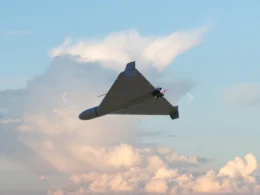
Latvia's State Police said it had detected the spread of false information online claiming that a Ukrainian drone had crashed into a passenger train on the Rīga–Daugavpils line two nights earlier, the Russian-language edition of Delfi reports.
The fake post placed the alleged crash on the stretch of track between Nīcgale and Vabole in eastern Latvia.
Train fire blamed on engine damage, not aerial attack
According to the police, what actually happened on the evening of 5 May was a fire in the first car of a passenger train on that same Nīcgale–Vabole section. The information available so far, the agency said, points to the fire having started in the engine compartment, and was most likely linked to damage to the motor itself.
The exact circumstances will be established in the course of a criminal investigation, the police added. All passengers were evacuated from the scene, and there were no injuries.
The State Police used the occasion to warn that "the targeted dissemination of false and harmful information, the deliberate provocation that sows fear in society, may incur criminal liability." Officers urged residents to evaluate online information critically and to trust only official sources — government agency websites and verified social media accounts.
Real drone incidents fuel a confused information environment
The fake circulated against a backdrop of genuine airspace incidents on Latvian territory.
On the morning of 7 May, two drones that had entered Latvia's airspace from the Russian side crashed inside the country, LSM reported. An air-threat alert was issued in the Balvi, Ludza, and Rēzekne districts; as of 07:00, the warning remained in force. Classes were cancelled in all schools in Rēzekne, the Rēzekne district, and the Ludza district.
One of the drones fell on a street in Rēzekne — about 40 km from the Russian border — where an oil storage facility is located. According to the Delfi portal, around 03:30 several emergency calls came in to 112 about a possible fire at the oil depot on Komunālā Street. At the scene, four empty oil reservoirs were found to have been damaged by external impact; on one of them, a 30-square-metre patch of smouldering cladding was quickly extinguished. A thermal-imager check of the tanks found no elevated temperature.
The State Fire and Rescue Service worked at the site with six tanker trucks and ladder vehicles, alongside police and the National Armed Forces. The police opened a criminal case under section 10 of the Criminal Code, "Crimes against the state."
The location of the second drone had not been established at the time of reporting.
Defence Minister Andris Sprūds, who was heading to the Rēzekne district, said the situation there was complicated and the threat ongoing. "Currently, the National Armed Forces, together with NATO allies, are exercising maximum control over the airspace; fighters are also in the air," he said.
Sprūds added that Ukraine has every right to defend itself and to strike targets on Russian territory. "At first glance, there is a possibility that these are drones directed from the Ukrainian side at targets in Russia. But this is only an assumption; the information needs to be verified," he said.
Lithuanian minister: no incidents on our side
Lithuania's Minister of National Defence Robertas Kaunas told LRT that no comparable incidents had occurred in his country. "As far as I know, no such incidents have been recorded in Lithuania, no cases of airspace violation. Every morning I ask about this, and I am assured that there are no such incidents in Lithuania," he said.
NATO air-policing assets had been activated, the minister said. "Our Latvian colleagues informed us, and NATO fighters also carried out their mission. They flew out of Šiauliai airport to patrol Latvian airspace and returned to Šiauliai around six in the morning."
Kaunas described the recent incidents in Latvia, Estonia, and Finland as "consequences of the war against Ukraine provoked by Russia."
Earlier, on 3 May, residents of several regions of Latvia and Estonia had been warned of a possible drone threat linked to Russia's aggression against Ukraine. The same day, a drone violated Finnish airspace near the Russian border, after which Finnish Prime Minister Petteri Orpo told President Volodymyr Zelenskyy that violations of Finnish airspace by drones were unacceptable.