

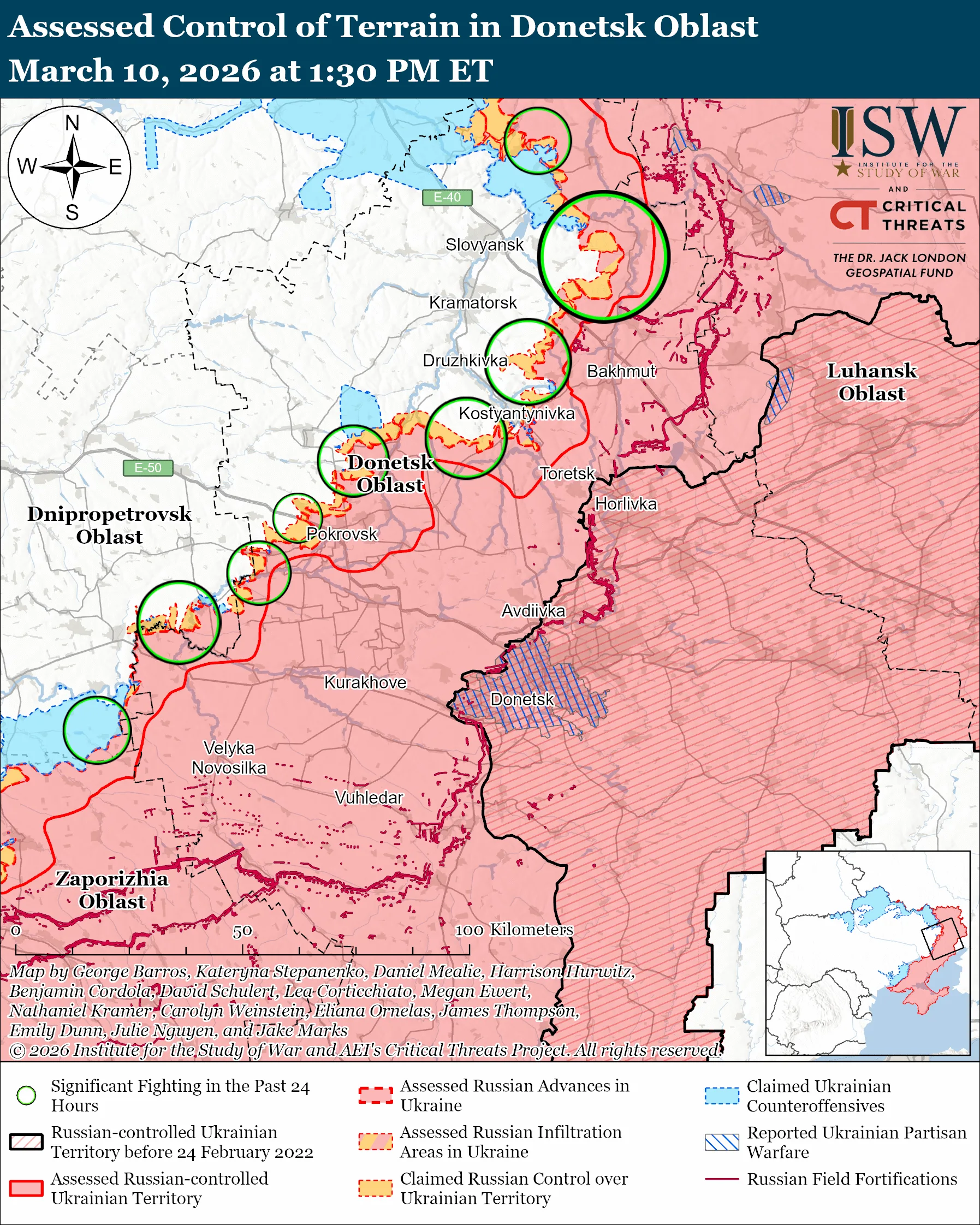
Ukraine drove Russian forces from nearly all of Dnipropetrovsk Oblast through two coordinated advances that reportedly liberated more than 400 km² since late January 2026, ISW assessed on 10 March. The operation combined deliberate exploitation of Russian tactical weaknesses with a strategic goal of disrupting Moscow's anticipated spring offensive.
Two drives, one objective
Ukrainian forces conducted mutually supporting advances in the Huliaipole and Oleksandrivka directions in late 2025 and early 2026. ISW assessed the two drives both expelled Russian forces from Dnipropetrovsk Oblast and disrupted Russian preparations for a spring offensive. The Huliaipole drive set flank conditions in late 2025. The Oleksandrivka counterattack launched on 29 January 2026. Together they advanced 10–12 km into Russian-held territory in two separate directions.

Maj. Gen. Oleksandr Komarenko, head of the Main Operations Directorate of the Ukrainian General Staff, told RBC-Ukraine on 10 March that Ukrainian forces liberated over 400 km² in the Oleksandrivka direction. ISW's conservative mapping puts the figure at roughly 279 km² since 1 January — the institute noted its methodology likely underestimates Ukrainian advances.
As of 10 March, ISW identified five settlements in Dnipropetrovsk Oblast where Russian forces still maintain positions: Novomykolaivka, Zaporizke, Novoheorhiivka, Sichneve, and Maliivka — though the status of three additional settlements in Synelnykivskyi Raion remained unclear.

“Almost the entire territory liberated”: Ukraine nears full clearance of Dnipropetrovsk Oblast – reversing Russia’s “buffer zone”
How Ukraine broke through
ISW says that Ukraine likely advanced rapidly because Russian positions were dispersed and non-linear, winter weather grounded Russian drone operations, and Ukrainian forces actively suppressed Russian drone-based defenses. The commander of a Ukrainian airborne assault battalion said his unit infiltrated Russian positions under snow and fog cover, which degraded Russian aerial reconnaissance and strike operations. Ukrainian Airborne Assault Forces Commander Maj. Gen. Oleh Apostol stated that the General Staff deliberately selected a frontline sector where Russian forces lacked significant manpower concentrations.
Starlink's contribution
SpaceX blocked Russia's Starlink satellite connection in Ukraine in early February 2026, which ISW found further enabled Ukrainian advances in Dnipropetrovsk Oblast. Ukraine's Airborne Assault Forces reported that the block degraded Russian situational awareness and complicated Russian command and control in the Oleksandrivka direction.
The planning group head of a Ukrainian unmanned systems battalion in the Lyman direction told ArmyInform that Russian forces, after losing Starlink, switched to large antennas to maintain connectivity — which expose their positions from afar and are more vulnerable to Ukrainian strikes. A Ukrainian brigade in the Pokrovsk direction separately reported that Russian forces are mounting antennas on high-rise rooftops in Myrnohrad to compensate for the loss.
ISW noted that these vulnerabilities likely exist across the entire frontline, not only in the south.

ISW: Ukraine advances near Kupyansk, counter Russian offensive in Zaporizhzhia Oblast
Pre-emption, not counteroffensive
Ukrainian 1st Separate Assault Regiment Commander Capt. Dmytro Filatov stated that the Dnipropetrovsk operations do not mark a new "counteroffensive" — they are counterattacks to stabilize the frontline and improve Ukraine's positions as Russian forces redeploy to the area. Filatov noted that Russian forces had themselves planned to use the Oleksandrivka direction as a "pre-spring" launch pad for subsequent offensives toward Pokrovsk and Lyman. Ukraine's Airborne Assault Forces reported the operation was approved through standard planning procedures and launched on 29 January.


