

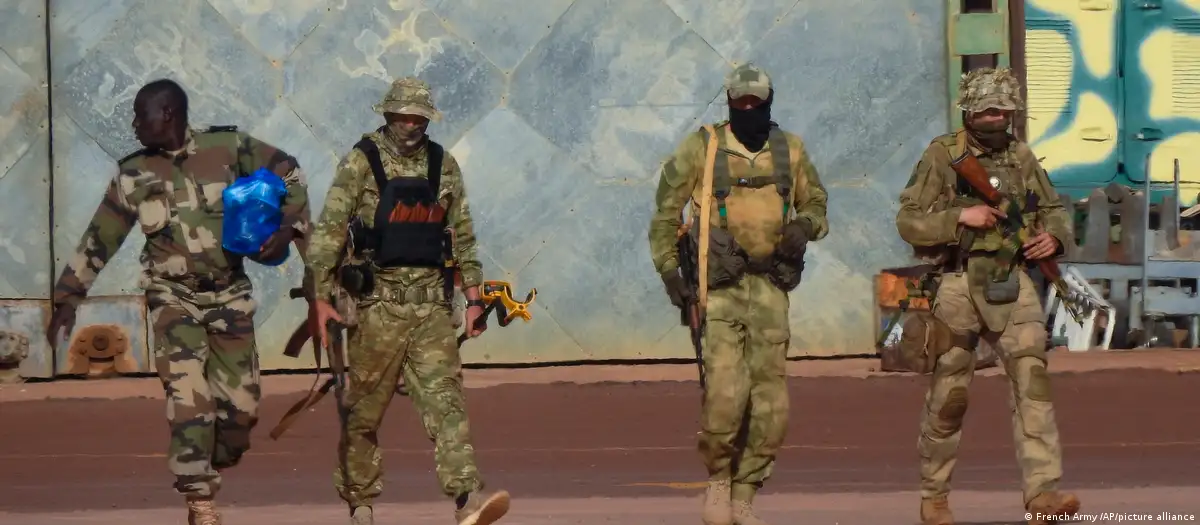
France's foreign minister, Jean-Noël Barrot, says Russia has lost. "In Africa as elsewhere—in Mali, but also from Venezuela to Iran and Syria—Russia has been largely defeated," he told Le Monde in an interview published on 13 May. Three weeks earlier, Russia's Africa Corps had slipped out of the northern Malian city of Kidal under an escorted withdrawal negotiated with the rebels advancing on it, and a senior Malian official told RFI what the junta thought of its protector: "The Russians betrayed us in Kidal."
Barrot is passing judgment on a model. Russia offered the juntas of Mali, Burkina Faso, and Niger one proposition—security in exchange for resources, no questions about democracy—and presented it as the alternative to the West.
Kidal was the proof it worked: Malian and Wagner forces retook the city from Tuareg separatists in November 2023, the one clean battlefield win Moscow could point to in the Sahel. Three weeks before the interview ran, the Africa Corps handed Kidal back without a fight, and Sadio Camara, the defense minister who built Mali's turn to Moscow, was dead. The model is being tested in public, and Russia's own clients can observe the result.
What Barrot said
Barrot's case rests on more than the battlefield. France's trade with Africa is three times larger than Russia's, he told Le Monde, its investment eight to 10 times higher, the number of African students in French universities eight times greater. "Vladimir Putin's Russia offers nothing but security services traded for exploitation of Africa's resources," he said, putting Moscow's contribution to African development at "zero." On influence, he was categorical: "There is no loss of French influence in Africa."
That last claim is the one the facts strain against. France was forced out of Mali, Burkina Faso, and Niger between 2022 and 2024—troops expelled, ambassadors withdrawn—and the three juntas formed the Alliance of Sahel States in part to make the break with Paris permanent. Barrot stands on firmer ground describing Russia's troubles than describing France's position. And the force that drove Russia out of Kidal was not French. It was an al-Qaeda affiliate, Jama'at Nusrat al-Islam wal-Muslimin, fighting alongside the Tuareg separatists of the Azawad Liberation Front—the same coalition whose July 2024 ambush at Tinzaouaten inflicted Wagner's heaviest known losses in Africa, some 80 mercenaries killed. Where Russia is retreating, France is not the one moving in.

The retreat from Kidal
The withdrawal itself was filmed. Tuareg fighters posted video of Russian vehicles leaving their Kidal base; the FLA announced it had reached an agreement with the Russians to vacate the town "permanently," CNN reported. The Malian official who spoke to RFI said the regional governor had warned the Russians "three days before the attack," and that "they did nothing"—the departure, he said, appeared to have been negotiated in advance.
Three days' warning. Nothing done. A convoy filmed leaving.
Trending Now
The Africa Corps left equipment behind, mine-resistant vehicles among it, now in rebel hands. Malian troops and the civilian administration pulled back to Gao. Tessalit, another northern base, fell within days, its garrison gone before the rebels arrived. The April assault that opened the door had killed Camara at his home near Bamako and struck the garrison town of Kati and the capital's airport in a single coordinated wave—the largest offensive Mali has seen since the 2012 rebellion.
The pattern Barrot is pointing at
His list—Mali, Venezuela, Iran, Syria—is not only a French talking point. When Bashar al-Assad fell in December 2024, Russia began losing the bases that supplied its African operations. When US forces seized Nicolás Maduro in January 2026, Moscow's answer was tweets and phone calls; Euromaidan Press reporting at the time traced a consistent record—loud commitments, nothing delivered when a partner is directly threatened. Chatham House analysts reached the same conclusion about Mali that Barrot reaches about the continent: as in Syria, Venezuela, and Iran, Moscow proved unable to keep an allied government from being overrun. The Africa Corps is thinner than Wagner was—battles involving Russian fighters in Mali dropped from 537 in 2024 to 402 in 2025, the drawdown pulled partly toward Ukraine—and analysts say it can prop a regime up briefly while doing nothing about the governance collapse underneath it.
Who pays
What the model does reliably is profit from the insecurity it is paid to fix. EP's reporting on the Wagner playbook set out the mechanism: a monthly fee from the junta, resource concessions—gold, uranium, lithium—and an incentive structure with no reason to end a war that pays. In Mali that arithmetic carries a body count. Russian and Malian forces killed more than 500 people at Moura in 2022. Seven civilians were killed near the Mauritanian border this March; Malian and Russian forces were blamed. The juntas are now flying joint airstrikes to hold what is left, and JNIM has threatened to seal off Bamako, a city of four million, "from all sides," the Guardian reported.
Barrot says Russia has been defeated. In Kidal, the people who were promised protection learned what the word means when the protector negotiates its own way out.


