Russian forces have not fully seized Siversk in Donetsk Oblast despite Kremlin claims, and the frontlines in Ukraine are not collapsing, according to the Institute for the Study of War (ISW). In reality, Russia is "only making tactical gains across most of the theater," the think tank says.
Kremlin escalates disinformation over Siversk
In a report dated 11 December, ISW rejected Russia’s announcement that it had taken control of Siversk, calling it part of a wider “cognitive warfare effort” by the Kremlin.
“The Kremlin claimed that Russian forces seized Siversk [...] and Russian battlefield victory as inevitable. Neither is true,” ISW wrote, adding that the fall of Siversk remained unconfirmed.
The claim came during a virtual meeting on 11 December between Russian President Vladimir Putin and his military commanders. Lieutenant General Sergei Medvedev, commander of the Russian Southern Grouping of Forces, told Putin that elements of the Russian 3rd Combined Arms Army had seized the town. However, ISW noted that only geolocated footage showed that Russian troops likely entered eastern Siversk, while control of western parts remained unverified.

Ukrainian 11th Army Corps spokesperson Lieutenant Colonel Dmytro Zaporozhets dismissed the Russian statement outright, saying that “fighting continues throughout Siversk.” He said Russian troops were exploiting poor weather conditions to infiltrate and falsely claim territorial control. A Ukrainian brigade operating in the area said Russian soldiers used small-unit tactics to sneak into parts of the town, raise flags, and promote the illusion of control.
ISW said these actions were part of Russia’s campaign “to portray them as a sweeping, broad-front advance.”
Some Russian milbloggers also contradicted the Kremlin narrative, writing that Ukrainian forces remained in the town and that Russian control was not complete.
Sloviansk not under threat, despite Russia's claims
Russia is using its claimed capture of Siversk to suggest a looming offensive on Sloviansk in Donetsk Oblast. However, ISW said this projection is misleading and premature. According to Medvedev, taking Siversk supposedly opens the way for an attack on Sloviansk, which sits at the northern end of Ukraine’s so-called Fortress Belt. But ISW wrote that “Russian forces are at least several months away from being able to begin an offensive” there.
ISW emphasized that Russia would have to first fully seize Lyman and either cross the Siverskyi Donets River or advance more than 30 kilometers from Siversk. The advance on Siversk itself has taken Russian forces 41 months and stretches back to their gains in Lysychansk in July 2022. Sloviansk, a larger city, would require several more months of fighting, even if Russia reaches its outskirts.
Russian advances limited and slow
ISW noted:
"Russian forces are only making tactical gains across most of the theater."
According to the think tank, most Russian advances in 2025 have occurred in just six of the 16 operational directions it tracks. Out of the 4,652.2 square kilometers gained by Russia this year, nearly 80% were in the Lyman, Kostiantynivka, Pokrovsk, Novopavlivka, Oleksandrivka, and Huliaipole directions.
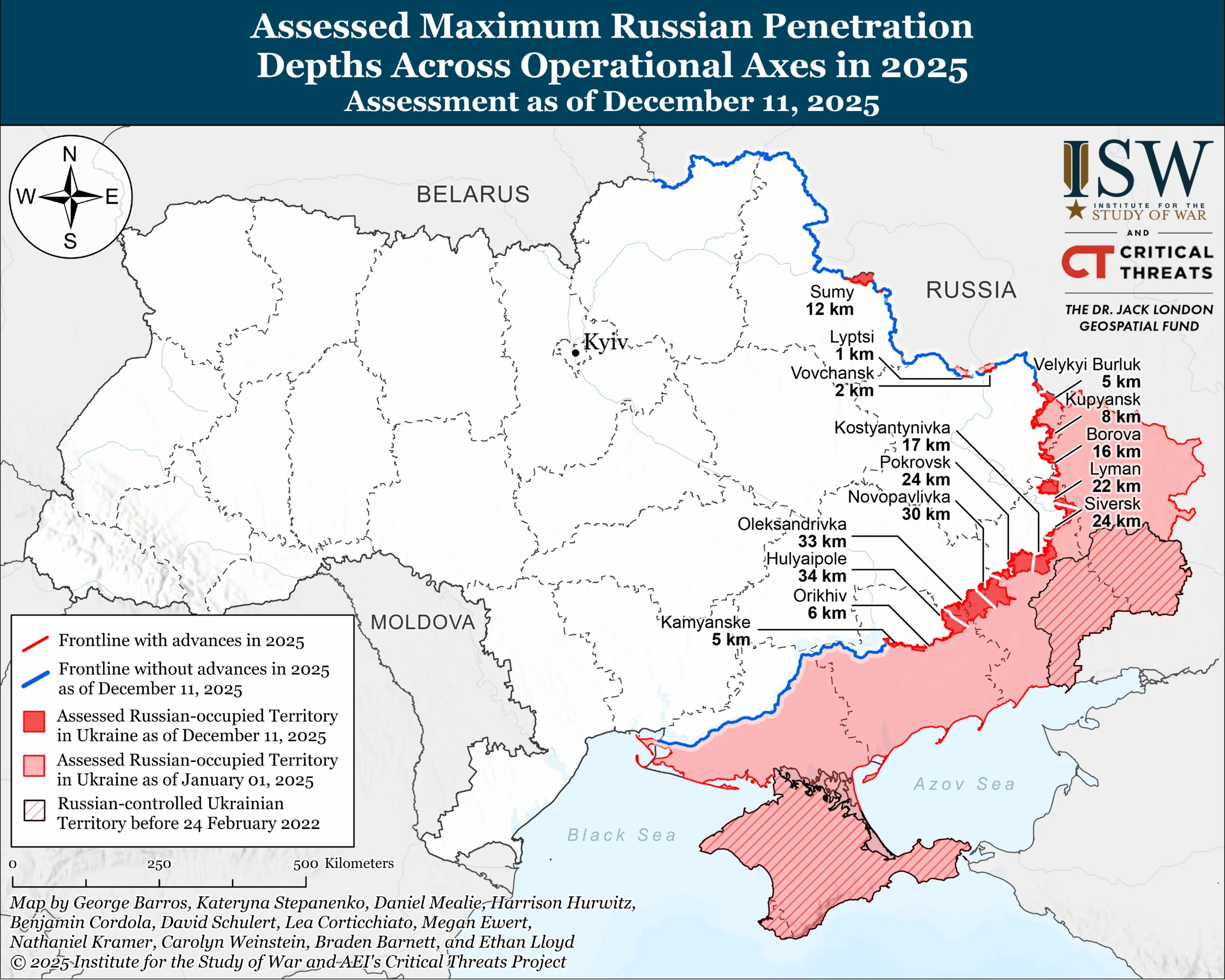
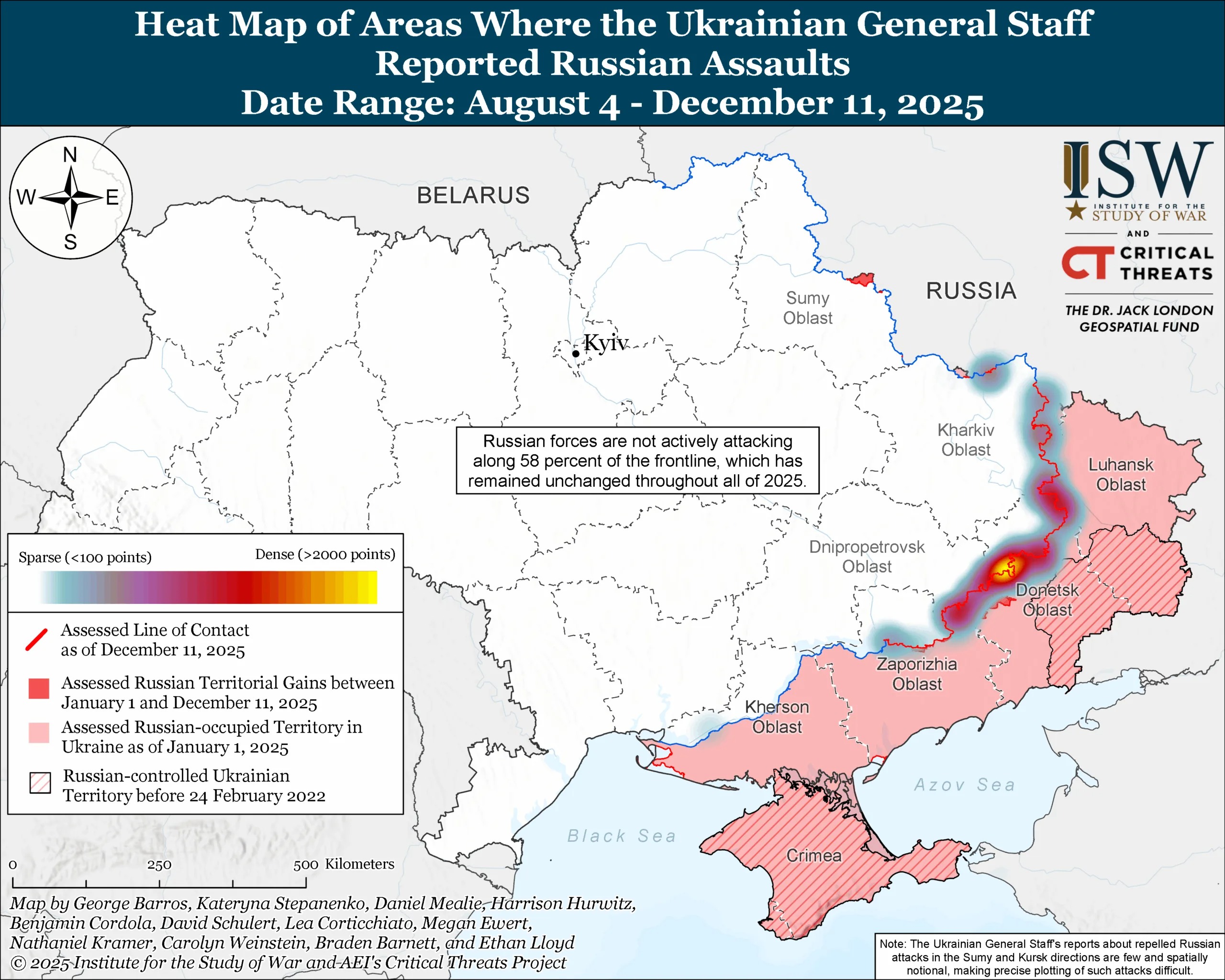
In contrast, Russian forces made no significant gains in Sumy or northern Kharkiv oblasts, despite repeated claims of progress and a supposed push to create “buffer zones.” Russia’s efforts in Kherson have also stalled since its 2022 withdrawal from the west bank of the Dnipro River.
Russia’s most substantial gains, ISW said, came in areas where it deployed massive force concentrations — sometimes over two combined arms armies. Even there, the pace of advance remained slow.
“Even the most extensive Russian advances are constrained to foot pace,” ISW wrote.
Putin’s meetings aim to sell a collapsing frontline
Putin’s latest meeting follows a series of similar sessions in recent weeks where top officials exaggerated military achievements. These include claims of progress near Vovchansk, Kupiansk, Pokrovsk, and Hulyaipole. ISW noted that Russian ultranationalist milbloggers have challenged many of these assertions.
"The Kremlin continues to engage in a systematic cognitive warfare effort to aggrandize Russian advances through exaggerated claims of gains and flag raising infiltration missions in an attempt to portray them as a sweeping, broad-front advance to falsely portray the frontline as collapsing across the theater, contrary to all available evidence," ISW wrote.
Read also
-
Seoul backs Ukraine, but sanctioned tankers carried fuel from South Korea to Russia
-
Germany accuses Russia of a drone bomb attempt at Leipzig. Now its eight biggest airports get drone detection
-
At ruined Donetsk’s airport, three Russians snap selfies and ready jet-powered Geran-4. Ukrainian drone slips in unseen and rams their launcher