Vadym Skibitskyi, deputy head of Ukraine’s military intelligence, says Russia continues to recruit tens of thousands of contract soldiers each month to sustain its forces in Ukraine. Photo: HUR
Russia fired 198 ballistic and hypersonic missiles at Ukraine in July, its highest monthly total of 2026, alongside 153 cruise missiles, as its factories ran their main missile lines at 110 to 120% of plan, the deputy head of Ukraine's Defense Ministry intelligence directorate (HUR), Major General Vadym Skibitskyi, told RBC-Ukraine in an interview published on 10 August.
The volume reflects a production run, not a drawdown of reserves. Moscow has spent recent months building and firing more of exactly the weapons most likely to penetrate Ukrainian defenses, as Kyiv runs short of the Patriot interceptors that are its only reliable counter to ballistic missiles. On 5 August, Ukraine failed to intercept any of 28 Russian missiles, including 24 ballistic ones.
Launches climbed through the summer
Ballistic launches rose steadily before July's peak: 61 in April, 107 in May, and 134 in June, Skibitskyi said. Attack intervals shortened from roughly one strike every 10 days to weekly, then tighter. "Everything depends on the quantity of weapons produced," he said.
Russia is meeting its monthly plans for the main missile types at 110 to 120% and, by 3 August, had already fulfilled its full-year plan for the Zircon hypersonic and modernized Onyx missiles, building 33 Zircons and 60 Onyx in seven months. That output, Skibitskyi said, makes a lasting pause in strikes unlikely.
A downed Russian Kh-101 missile. Illustrative photo by Ukraine's Air Force
Plans overfulfilled, reserves untouched
Output for individual systems ran well above target. The July plan for the Kh-101 cruise missile was met at 140%, the Kalibr at 111%, and the Kh-35 at 200%, according to HUR figures. In absolute terms, Russia planned 72 Kh-101s and built 87. It planned 26 Kalibrs and built 29.
Its stockpile of 9M723 ballistic missiles for the Iskander-M stood at about 130 as of 5 August, against a monthly plan of 60, though July output reached 65, Skibitskyi said. For the RM-48U, a Mach 6 surface-to-surface missile launched from the S-400, the August plan is about 40 units on estimated reserves of 400.
"They are not really going into reserves. Right now almost everything for use comes off the assembly line," Skibitskyi said.
An Iskander-M short-range ballistic missile launcher with its missile raised, at the Army-2016 military expo near Moscow, Russia, 8 September 2016. Photo: Vitaly V. Kuzmin
Newly built Kalibrs now largely go to equip Russia's new warships and submarines, he added, and Ukraine intercepts nearly all the Kalibrs fired when it has the surface-to-air missiles to do so.
Kinzhal and Kh-32 output halted since April
Part of the ballistic surge came from stopping other programs. Russia suspended production of the hypersonic Kinzhal and the Kh-32 cruise missile in April, redirecting their propellant and components to missiles it considers more effective, Skibitskyi said. The Kh-32, a modernized Kh-22, had failed repeated attempts to improve its accuracy and was returned to development.
The Kinzhal has a similar problem.
"We can hardly recall a case when this missile hit the target precisely," Skibitskyi said. "For an effective missile the deviation from the target should not exceed 5 to 7 meters, and theirs is 30 meters and more."
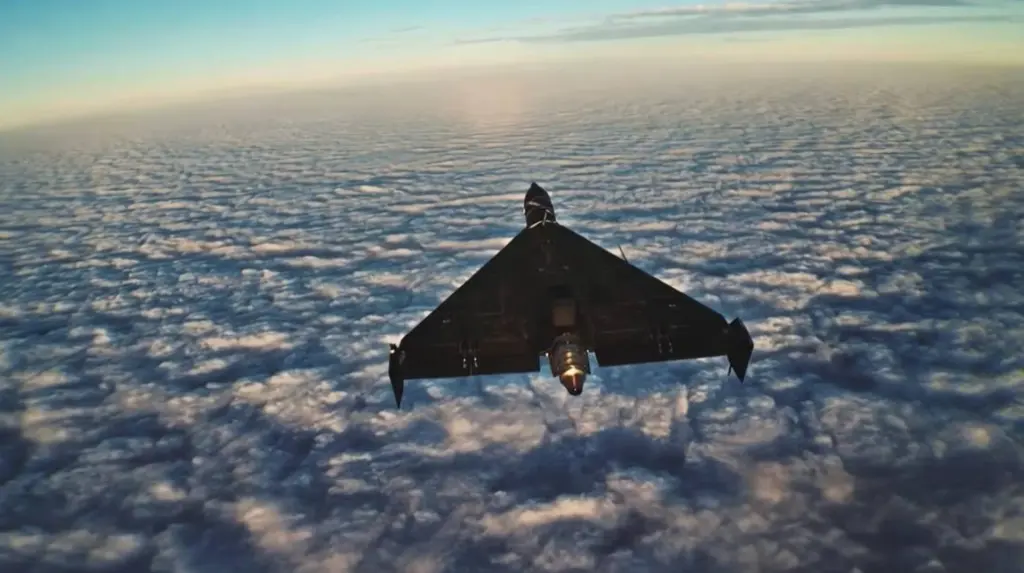
The Geran-3 jet-powered Russian attack drone. (Photo: Wild Hornets)
A shift to jet-powered drones
Russia's August plan for strike drones, across the Geran, Gerbera, and Harpia families, is 11,000 units, Skibitskyi said. Production dipped in July as plants retooled toward the turbojet Geran-4 and Geran-5, which already made up half of one recent attack and require faster interceptors to stop.
The engines remain a bottleneck. Russia depends on China for the turbojets, pays about $35,000 to $40,000 apiece, and is trying to build its own, Skibitskyi said.
Targets: defense plants, logistics, and Black Sea shipping
Russia concentrates its strikes on Ukraine's defense-industrial complex, centered on Kyiv, Zaporizhzhia, Dnipro, and Kharkiv, and on logistics, including railways, ports, and shipping, Skibitskyi said. He described a methodical campaign against civilian vessels in the Black Sea: "This is an unprecedented situation, when civilian vessels are not simply struck but methodically finished off and destroyed, to deny us the ability to conduct trade."
Energy sites tied to ports and logistics are also targeted, he said, along with other infrastructure meant to sow panic and destabilize the country.
North Korea, Iran, and a Starlink analog
North Korea has transferred 40 more KN-23 and KN-24 missiles after an initial batch of about 100, Skibitskyi said. One recent North Korean missile strayed roughly 15 kilometers from its target and killed a family. Iranian cooperation has narrowed since 2022 and 2023, as Russia now builds its own strike and FPV drones.
Moscow is also fielding Rassvet, a Russian analog of Starlink, faster than planned. Sixteen satellites reached orbit in March 2026, with a planned constellation of 292 by 2027 and 924 by 2035. For now, it works only in fragments, as each satellite passes over Ukrainian territory.
A pause looks unlikely
Russia may cut the number of missiles sent at a single target but is unlikely to stop, Skibitskyi said. The tempo will depend above all on how much it can produce. "They will be able to reduce the number of missiles flying at one target, but they are unlikely to make a pause," he said.
We are an independent media outlet that relies solely on advertising revenue to sustain itself. We do not endorse or promote any products or services for financial gain. Therefore, we kindly ask for your support by disabling your ad blocker. Your assistance helps us continue providing quality content. Thank you!
Russia has moved its Kalibr-carriers out of the Black Sea, attempting to get out of the reach of Ukraine's naval drones. They can run but they can't hide.