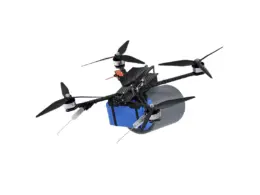
Ukrainian drone operators claim they’ve set a record by hitting a Russian minibus at 102 kilometers with a quadcopter FPV drone without using a drone carrier. Activist Serhii Sternenko posted the purported exchange with the operators on his Telegram channel.
The operators wrote that Russian movements ground to a halt. “The killzone for them is fucking insane,” they wrote.
Euromaidan Press was not able to independently verify the report, however some Ukrainian miltech developers said that this achievement is possible, citing breakthroughs in batteries and communications.
Misha Rudominski, whose company Himera makes hand-held radios and signal repeaters for Ukrainian troops in the field, said the feat “seems feasible. But needs very specific work on antennas, and last mile autonomy, too.”
Maksym Hnatyk, a representative with drone battery maker Pawell Power, was more sanguine from the power supply point of view.
“There is no doubt it’s possible,” he said. “High-density energy batteries are becoming increasingly popular.”
According to him, batteries with 400-500 watt-hours per kilogram are already available on the market and a light drone with a big battery can make that trip and still blow up a light target. Manufacturers have moved from Lithium-ion batteries towards semi-solid-state, gaining 30% more capacity at the same weight, while being able to handle demanding maneuvers with a high discharge rate.
“There is a massive boom in research, with scientists constantly developing novel chemical formulas to make batteries both cheaper and higher in capacity. We will see in the near future more and more crazy distance records, he added.
“The kill zone expansion is coming. Soon it will go from 15-30 kilometers to 50-80.”
Growing the kill zone, expanding mid-range strikes
In many ways, the war between Ukraine and Russia has evolved into a contest of who has the longest stick.
The growing kill zone is a defining factor of Russia's full-scale invasion. Like a reverse tug-of-war, both sides are trying to expand this zone towards their enemy.
Ukraine has been increasing its mid-range strike capabilities. The number of these strikes more than doubled between February and March, hitting air defenses, infrastructure, and Russian trucks, vans and trains within occupied territories.
At those distances, fixed-wing designs that can carry more payload are common. Compared to FPV quadcopters, they are more expensive to develop and scale in production, said Lyuba Shipovich, head of the military support fund Dignitas.
Trending Now

Drone carriers are a widely-fielded solution to expand the range of shorter-range drones like FPVs. These carriers can also carry signal repeaters, improving the reliability of communication with the drone.
Ukrainian defense firms have been working on making their drones controllable at longer distances, largely through signal repeaters and relays. The company Wild Hornets announced in April that operators were able to control interceptors from 2,000 kilometers away.
The use of AI to improve individual tasks, including navigating terrain and enhancing last mile guidance has already been in the field for many months, developers previously told Euromaidan Press.
Suppressing the Russians
If the 102-kilometer FPV record Sternenko posted doesn’t end up being a fluke, it can signal two things.
One: Ukrainian forces may have more flexibility with their attacks beyond the 30-kilometer range with lighter, cheaper drones that can handle lightly-armored targets transporting troops or materiel, without having to always rely on carriers or mid-range fixed-wing UAVs.
Two: the technology behind this, such as better batteries, stronger mesh networks, and AI autonomy, also applies to bigger, deadlier drones, making them progressively more effective at wearing down the Russians, while cutting corridors to strike their territory directly.
This can further reduce the capability of Russian troops to maneuver and resupply at longer distances from the zero line, distances that were once considered relatively safe from FPVs.
Still, the Russians are improving their own tech and adapting Ukrainian solutions. It is likely that as the kill zone expands into Russian-held territory, it will likewise expand into the defenders.
Read also
-
Russia just accidentally crashed its first Tu-95 bomber in 11 years. Its missiles will keep striking Ukraine anyway
-
In Ukraine’s Vivaldi offensive, nobody rides in the BTR-60s. Bulgaria’s old troop carriers go into Russian bunkers packed with mines
-
Ukraine’s tanks are fighting from kilometers back. A 1960s Soviet model does that nearly as well