


- The degradation of Russian air defenses means Ukrainian drones can attack with greater freedom
- Now 1st Azov Corps drones are striking Russian logistics in Donetsk city, once a safe haven for Russian forces
- Recent attacks include strikes by AI-assisted Hornet drones that can power through any lingering Russian jamming
Ukrainian forces are flying a new AI-assisted attack drone over Donetsk city in order to strike at critical logistical targets.
That Ukrainian drones can range over Donetsk with near impunity is further evidence of the ongoing collapse of Russian air defenses. A collapse that itself is being hastened along by Ukrainian drone strikes.
The fixed-wing Hornet drone, built by US-based Swift Beat LLC, boasts an internal algorithm that scrutinizes the image from the drone's forward-looking camera, and automatically recognizes military targets. The AI can steer the explosive drone to a precision hit even when the distant human operator loses contact with the drone due to interference from weather, terrain or Russian jamming.
The Hornet is a recent addition to the Ukrainian arsenal, and a powerful one. The Ukrainian 1st Azov Corps claimed its drones, which can be identified as Hornets by their distinctive operator displays, are flying over Donetsk city with ease. "Drone units maintain constant surveillance and fire control over all supply routes around Donetsk," the corps stated.
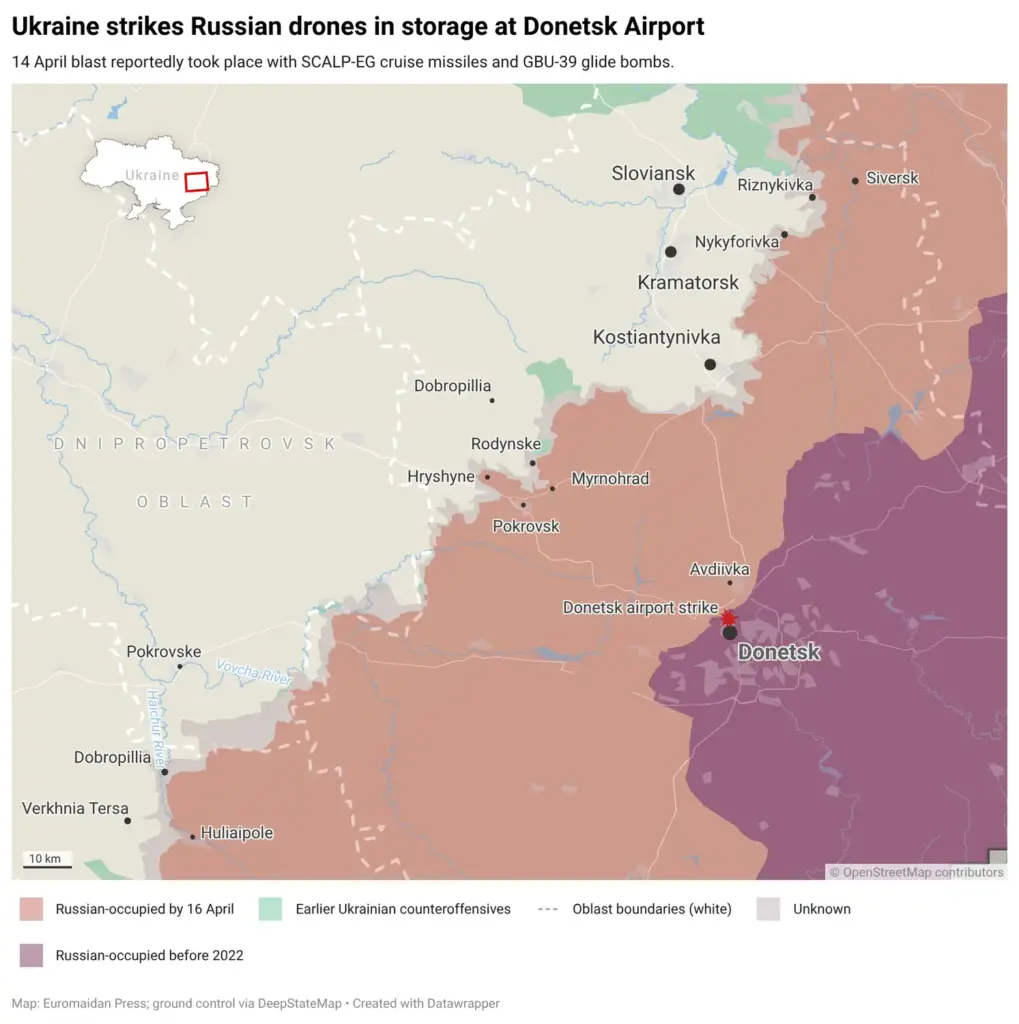
Donetsk city, 40 km from the eastern front line, is a Russian stronghold. But it's an increasingly vulnerable one as Ukraine forces degrade Russian air defenses.
Systematically hunting Russian radio jammers, radars, surface-to-air missile batteries and mobile guns and launchers all along the 1,200-km front line of Russia’s 50-month wider war on Ukraine, Ukrainian forces are “collaps[ing] the layered defensive architecture that the Russian integrated air defense doctrine depends upon to function,” according to an investigation by Tochnyi.info.
The attacks on Russian air defenses—at least 492 of them between June 2025 and early March 2026—are part of a wider plan. Destroying the right air defenses faster than the Russians can replace them has the effect of “facilitating strikes on more critical targets deep within Russian territory,” Tochnyi.info explained.

Close glide bombing
That was evident on 14 April, when Ukrainian warplanes flew close enough to Donetsk airport to strike Russian drone storage at the airport with GBU-39 glide bombs that range just 40 km or so when dropped from low altitude. That kind of close strike on Donetsk by manned warplanes wasn't possible until recently.
Trending Now
More and more, all sorts of Ukrainian air operations are possible in the increasingly permissive air over Donetsk. Now the 1st Azov Corps' drone units "maintain constant surveillance and fire control over all supply routes around Donetsk."
If any drone-grounding radio jammers have survived the Ukrainian campaign targeting Russian air defenses in the city, the Hornet drones' internal AI can steer the drones right through the electronic protection.
The Hornets appear to be prioritizing trucks and other logistics forces, but if they also strike any remaining air defense systems, they could further loosen the Russians' control of the air space over Donetsk.
That, in turn, would allow Ukrainian drones and warplanes to strike even harder, more precisely and more often in a wider swathe of the Russian rear area.


