

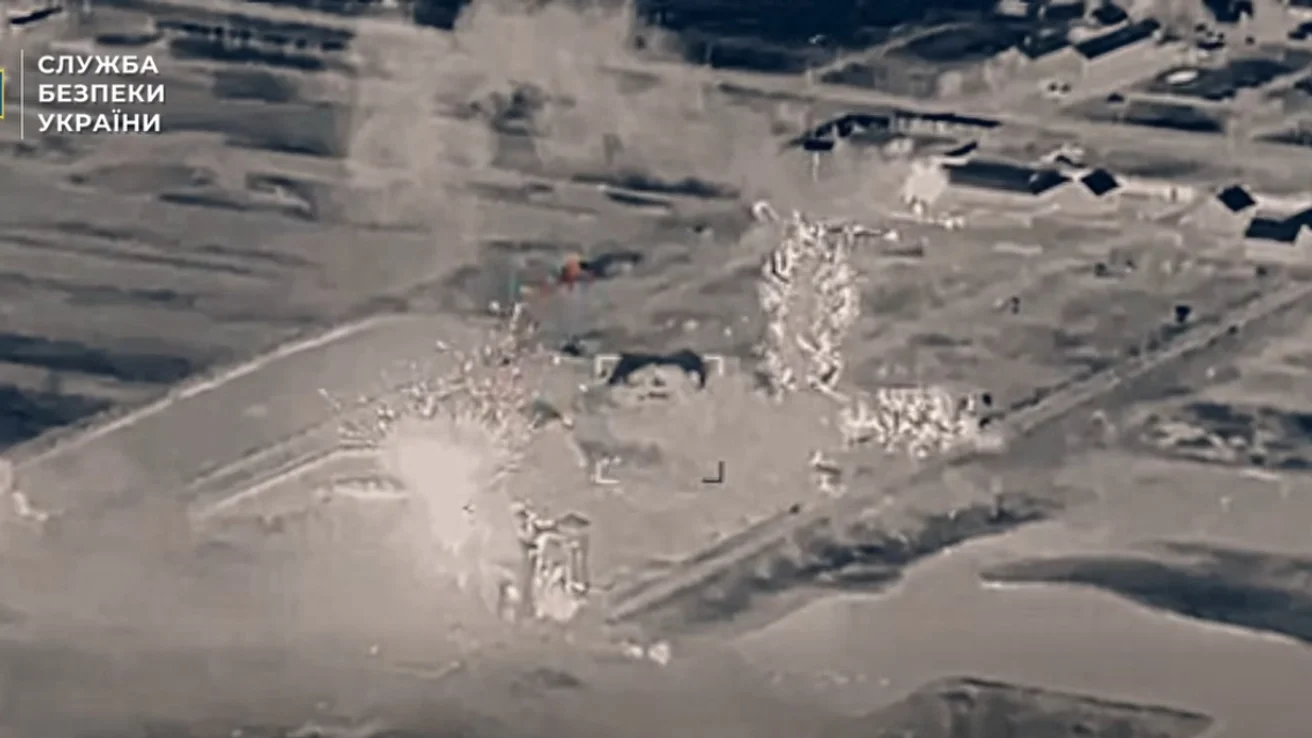
Ukraine's Security Service (SBU) struck a Russian Federal Security Service (FSB) headquarters and destroyed a Pantsir-S1 surface-to-air missile system on Russian-occupied Ukrainian territory in a single operation that left around 100 Russian troops killed or injured, President Volodymyr Zelenskyy said on 21 May 2026.
The operation is the latest hit in a documented campaign by the SBU's elite Alpha unit—formally the Special Operations Center «А»—that destroyed roughly half of Russia's Pantsir-S1M and S2 air defense systems through 2025, opening what the SBU calls "blind corridors" for Ukrainian long-range strikes deeper into occupied territory and Russia itself.
The strike came on day three of joint Russia-Belarus nuclear drills, as Putin sat in Beijing with Xi Jinping with Ukraine on the agenda. On the same morning, the Russian and Belarusian defense ministries jointly released video footage of what they claimed was a delivery of nuclear munitions to a Belarusian missile brigade.
A single operation, two Russian targets
Zelenskyy said the strike was carried out by Alpha, attributing the action to the unit by name in his Facebook video, and that its fighters both hit the FSB headquarters and destroyed the Pantsir-S1 on Ukrainian territory under Russian occupation.
"Thanks to just this one operation, Russian losses amount to around a hundred occupiers killed and wounded," the president said. The casualty figure is the Ukrainian claim and has not been independently verified.
Zelenskyy did not name the exact location of the strike in his statement; Hromadske reported it took place in an occupied village in Kherson Oblast.
Zelenskyy's message to Russia
"There are good results from the warriors of the SBU's Special Operations Center 'A,'" Zelenskyy wrote at the start of his Facebook post, before describing the two destroyed Russian targets.
He then issued a message to Moscow: "Russians must feel that they must bring this war of theirs to an end. Ukraine's medium- and long-range sanctions will keep working." Since mid-May, Zelenskyy has been framing Ukraine's deep-strike operations as "long-range sanctions"—Kyiv's own pressure tool when Western sanctions fall short.
Read also
-
Romania hits cost trap Ukraine spent years escaping: $400,000 missiles against $20,000 drones
-
Look at this huge airport fire truck that Ukraine’s Emergency Service just received from Luxembourg
-
Ukraine’s new remote turret trades heavy machine gun for twin AK-74s and relies on Starlink when signal drops


