Russia said it delivered nuclear munitions to a missile brigade's positional area in Belarus on 21 May 2026, the final day of joint exercises that capped a broader Russian strategic nuclear drill of roughly 64,000 personnel. On the same morning, the Russian and Belarusian defense ministries jointly published video footage of the alleged transfer, while Belarus reported simulated Iskander missile launches and bombing runs against undisclosed targets, RFE/RL's Belarus service Svaboda reported.
The wrap-up overlapped with the second day of Vladimir Putin's Beijing visit, where Ukraine was on the agenda in his meetings with Xi Jinping. Ukraine's foreign ministry condemned the exercises as a violation of the Treaty on the Non-Proliferation of Nuclear Weapons; the State Border Guard Service said it was continuing to fortify the entire length of the Ukraine-Belarus border.
The drills came one week after Russia's first test of its Sarmat intercontinental ballistic missile on 12 May—the same day Belarusian leader Aliaksandr Lukashenka ordered a rotational mobilization of selected military units with the public statement "We are all preparing for war." The broader Russian exercise involved 7,800 pieces of equipment, more than 200 missile launchers, around 140 aircraft, 73 warships, and 13 submarines, spanning the Leningrad and Central military districts and the Northern and Pacific fleets, according to the Russian defense ministry.
Belarus simulates strikes against undisclosed targets
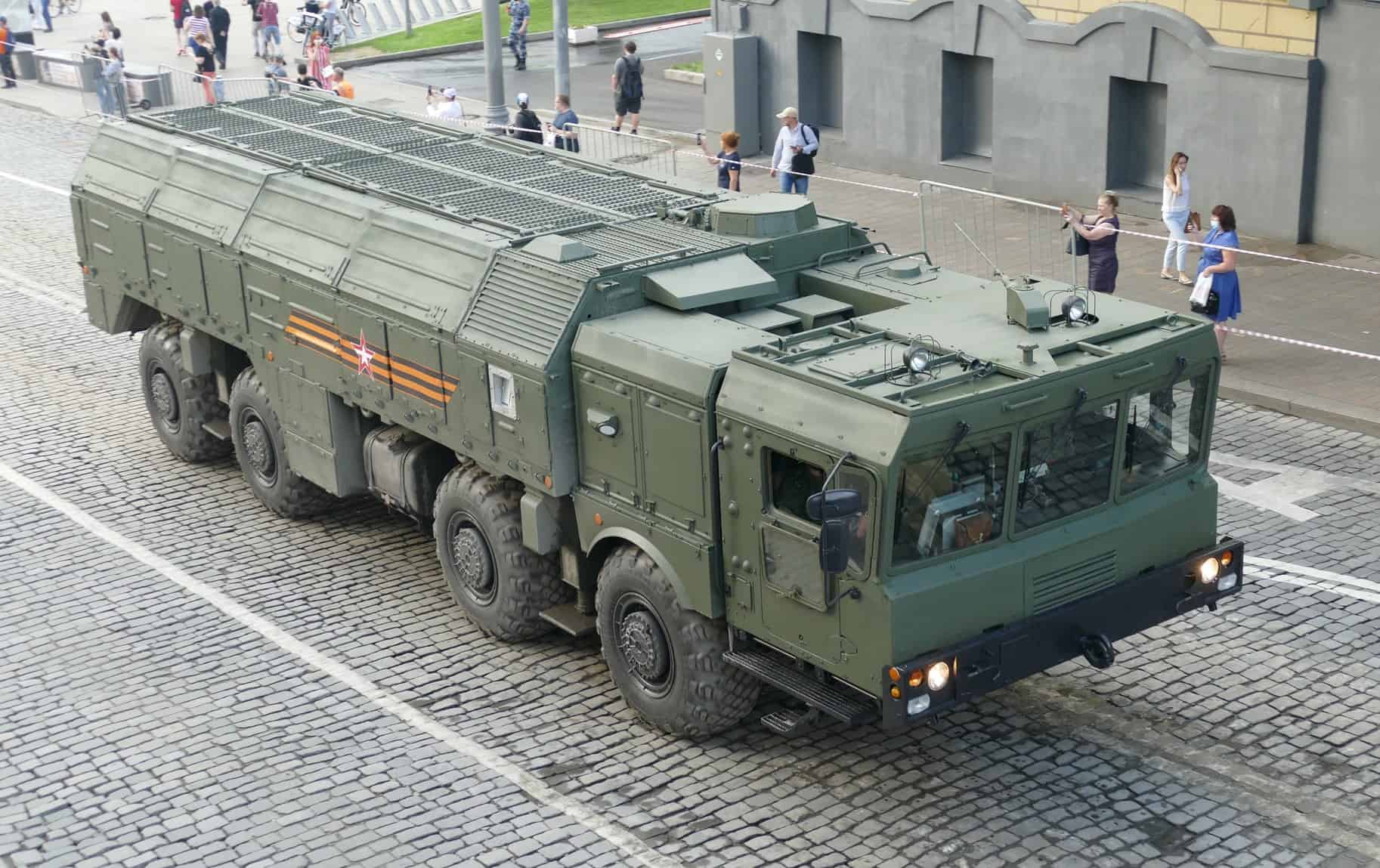
Combat crews of a Belarusian missile unit prepared to receive special munitions for the Iskander-M short-range ballistic missile system and to load them onto launchers, the Belarusian defense ministry said.
"Then, after loading missile carriers onto launchers and transport-loading vehicles, they moved covertly to a new area. After taking it, the missile unit carried out simulated missile launches at designated targets," the ministry said.
Aircraft took off, moved to assigned air patrol zones, and on command simulated bombing of a hypothetical enemy with special munitions before returning to base. Unlike other military maneuvers, neither side made public the scenario of the exercises.
Russia claims nuclear delivery to Belarus
On the morning of 21 May, the Belarusian defense ministry published a video showing the delivery of nuclear munitions to field storage points within a missile unit's positional area. Russia's defense ministry illustrated the same claim using the same video.
The Russian defense ministry had announced on 19 May that the exercises, running from 19 to 21 May, would cover preparation and use of nuclear forces "in conditions of threat of aggression," including "joint preparation and use of nuclear weapons located on territory of Belarus." Belarus said it would practice "issues of delivering nuclear munitions and preparing them for use."
The Iskander-M—NATO-designated SS-26 Stone—has a range of up to 500 kilometres and can carry conventional or nuclear warheads, Reuters reported from Moscow.
Belarus and Russia have held publicly announced joint nuclear exercises since May 2024, when Moscow disclosed its first such drill. Russian tactical nuclear weapons have been stationed on Belarusian territory since 2023, and the nuclear-capable Oreshnik intermediate-range missile system was reportedly deployed there in 2025. Independent confirmation that Russia has transferred actual tactical nuclear warheads to Belarus, as distinct from delivery systems, has not been established.
Ukraine condemns drills, fortifies border
Ukraine's foreign ministry called the joint drills an "unprecedented challenge to the global security architecture" and said they violated Articles I and II of the Treaty on the Non-Proliferation of Nuclear Weapons (NPT), which prohibit nuclear-weapon states from transferring control over weapons-of-mass-destruction technology and non-nuclear signatories from receiving it. By "turning Belarus into its nuclear staging ground near NATO borders, the Kremlin is de facto legitimizing the proliferation of nuclear weapons worldwide," the ministry stated.
Andrii Demchenko, spokesperson for Ukraine's State Border Guard Service, said engineering work and fortification reinforcements were continuing along the full length of the Ukraine-Belarus border because of the threat of action from Minsk or Moscow.
"Actually, since 2022, when Belarus opened its border to Russian troops, much attention has been paid to this direction: engineering arrangement directly on the border line and creation of fortification reinforcements along the entire length of the border with Belarus is continuing," Demchenko said. Ukrainian armed forces were also laying mine-explosive barriers in the most threatening areas to prevent the movement of equipment, he added.
Demchenko said the border remained a "risk zone" from which Russia, or Belarus under pressure from Moscow, could "more massively join the war." On 19 May, Ukrainian OSINT monitoring channels recorded the redeployment of two Russian fighter jets to Belarus.
Read also
-
Ukraine sank Russian ship that shot at its sailors in 2018 with Sargan-3000 naval drone
-
Consequences of own destruction: Russia is stripping canal it killed to fix Crimean substations Ukraine keeps hitting
-
Polish man approached passerby in Łódź and hit him twice in head. Police say he took him for Ukrainian