


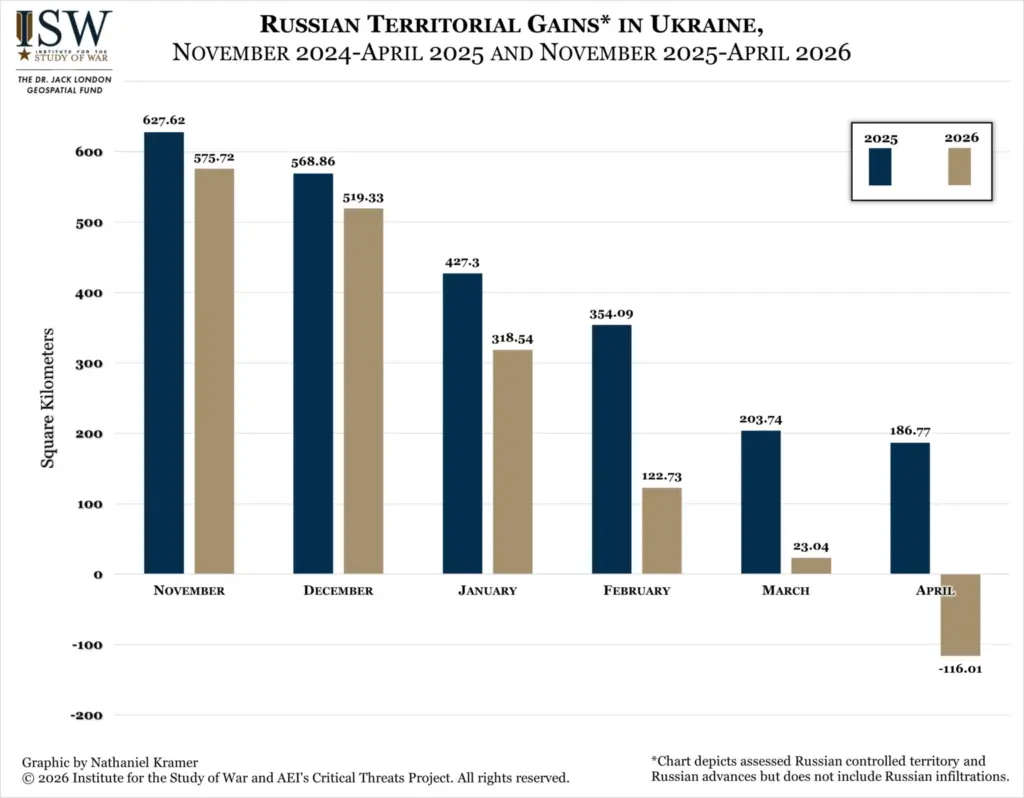
For April 2026, the Institute for the Study of War assessed Russian forces lost net control of 116 square kilometers of Ukrainian territory—the first month of net loss since Ukraine's August 2024 incursion into Kursk Oblast, according to ISW's 2 May campaign assessment.
The reversal sits alongside the highest weekly assault tempo in two months: in the week of 20–26 April, Russian forces launched 1,384 assaults along the front, concentrated particularly on the Pokrovsk axis "after the unsuccessful start of the spring campaign," in the assessment of Ukrainian battlefield monitors at 24 Kanal.
Despite the pressure and talk of "bargaining over a few square kilometers of territory," Ukraine continues to hold the front firmly—and to mount counter-offensive operations that thwart Russian plans and inflict heavy losses.
Russia continues to prioritize capturing Donetsk Oblast—yet remains unable to reach even its administrative border. Russian spokesman Dmitry Peskov's demand that Ukraine surrender the unoccupied parts of Donetsk Oblast is itself an attempt to extract through negotiation what Russia cannot take by force. The slowing pace of Russian advance demonstrates the difficulty of occupying the region—and the Kremlin knows it.
The main pressure points of the Russian army—Donetsk Oblast
Through late March and April, Russian forces concentrated on several "focal points" of pressure. Their greatest advances came in Donetsk Oblast.
Russia achieved some success toward the Kramatorsk-Sloviansk conurbation—the fortress cities of northern Donetsk Oblast. Russian units advanced slightly along the Sloviansk-Bakhmut road, capturing small villages along the Minkivka-Pryvillia-Nykyforivka line. Russian troops near Minkivka have likely reached the Siverskyi Donets-Donbas Canal, intelligence reports—one of the main obstacles for forces advancing east of Kramatorsk.
Russia crossed the canal earlier near Chasiv Yar, so the Russian command is likely to intensify flanking pressure—advancing along the canal from the south (Maiske-Novomarkove) and the northeast (Fedorivka-Nykyforivka-Druha).
The security situation around Kramatorsk is already deteriorating. The threat from Russian tube artillery and FPV drones is at its highest level yet. The Sloviansk–Kramatorsk road has become extremely dangerous for travel, even at speed, sitting only 18–20 kilometers from the line of contact. The situation is not yet critical, partly thanks to anti-drone nets installed against Russian Molniya-2 drones.
The Kramatorsk offensive runs through a second focal point: Kostiantynivka. Pushing west from Chasiv Yar, Russian forces are pursuing two simultaneous objectives—pressuring Kramatorsk from the southeast while bypassing Kostiantynivka from the northeast. These plans have not been realized, but Russia will continue to apply systematic pressure.
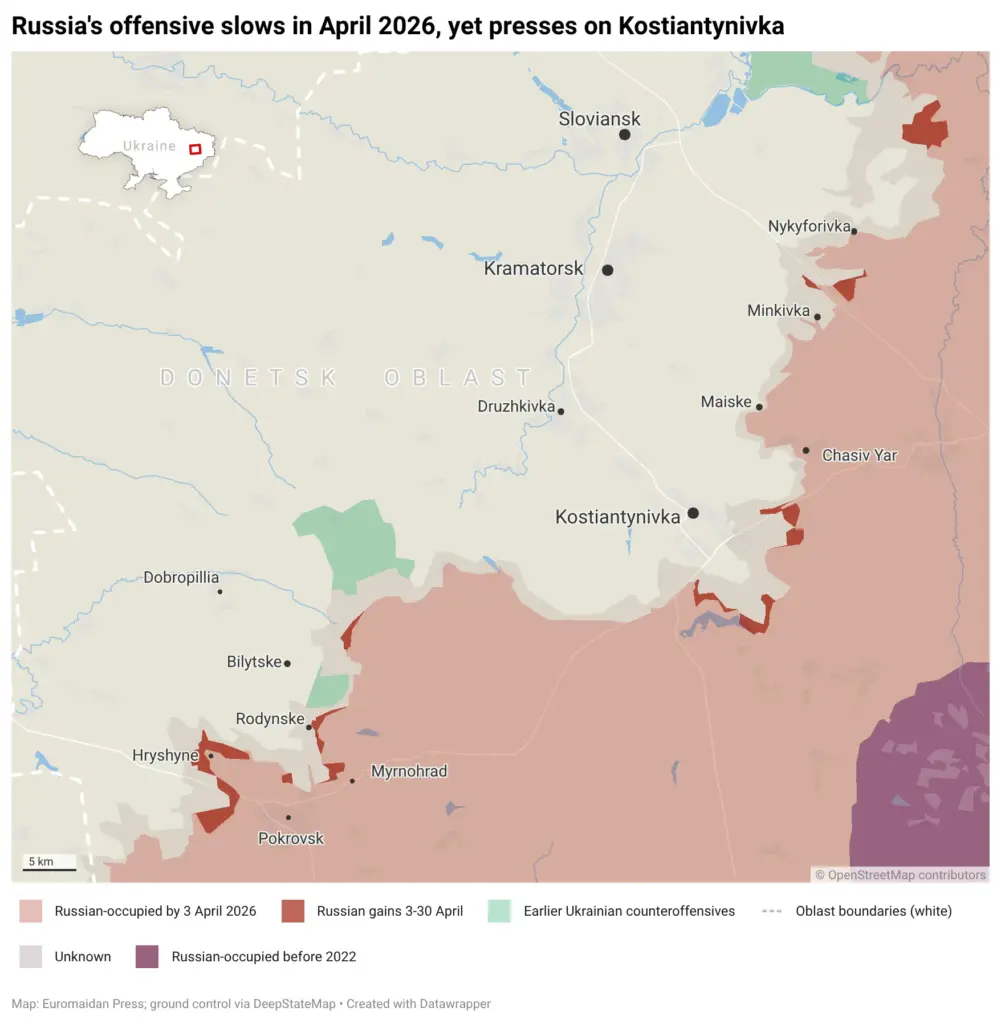
Russia's 8th Combined Arms Army and 3rd Army Corps "now have to break through toward Kostiantynivka via the short route, essentially head-on, literally covering its southern and southeastern approaches with the bodies of their assault infantry," Ukrainian military analyst Kostiantyn Mashovets wrote in mid-April. "This is slow, exhausting, and, above all, extremely bloody and costly." The same Russian playbook that took Pokrovsk—small infantry groups slipping through gaps in Ukrainian drone surveillance—is now visible inside Kostiantynivka itself.
By mid-April an estimated 2,500 residents remained in Kostiantynivka itself—down from 4,800 in November—with neither police nor civilian authorities able to enter the city. Ukrainian defenders are now the only force capable of evacuating those who want to leave.
Russian drone operators are striking the Druzhkivka-Kostiantynivka road to cut off supplies to the city's garrison. In recent weeks, Russian troops have tried—and failed—to infiltrate the city from the surrounding settlements of Berestka, Ivanopillia, and Predtechne. Russian incursions into the city itself have grown more frequent, but Ukrainian defenders prevent them from consolidating.
Pokrovsk sector: Russia's goal is to flank Kramatorsk from the west
Since mid-March, Russia has occupied the entire northern part of Pokrovsk—following its capture of the city's center in late January. Through constant assault operations—averaging 270 attacks per day—and concentrated drone strikes, Russian forces advanced toward Hryshyne, northwest of Pokrovsk.
The more revealing move is north of the city. Having captured Rodynske on 24 April after months of fighting, Russian forces are now pushing on Bilytske, south of Dobropillia. The lead unit is the 76th Guards Air Assault Division—Russia's Pskov-based airborne elite—which is sustaining what Ukrainian commanders describe as "colossal losses" and being reinforced with Russian-proxy "Somali" battalion units to plug the gaps, according to the Ukrainian 7th Rapid Response Corps of the Air Assault Forces.
The strategic logic is no longer simply to take Pokrovsk and clear the salient. "The fate of this direction is decided not in Pokrovsk and not in Myrnohrad," Volodymyr Polevy, communications head of the 7th Air Assault Corps, told Ukraine's national telethon on 28 April. Dobropillia is the lever to flank the entire Kramatorsk-Sloviansk agglomeration from the west—severing the fortress belt from rear-area logistics rather than storming it head-on. When the front door costs too much, the Russian command tries the back.
Russian advance in this sector was slowed earlier this spring, when units were pulled south to fight Ukraine's late-February counter-offensive at the junction of Donetsk, Dnipropetrovsk, and Zaporizhzhia oblasts.
Russia's main effort remains in Donetsk Oblast, with the highest concentration of attacks over the past three weeks. The campaign's center of gravity has not shifted—it keeps returning to the Pokrovsk-Kostiantynivka-Kramatorsk corridor. The April assault tally confirms it: the intensity is rising; the territorial yield is not.

Tanks couldn’t take Chasiv Yar. So Russia’s reaching for the playbook that took Pokrovsk.
Southern Front—Huliaipole and Oleksandrivka sectors
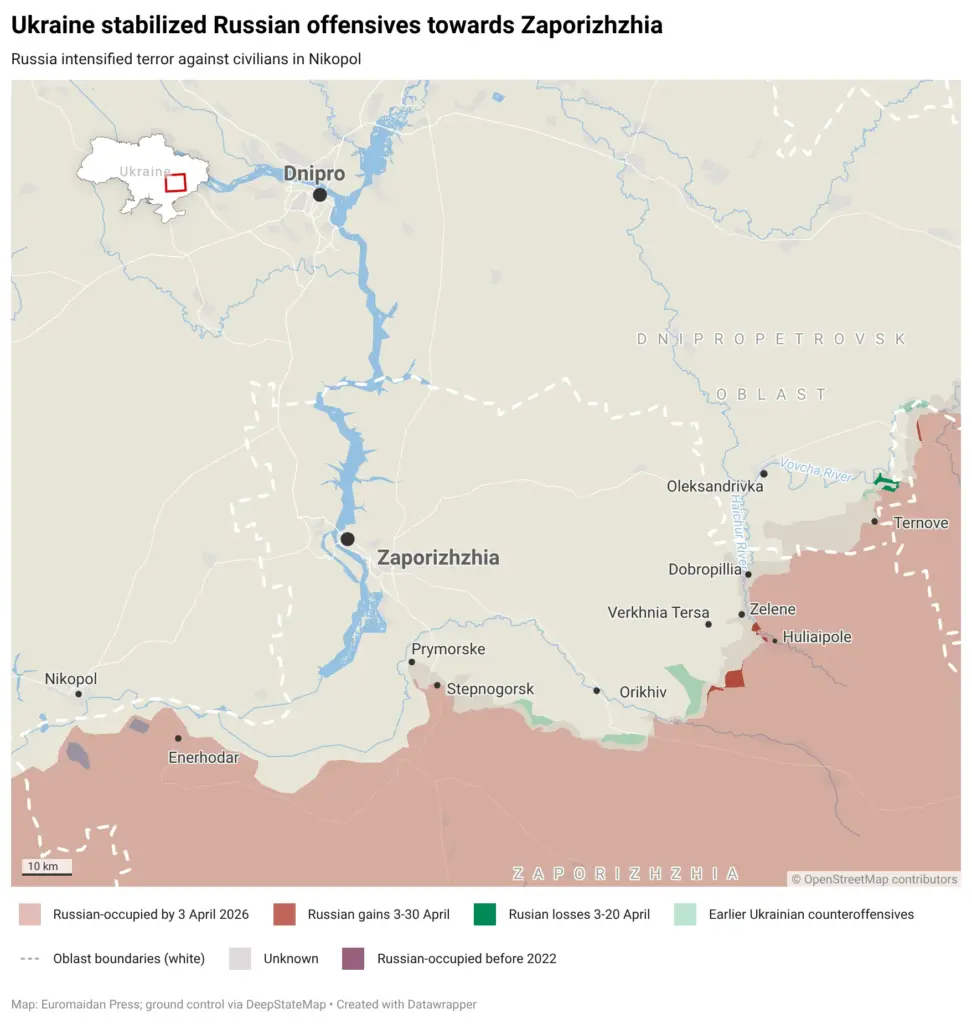
Ukrainian counter-offensive operations at the junction of three oblasts, launched in late February, allowed the Defense Forces to retake much of the territory south of Oleksandrivka—forcing Russia onto active defense in the sector and driving Russian units out of Dnipropetrovsk Oblast.
It also stabilized the situation around Huliaipole, which Russia had occupied rapidly in late December 2025. Despite continued Russian assaults and intensifying air strikes—with one in three aerial bombs hitting targets in Zaporizhzhia Oblast—Russia has not converted the pressure into territorial gains.
Trending Now
The intensity of bombing in Zaporizhzhia Oblast—the highest of any sector over the past two months—may reflect Russian attempts to disrupt Ukrainian offensive operations from the air.
The situation also held around Prymorske and Stepnogorsk, where Ukrainian units, including Main Intelligence Directorate forces, earlier carried out stabilization operations.

Russia is losing ground for the first time in 27 months. Ukraine’s drones might be why.
Nikopol—a manhunt
Unable to deliver on military objectives, Russia has intensified its terror against civilians—particularly in Nikopol, separated from occupied territory only by the Dnipro River.
Russian shelling in the Nikopol community killed five and wounded 52 in March 2026. In the first week of April alone, the toll was 10 dead and 89 wounded. The escalation followed the deployment to Enerhodar of a Russian Special Forces brigade operating to the standards of the Russian drone unit "Rubicon"—a 5,000-strong center for advanced unmanned tactics that has become the testbed for Russia's frontline drone warfare.
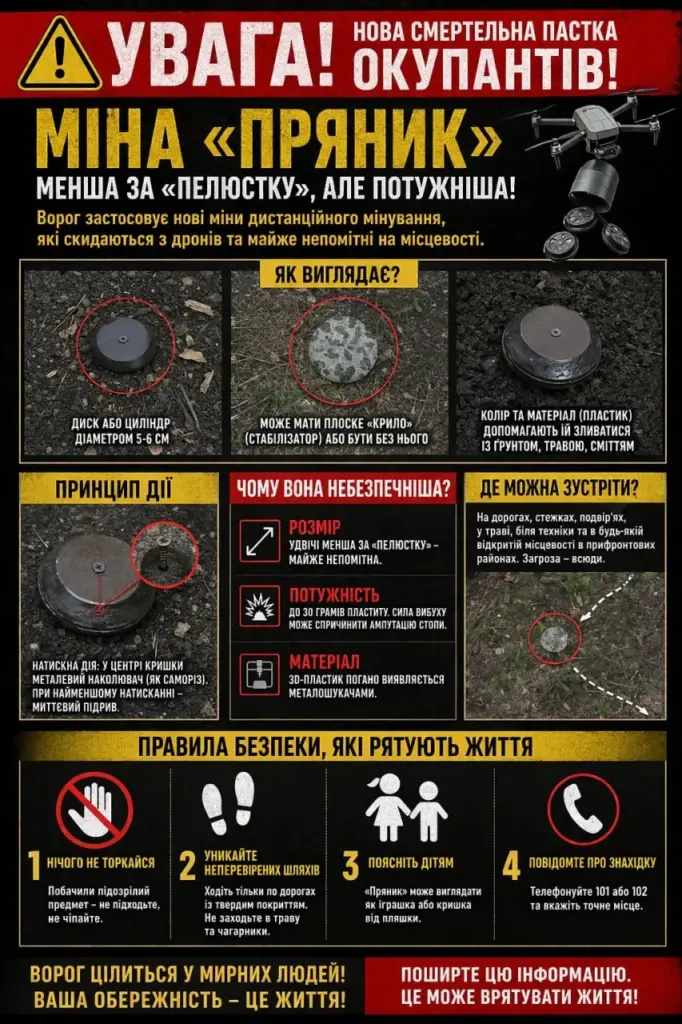
Beyond direct drone attacks on civilians, Russian troops are laying anti-personnel mines—known as "gingerbread"—in residential areas and dropping propaganda leaflets from drones. Anti-personnel mining of populated areas is prohibited under the Geneva Conventions; the pattern is deliberate—and the UN has previously confirmed Russia's systematic FPV-drone targeting of civilians in southern Ukraine as crimes against humanity.
Attempts to establish a buffer zone
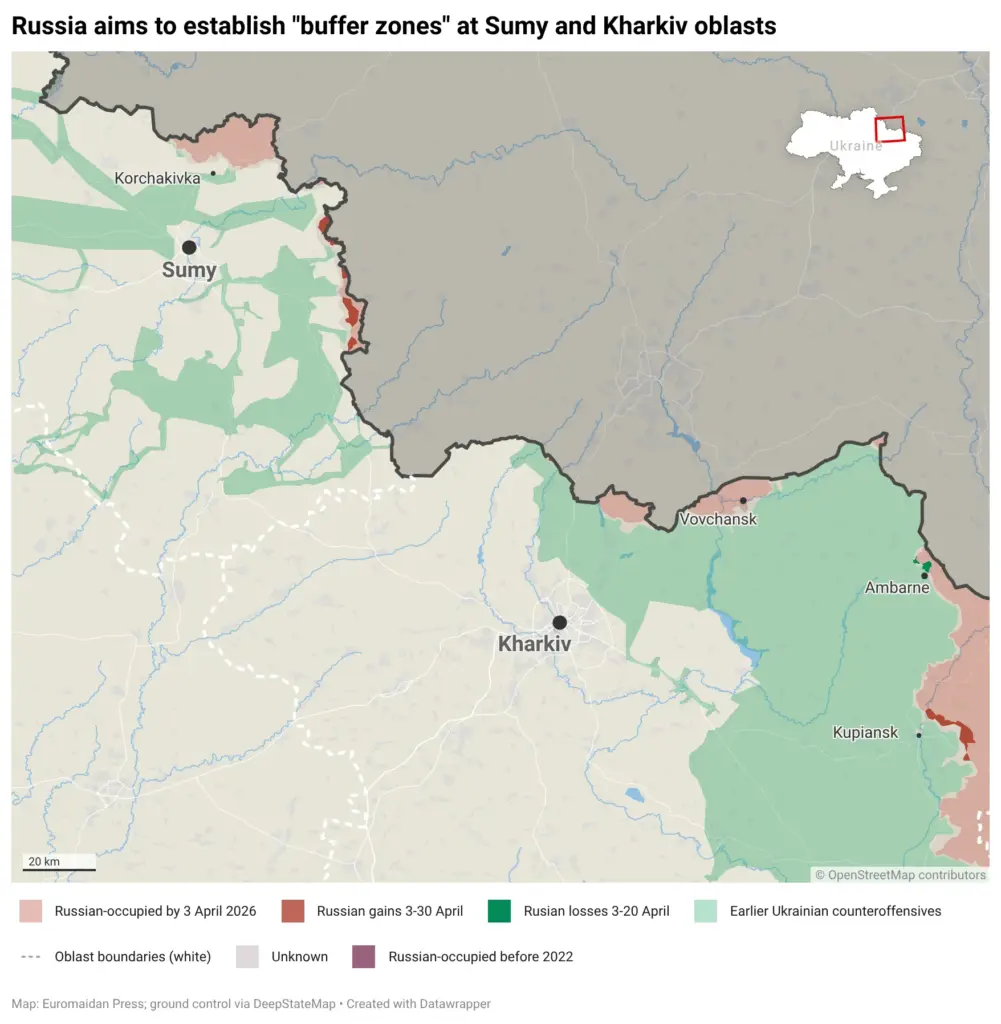
Russia remains determined to implement its "buffer zone" plan along Ukraine's state border. In March and April, Russian forces achieved territorial gains along the border in Sumy and Kharkiv oblasts. Ukrainian intelligence has detected Russian plans to extend "buffer zones" to Vinnytsia Oblast from occupied so-called Transnistria, said Deputy Head of the Office of the President Brigadier General Pavlo Palisa—though, he added, Russia lacks the resources to deliver.
Where Russian forces did advance along the border, they infiltrated abandoned settlements with small groups—effectively occupying a grey zone with no concentration of Ukrainian forces.
Ukrainian Joint Forces continue to thwart these infiltration attempts. In late April, Ukrainian units advanced around the border village of Ambarne in Kharkiv Oblast and struck a concentration of Russian infantry near the border in Russia's Bryansk Oblast—pre-empting the buildup and likely infiltration into Sumy Oblast.
Ukrainian drones—and the cost curve
Over the past year, Ukraine has dramatically scaled up strike-drone use along the front, matching and in some sectors exceeding Russian capabilities at the line of contact. Ukrainian forces deploy 30% more front-strike drones than Russia—a 1.3-to-1 ratio, according to Brigadier General Pavlo Palisa. Russian military bloggers and war correspondents confirm the shift, complaining in recent weeks about the volume and quality of Ukrainian front-strike drones, the threat they pose, and the absence of countermeasures from the Russian command.
The result is visible in the price Russia now pays per square kilometer of Donetsk soil. In the first quarter of 2026, Russian forces in Donetsk Oblast lost an average of 316 soldiers killed or wounded per square kilometer, up from roughly 120 a year earlier. In some sectors, losses have doubled. This is the arithmetic that ties the assault tempo to the territorial loss: Russia is buying less ground at higher cost than at any point this year. The April reversal is what the cost curve looks like when it finally crosses the line.

Russia still holds the upper hand in certain sectors—particularly in concentrated drone strikes—and retains the ability to exert pressure. Ukraine, in turn, retains the resilience to absorb that pressure, partially neutralize it, and gradually regain ground.
Whether the late-April reversal hardens into a sustained shift, or proves a short window before Russia regenerates offensive momentum, depends on two variables outside the front line itself: the tempo of Western military assistance, and what happens on the negotiation track in the weeks after 9 May. The cost curve, for now, is on Ukraine's side.


