

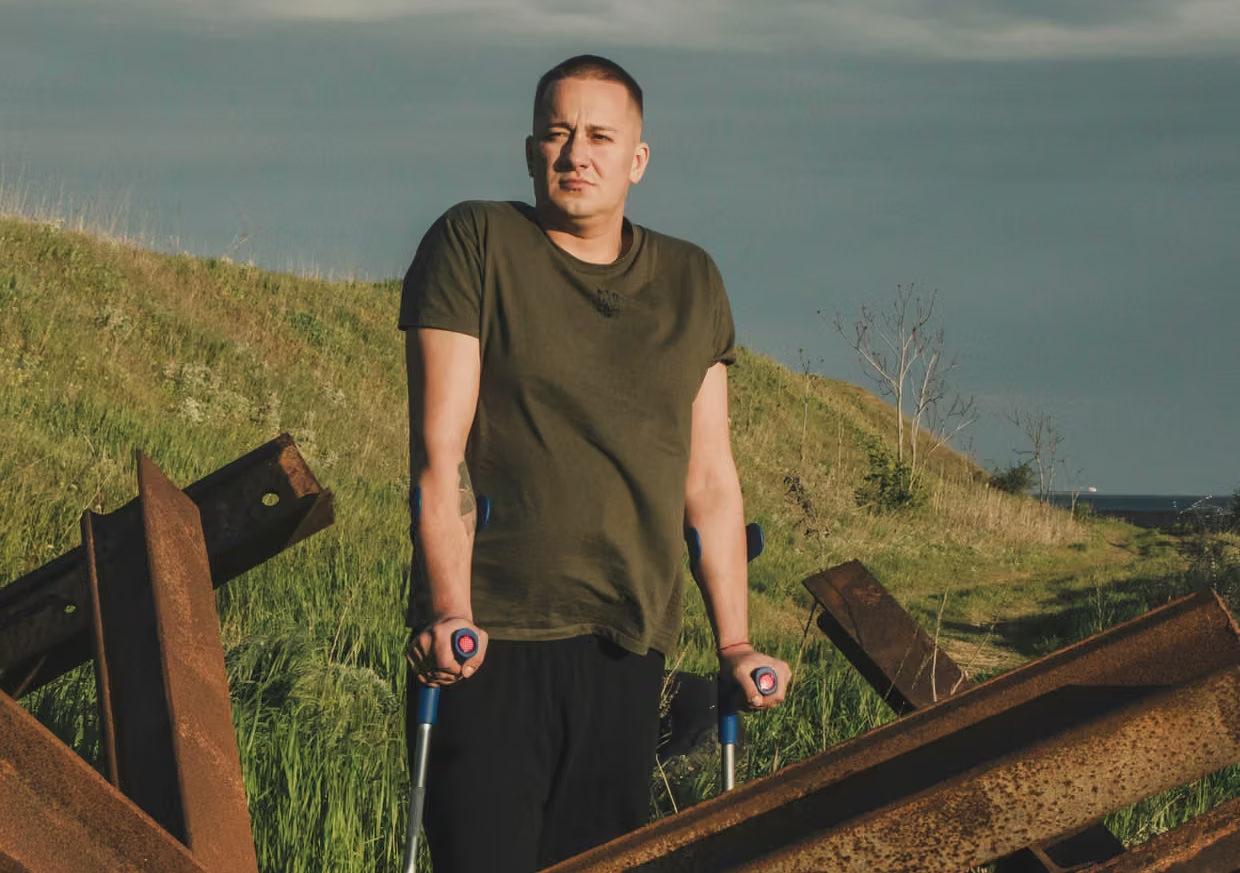
Vadym Lietunov spent fourteen days in a Russian dugout he had walked into by accident. The Russian inside kept a rifle on him for most of those days. When a Ukrainian armored vehicle finally pulled up at the position, Lietunov got in. So did the Russian — but he got in as a prisoner.
Lietunov's account, published 3 May in The Guardian, exposes conditions on the Russian side of the Zaporizhzhia line: prison-recruited soldiers and 250-gram daily rations from drone drops.
The 34-year-old corporal from Odesa, callsign Cartman, serves with Ukraine's 118th Separate Mechanized Brigade. His position on the Zaporizhzhia front had been under sustained drone and mortar fire for days. In late February an anti-tank mine destroyed the trench and killed his comrade Sasha. Concussed and barefoot, Lietunov ran toward what he believed were Ukrainian lines and ducked into the first dugout he saw.
He started shouting for his unit. Then he heard rustling. Then an accent. Lietunov realized it was a Russian soldier and said:
"You are not one of us, are you? Please don’t kill me.”
The Russian soldier, identified by Lietunov as Nikita, was a former prison inmate sent to the front — a drug user, by Lietunov's account, and someone who believed in the Kremlin's standard claim that Ukrainian troops were “narco-maniacs” fitted with secret GPS trackers. Nikita searched Lietunov's belongings for drugs and found none. He let Lietunov stay.
Two men, 250 grams of food a day, fourteen days
The two men lived inside the dugout for the next two weeks. Nikita's daily ration was 250 grams of food, dropped by Russian drone when the wind allowed it. He drank rainwater. Sometimes worse. Lietunov, unarmed and concussed, watched him.
The threats came and went. Nikita pressed the rifle to Lietunov's forehead, said he would shoot, then put the rifle away again. Lietunov is a corporal—he ran a store before the war, has a wife and a young son in Odesa, has no formal training in interrogation or hostage psychology. What he had was attention. He pretended to be less capable than he was. He waited out the rage. When the cigarettes ran out, when the supply drone didn't come, when Nikita complained about how the Russian army was supplying its men, Lietunov talked to him about the Geneva Conventions. About three meals a day. About what surrender to Ukraine actually looked like.
One morning Nikita asked him: "Maybe I should surrender to you?"
Lietunov played it down—there was no rush, he said. Then he laid out the offer again.
Ukrainian forces sent two kill drones before they sent a rescue
When the water ran out completely, the men stepped outside. Fog. A Ukrainian drone overhead. Lietunov held up a sign with his callsign and brigade number. His command had assumed he was dead.
The first drone Ukrainian forces sent was a kill drone. They sent a second one too. Both were called off only after a commander pulled up Lietunov's social media accounts and recognized the emaciated figure on the ground as their missing comrade. Lietunov has described that interval—the half hour between the second cancellation and the next drone arriving—as the moment he understood it was either the end or the start of a new life.
The next drone dropped a radio. Lietunov used it to tell his unit that he was the prisoner, not Nikita, and that his life depended on Nikita's mood. He asked for food and water.
The first delivery brought four boil-in-the-bag meals, water, and what Lietunov has called nasty cigarettes. He told Nikita he could not swallow and gave him his share. It was manipulation, Lietunov has acknowledged. Nikita had told him: when he was full, he was kind.
Russia's drones started delivering bombs to plant in the forest
The Russian side did not stop operating just because the Ukrainian side was now feeding both men. At one point a Russian drone dropped Nikita a log with TNT hidden inside. His orders were to plant the booby-trap in the forest.
Nikita had also been turning over other options aloud. He had wondered whether, when the Ukrainian armored vehicle came, he might capture it and drive it back to Russian lines. Until it appeared, Lietunov did not know whether Nikita would surrender, drive away with the vehicle, or detonate the dugout with both of them inside.
It was a Friday when the fog rolled in and the Ukrainian armored vehicle appeared without warning. Both men climbed into the back. Lietunov was still without boots. Nikita surrendered without resistance and destroyed his mobile phone before they pulled away.
At brigade HQ, his people thought he was dead
Back at the 118th Brigade headquarters, Lietunov's comrades hugged him. He told a senior officer he had promised Nikita decent treatment under the Geneva Conventions—the promise needed to hold. A video that circulated later showed Nikita smiling and relieved, saying that he took Vadym prisoner.
The Security Service of Ukraine took custody of him for use in a prisoner exchange. Lietunov has described the survival as a one-in-a-million chance.
Read also
-
Russia holds 2,000 people hostage in Oleshky without food or water—Ukraine flew 4,000 kg of food to locals across the Dnipro
-
New Vivaldi tactic: Ukraine’s ground robots, each carrying two Bullspike grenade launchers, attack Russian positions and then detonate inside their shelters
-
Swiss voters crush neutrality initiative that would have ended sanctions against Russia—70% say No


