

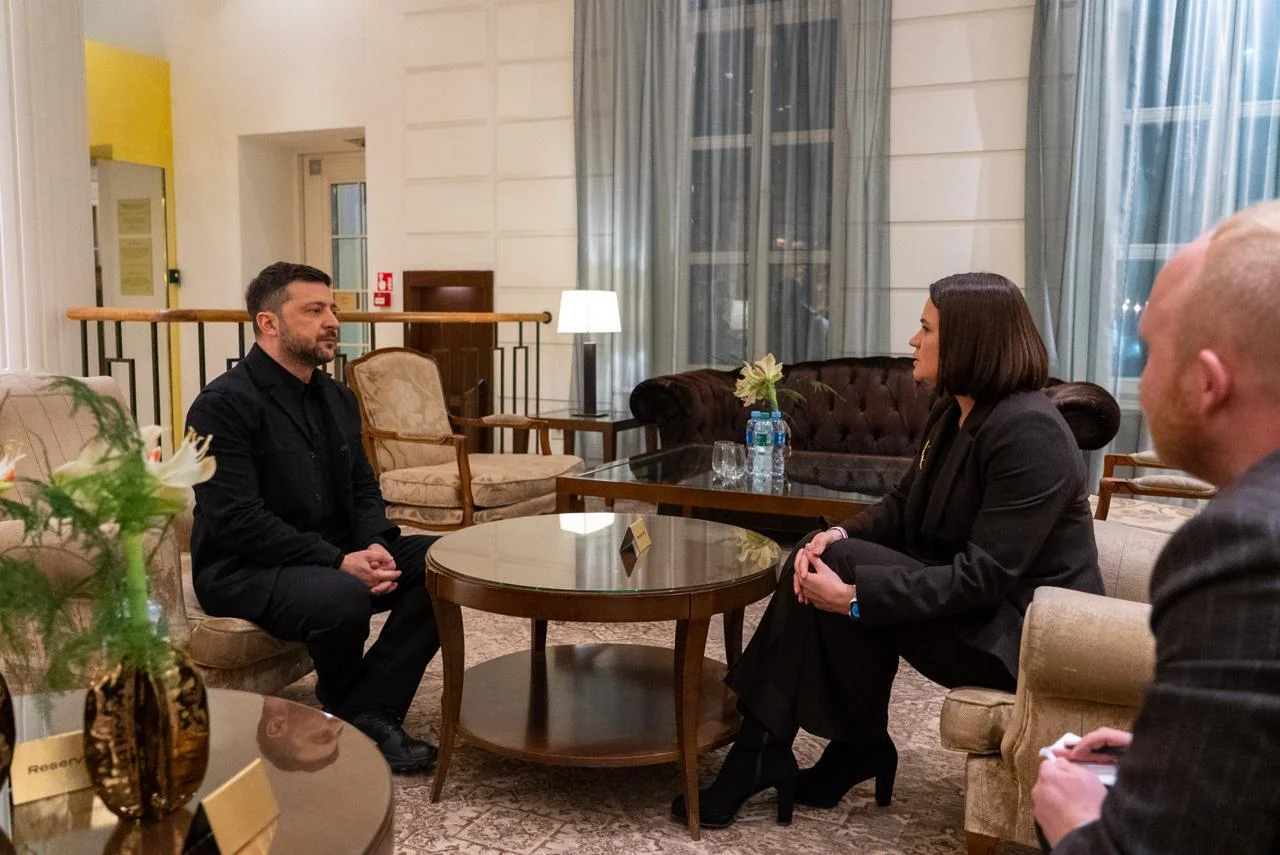
On 25 January in Vilnius, Volodymyr Zelenskyy held his first full bilateral meeting with Sviatlana Tsikhanouskaya, head of Belarus's United Transitional Cabinet. The initiative came from the Ukrainian side—a detail noted with some surprise by those who had watched Kyiv carefully avoid exactly this meeting for years. Foreign Minister Andrii Sybiha followed up by announcing a revision of Ukraine's approach to cooperation with Belarusian democratic forces. Zelenskyy invited Tsikhanouskaya to Kyiv and said he was selecting a Special Envoy for Belarus.
More than two months later, neither promise has been fulfilled. Tsikhanouskaya’s planned Kyiv visit was postponed to an unspecified date. The special envoy remains unnamed. That does not erase the significance of the Vilnius meeting, but it tempers expectations. Ukraine has clearly moved toward Tsikhanouskaya’s office. What remains unclear is whether Kyiv is ready to turn a symbolic breakthrough into a consistent policy.
In an interview with Euromaidan Press, Svitlana Shatilina, head of the Mission of the Democratic Forces of Belarus in Ukraine, said she remains optimistic about the opening created by the January meeting. But she also pointed to the gap between diplomatic rhetoric and practical delivery.
What happened in Vilnius
The agenda covered significant ground. The two sides discussed sanctions policy, a joint strategy with Western partners, and efforts to hold Aliaksandr Lukashenka accountable—including for the forced displacement of Ukrainian children. Tsikhanouskaya raised the situation of captured Belarusian volunteer fighters in Russian custody and thanked the Presidential Office—specifically naming intelligence chief Kyrylo Budanov—for facilitating political prisoner releases and accepting freed prisoners into Ukraine. She proposed that Ukraine appoints a Special Envoy for Belarus.

On the volunteer fighters in Russian captivity: two are known—Yan Dziurbeika and Siarhei Dziogtsev. Both of them fought in the ranks of the Kalinouski Regiment and were captured on 26 June 2022. Their whereabouts and condition remain unknown. When the Mission of the Democratic Forces of Belarus in Ukraine formally approached Ukraine’s Coordination Headquarters for the Treatment of Prisoners of War, it was told such information could be released only to relatives. “Unfortunately, we have no information about where they are or what condition they are in,” Shatilina told Euromaidan Press.
She thinks that the Ukrainian authorities might consider a possible exchange mechanism. Around 14 to 20 Belarusians who fought on Russia’s side are currently held in Ukraine. In her view, they might be exchanged for Belarusians who fought for Ukraine and were later captured by Russia — a Belarusian-for-Belarusian swap that would carry humanitarian and symbolic weight. “It would be a very symbolic humanitarian gesture,” she said, adding that such a move would show Belarusians worldwide that Ukraine remembers those who fought for it.
Ukraine still does not officially recognize Tsikhanouskaya as Belarus’s legitimate president-elect. But the relationship her office has built gradually — through Ukrainian MPs, Foreign Ministry officials, and civil society — was, for the first time, acknowledged at the highest political level. That matters. It means Ukraine has at last joined a position long taken by much of Europe: treating Tsikhanouskaya as the democratic representative of Belarus, even if without formal recognition language. Several European governments host her office, receive her at the level of presidents and prime ministers, and maintain regular working contacts with her team. However, no state officially recognized her as president-elect.
"Ultimately, Ukraine has done nothing extraordinary. Tsikhanouskaya is recognized as the democratic leader of Belarus throughout Europe, and we have simply finally joined the common European position", said Ihor Kyzym, former Ukrainian ambassador-at-large for Belarus
Why Kyiv waited
European Pravda reported that the previous head of the Presidential Office, Andriy Yermak, actively opposed contacts with Tsikhanouskaya's team. His alleged argument: the Belarusian democratic camp was fragmented, engagement carried risks along the northern border, and cooperation would not strengthen Ukraine but create additional exposure. The goal was to manage Lukashenka, not antagonize him. Shatilina, speaking carefully, acknowledged the reports without confirming them: "Official sources neither confirm nor deny it, so we can only work with rumors." The strategy she described in broader terms was blunter: "don't anger the old man"—Lukashenka—a posture Ukraine maintained even after February 2022.
That logic survived even after February 2022, when Lukashenka allowed Russian forces to stage from Belarusian territory for the assault on Kyiv. The regime’s alignment with Moscow was no longer in doubt, yet - surprisingly, to many - Ukraine’s approach to the democratic opposition changed little. In November 2023, when the Kastus Kalinouski Regiment held a major “Path to Freedom” conference in Kyiv with more than 100 Belarusian democratic representatives, Tsikhanouskaya could join only by video link. Ukraine’s Foreign Ministry had not issued the formal invitation required for her to enter the country.
That episode matters, because it showed that Kyiv’s distance was not merely rhetorical. It was administrative, political, and sustained.
By early 2026, several things had changed. Yermak’s departure from the Presidential Office may have been one factor. His replacement, Kyrylo Budanov, had already been active on the Belarus file in ways Yermak never was, including helping organize the transfer of more than 100 released Belarusian political prisoners to Ukraine in December 2025. He had also maintained working contacts with Belarusian democratic circles.
The external environment shifted as well. The Trump administration’s engagement with Lukashenka, and the prospect of sanctions relief for Belarus’s potash sector, suggested to Kyiv that the long-feared second-front risk was receding. Carnegie analyst Artyom Shraibman argued in February that the prospect of direct Belarusian military participation seems increasingly illusory. At the same time, Ukraine’s growing confidence in its own drone capabilities appears to have widened its room for maneuver. Lukashenka has long tried to present himself as Ukraine’s only meaningful postwar interlocutor in Belarus. The Vilnius meeting suggested that Kyiv was no longer willing to accept that premise.

Nobel laureate, top opposition figures freed as Belarus trades prisoners for US sanctions relief
The change in diplomacy, however, still outpaces the change in policy.
That is visible not only in the delayed Kyiv visit and the missing envoy, but also in unresolved issues affecting Belarusians in Ukraine. Shatilina identified three concrete problems. Belarusian citizens can renew passports only inside Belarus — a step many opposition-minded Belarusians in Ukraine consider unsafe due to the risk of arrest for political activity or support for Ukraine, including volunteering or fighting as foreign volunteers. Temporary permits do not qualify as legal residency under Ukrainian law, leaving holders unable to open bank accounts or register businesses. And the roughly 250,000 ethnic Belarusians who hold Ukrainian citizenship have received no visible signal that Kyiv’s new more positive posture extends to them as well. Such recognition could strengthen engagement within this community, which has actively participated in the democratic movement and Ukraine’s defense while seeking to distinguish itself from the Lukashenka regime.
Trending Now
“These steps would demonstrate that democratic Belarus gets a green light here,” Shatilina said. “It would be a clear signal to democratic Belarusians across the world that Ukraine separates the Lukashenka regime from the Belarusian people.”
That may be the clearest test of whether Ukraine’s January shift is real. Diplomatic meetings matter, but the real question is whether Ukraine is willing to turn its revised approach into administrative and legal changes with tangible consequences for Belarusians.
The Kalinouski Regiment: a partnership with unresolved edges
Beneath the diplomatic timeline runs a practical relationship that predates it. Belarusian volunteers have fought in Ukraine since 2014, some of them consolidated after 2022 into the Kastus Kalinouski Regiment—named for the 19th-century leader of the January Uprising, the same historical figure commemorated in Vilnius on the evening Zelenskyy and Tsikhanouskaya finally met. It is not the only Belarusian volunteer unit in Ukraine, but it is the most prominent one. The regiment operates under Ukrainian military command while maintaining its Belarusian identity — using Belarusian language internally, displaying the white-red-white flag and the Pahonia emblem, and framing its mission as both defending Ukraine and fighting for a future democratic Belarus. It is both a combat unit and the clearest demonstration that many Belarusians stand with Ukraine against Russia.
At times, however, the regiment and Tsikhanouskaya’s office have approached Belarus’s future from different angles. At the November 2023 Kyiv conference, Tsikhanouskaya's representative Anatol Liabedzka declined to sign the closing declaration, citing lack of signing authority. Regiment commander Dzianis Kit signed; the Office's adviser did not. Spokesman Franak Viacorka called it an organizational failure. The deeper tension was strategic: the regiment has consistently pushed for a more radical scenario for regime change in Belarus, while the Office has moved more carefully, navigating between Western partners who prefer diplomatic language and fighters who measure progress in different terms.

By 2025 the relationship had settled into a division of labor—the Office handling diplomacy and material support, including drone deliveries to the regiment; the regiment handling the fighting. In Vilnius, Tsikhanouskaya called the regiment "something truly unprecedented in modern Belarusian history." In December 2024 she had gone further, saying publicly the regiment could serve as a vehicle for regime change. Whether Ukraine is prepared to back that vision—as distinct from simply hosting the regiment—is a question neither side has answered publicly.
“In my view, the time has come for Ukraine to reconsider its position toward Belarusian volunteers — not treating them merely as one of the national groups fighting against Russian aggression, but as a foundation for a broader military-political lever of influence on the Lukashenka regime,” Shatilina says.
Where things stand
The signals since then have been more encouraging. Diplomatic Advisor Dzianis Kuchynski has stated the Kyiv visit will take place soon. On the Special Envoy, the MFA has moved from vague intention to active process: Foreign Ministry Spokesperson Heorhiy Tykhy confirmed in late March that Sybiha would submit candidates to Zelenskyy for a final decision, adding: "The work is underway, and I think we will see its results in the near future." Zelenskyy had already said on 27 February that the Foreign Ministry was preparing candidates. Ukraine is also developing what Sybiha has called a separate systemic policy on Belarus—focused on pressuring the Lukashenka regime, neutralizing its threats, and supporting Belarusians who want a democratic future.
The same tension appears in the debate around prisoner releases and sanctions relief. Shatilina welcomed the humanitarian side of the December 2025 releases, having personally accompanied 109 freed Belarusian political prisoners through Ukraine to Poland and Lithuania. But she also pointed to the structural problem behind such deals. “250 people were released, and 8 more were imprisoned the same day,” she told Euromaidan Press. In her view, the regime is turning repression itself into a bargaining mechanism, collecting prisoners for later exchange in return for concessions.
On how much Ukraine can push back against a process shaped by Washington, she was frank. “You have to take into account the current circumstances. Ukraine is at war and urgently needs all kinds of support. US assistance is critically important.”
That realism runs through this entire story. Ukraine’s opening to Tsikhanouskaya did not happen because Kyiv suddenly discovered Belarusian democratic forces. It happened because the political and security calculus changed enough to make a long-delayed shift possible.
That is why the January meeting matters. It was not just overdue symbolism. It marked the first time Kyiv ratified, at the presidential level, a relationship that had long been built from below. But it is also why the unfinished parts matter just as much. Ukraine has finally moved closer to the common European position on Tsikhanouskaya. It took five years. Whether January 2026 proves to be a turning point rather than an overture will depend not on what was said in Vilnius, but on what Kyiv does next.


