On Sunday, 12 April, Hungary holds one of its most consequential elections since the fall of communism in 1989. Viktor Orbán, in power for 16 years, faces the most serious threat to his grip on power he has ever encountered. His challenger, Péter Magyar, leads Fidesz by double digits in most independent polls. The outcome will reverberate from Kyiv to Brussels to Washington.
What separates Orbán and Magyar on Ukraine is not just rhetoric but policy—choices a new government would have to unwind. What follows is a short guide to where each candidate stands.

Ukraine's EU membership
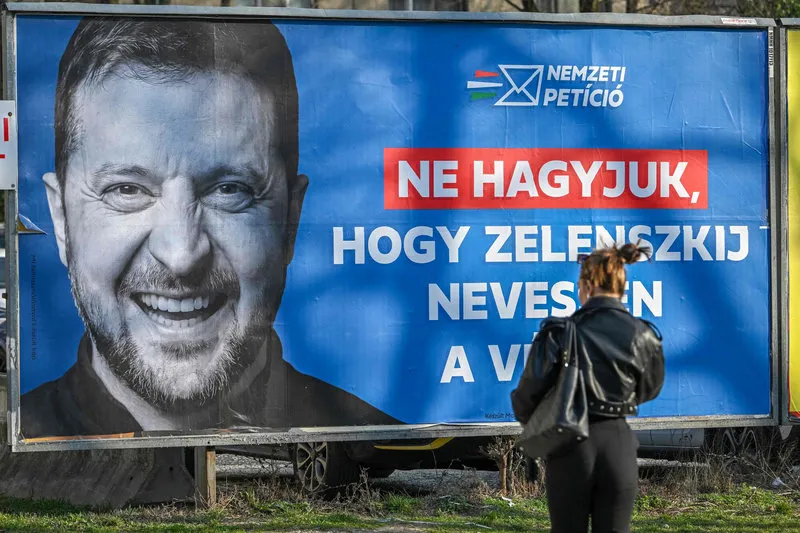
What Orbán did: Orbán blocked Ukraine's accession at every turn, commissioning a national consultation claiming 95% opposed membership, adding "Union without Ukraine" to his demands against Brussels, and giving Szijjártó cover to tell Kyiv it simply had to accept the veto.
Fidesz has won two previous elections by raising fears its opponents would drag Hungary into war. As Rácz noted in an AP interview:
"Populists often try to define an enemy, often an imaginary one, and then offer protection to the society from that enemy. Ukraine has been ideal from this perspective." — András Rácz, Senior Fellow, German Council on Foreign Relations
What Magyar said: At his Munich meeting with Polish Prime Minister Donald Tusk in February, Magyar said it directly: "I emphasized to the Polish Prime Minister that neither the TISZA party nor the majority of Hungarians supports Ukraine's accelerated EU accession."
Magyar's manifesto proposes a binding national referendum on membership. He has confirmed his first foreign trip as prime minister will be to Warsaw—rebuilding a relationship Orbán spent years poisoning.
László Bruszt, Director of the CEU Democracy Institute at Central European University—an institution Orbán's government forced out of Budapest to Vienna in 2017—expects "a pragmatic approach, like most of the other EU member states."
A January 2026 survey found 55% of Hungarians support Ukraine's EU membership in spite of years of state media messaging against it—"not the lowest in Europe," he told Euromaidan Press. That figure exists, he added, despite what he calls Orbán's "compact against Ukraine."
Russia policy
What Orbán did: A Bloomberg transcript published 7 April showed Orbán telling Putin directly: "I am at your service."
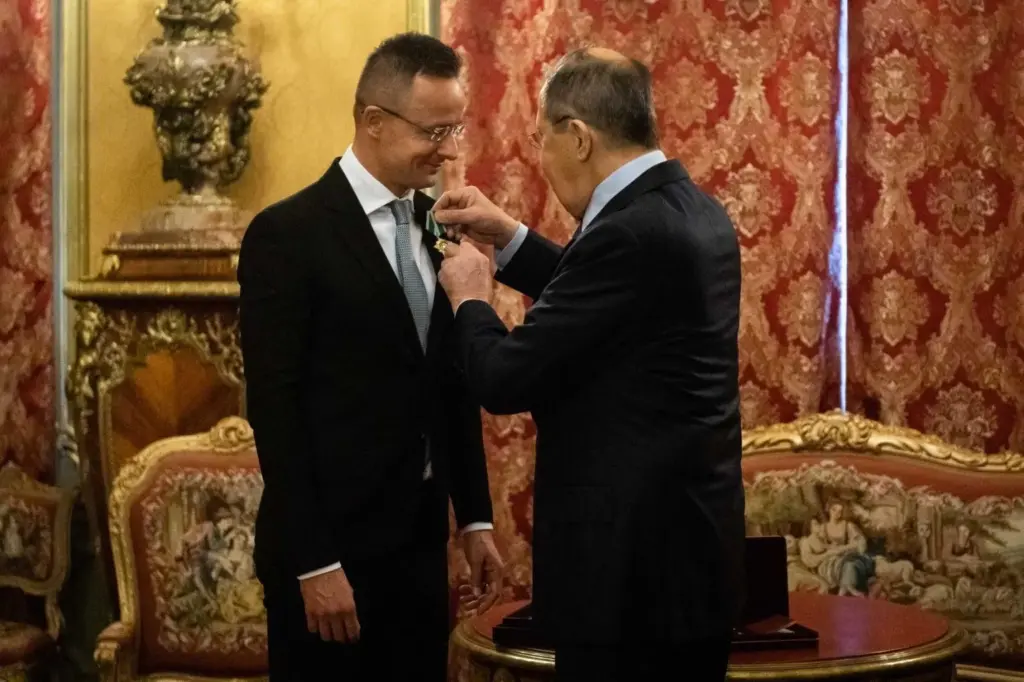
A joint investigation by five European outlets, led by VSquare, produced the first verbatim evidence of the mechanism. Leaked recordings showed Péter Szijjártó removing 72 entities from EU sanctions at Moscow’s request, asking Russia to draft his arguments for further removals, and routinely briefing Sergey Lavrov on the contents of closed EU Council sessions.
The consequences reached Warsaw: Polish Prime Minister Tusk told reporters his government deliberately limits what it shares with Budapest at EU meetings, knowing "how this information can be used."
"I am always at your disposal." — Péter Szijjártó to Russian FM Sergei Lavrov, recorded call published by VSquare
What Magyar said and what to expect: Magyar has declared he will not continue "serving the interests of Moscow" in EU foreign policy, Bruszt said.
He accused Orbán of treason for inviting Russian military intelligence into Hungary—drawing a comparison to Soviet-era PM János Kádár—and pledged an immediate investigation into Szijjártó's Russia ties.
"[Magyar] will stress the sovereignty of Hungary, independence from Russia. There is a very strong indication in his speeches about that," Bruszt told Euromaidan Press.
But Vitalii Diachuk, an analyst at the Institute for Central European Strategy, warns that dismantling the underlying ecosystem outlasts any government: "Hungarian youth have never lived in a country with free media or quality democracy." Moscow will keep funding anti-Ukrainian content regardless of who governs in Budapest, thus potentially complicating a Magyar government's pivot from Russia.
The €90 billion EU loan and Budapest's blackmail tactics
What Orbán did: He blocked the €90 billion EU loan approved by 26 other member states, conditioning veto removal on Ukraine repairing a pipeline Russia had bombed. When that moved too slowly, his government intercepted a legally transiting Oschadbank armored convoy, detained seven Ukrainian bank employees, and kept $82 million in cash and gold as "evidence"—then threatened to repeat it.
A second VSquare investigation showed Budapest coordinated with Moscow to block the EU's 18th sanctions package. Rácz explained the logic to the Wilson Center: "To basically extort money or favors by promising not to cause any further problems. This is a small-power strategy: the only way you can exert influence is actually to misuse the veto you have by spoiling things."
What Magyar did—already: In February 2026, Tisza MEPs voted against the €90 billion EU loan, aligning with Orbán. Bruszt argues this reflects opposition campaign constraints, not governing philosophy: as an EPP member, Magyar "will not continue this politics of Orbán, which was done primarily to show his loyalty to Trump and to Moscow." The key is a redefined sovereignty—one that treats a functioning EU as a Hungarian national interest rather than a constraint on it.
Hungarian minority rights in Zakarpattia
What Orbán did: He used Zakarpattia's 150,000 ethnic Hungarians as a recurring diplomatic weapon, framing Ukrainian language laws as persecution while blocking Ukraine's EU accession on minority grounds. In 2025 the SBU exposed a Hungarian military intelligence network operating inside Ukraine—the first time Kyiv had uncovered such an operation on its territory.
The mechanism and what to expect: In a correspondence with Euromaidan Press, Diachuk argued that Fidesz is "far less interested in the actual situation of the Hungarian community in Zakarpattia than in the symbolic function the community performs in the political mechanism." Demands appear, expand—and instead of resolving, Budapest escalates. The unresolved status is the intended outcome.
"Official Budapest, Fidesz, or individual Hungarian politicians do not give direct instructions—but they create an environment in which provocations are useful and go unchallenged. That way, Orbán can sincerely say he is only reacting to what is happening." — Vitalii Diachuk, Institute for Central European Strategy, written responses to Euromaidan Press
Bruszt pushes back on the idea that this is structurally intractable. Hungary has already negotiated minority rights settlements with Slovakia, Croatia, and Romania—countries that at the time had strongly anti-Hungarian forces in government—and reached workable agreements with all of them. Once a settlement is made, he argued, disputes stop: "Since making a settlement in these issues, I haven't heard of any kind of violation or any kind of conflict."
Diachuk is less optimistic. Even a Magyar government faces an electoral dilemma: refuting the myth means challenging the sincere beliefs of "your own people," which would be "electoral suicide." Ukrainophobic narratives, he warned, have "acquired a life of their own." Thus, counteracting them would take time, and would most likely not be a top-down initiative.
"Only politicians can create unsolvable problems—and this is not one of them." — László Bruszt, Director of the CEU Democracy Institute, Central European University, interview with Euromaidan Press, 11 April 2026
The constitutional question: what Magyar can actually do
The margin of Sunday's result matters more than most pre-election coverage has acknowledged, Bruszt argued—and it depends entirely on what Tisza actually wins.
If Tisza wins a simple majority: Magyar governs within the constitutional framework Fidesz engineered over 16 years—Orbán-era appointments entrenched across the judiciary, state media, and fiscal oversight. As Verfassungsblog has documented, Fidesz locked two-thirds requirements into changes to taxation, pensions, education, and media—meaning a simple-majority government cannot touch them.
That matters for Ukraine directly: a simple-majority Magyar government inherits the same EU Council unanimity rules Fidesz used to veto sanctions, block the €90 billion loan, and stall Ukraine's accession — the lever is the same, only the hand changes.
If Tisza wins a two-thirds majority: Magyar can rewrite the constitution—including the Fidesz-built legal framework that embedded Hungary's anti-Ukraine media ecosystem into state structures. Diachuk's warning that dismantling that environment takes years assumes that a new government lacks the constitutional tools to accelerate the process. A supermajority changes that calculation, as a CSIS analysis of post-election scenarios found.
Either way, the immediate priority for a Magyar government would be Hungary's domestic economy: "[Magyar] has to start with crisis management, because the economy is in a very bad situation," Bruszt says. A solvent Budapest, drawing down frozen EU funds, is less susceptible to the argument that supporting Ukraine costs money Hungary doesn't have.
What actually changes—and what doesn't
A Magyar win would remove Hungary's role as one of Russia's allies within the EU. The €90 billion loan clears. Szijjártó goes. Vetoes on sanctions lift. That alone is a genuine shift.
What does not change quickly is the soil in which those policies grew. Hungary ranks as the EU's most corrupt member state for the fourth consecutive year, per Transparency International's 2025 index.
Beyond corruption, dismantling Hungary's anti-Ukrainian media ecosystem would take time, even if a Magyar government were to take power. Kremlin-linked disinformation groups such as the Social Design Agency—which ran a covert pre-election campaign through Hungarian accounts—and Storm-1516 are likely to remain persistent threats to Hungary’s media ecosystem, regardless of any change of government in Budapest.
A Magyar victory stops the bleeding, but it does not close the wound. For Ukraine, that distinction might make a difference in the long run, even if the political situation improves in the short term.
Read also
-
“I am at your service”: Bloomberg transcript shows Orbán pledged full assistance to Putin
-
Hungary’s opposition Tisza still leads the election, but the gap is closing—and a win may not be enough for Ukraine
-
Russia bombed Hungary’s pipeline. Hungary deployed troops—against Ukraine.
-
How you rob a bank convoy in the EU: Be Hungary, bring an APC and machine guns, deport bank couriers, keep cash and gold as “evidence”
-
Szijjártó told Russia’s deputy minister he’d removed 72 entities from EU sanctions — then asked Moscow to write his arguments for removing more
-
Meet Orbán’s replacement: same Ukraine policy, better PR