


Russian forces have likely begun their anticipated spring-summer 2026 offensive against Ukraine's Fortress Belt, the Institute for the Study of War (ISW) reported on 21 March. The offensive is developing from the north through the Lyman direction and is being set up from the south through the Kramatorsk and Kostiantynivka directions, with ISW concluding that Russian forces are unlikely to seize the Fortress Belt in 2026, though they will likely make some tactical gains at a high cost.
Russia opens the northern axis: Lyman and the push toward Sloviansk
The main effort so far has been in the Lyman direction, where Russian forces are pushing to advance on Sloviansk — the northern tip of the Fortress Belt — from the northeast, ISW reported. Ukraine's 3rd Army Corps (AC) and Joint Forces Task Force reported that on 19 March, elements of the Russian 1st Guards Tank Army and 20th Guards Combined Arms Army — both from the Moscow Military District — conducted a roughly battalion-sized mechanized and motorized assault in the Lyman direction, attacking in seven prongs with over 500 personnel, dozens of armored vehicles, and more than 100 motorcycles, buggies, and all-terrain vehicles.
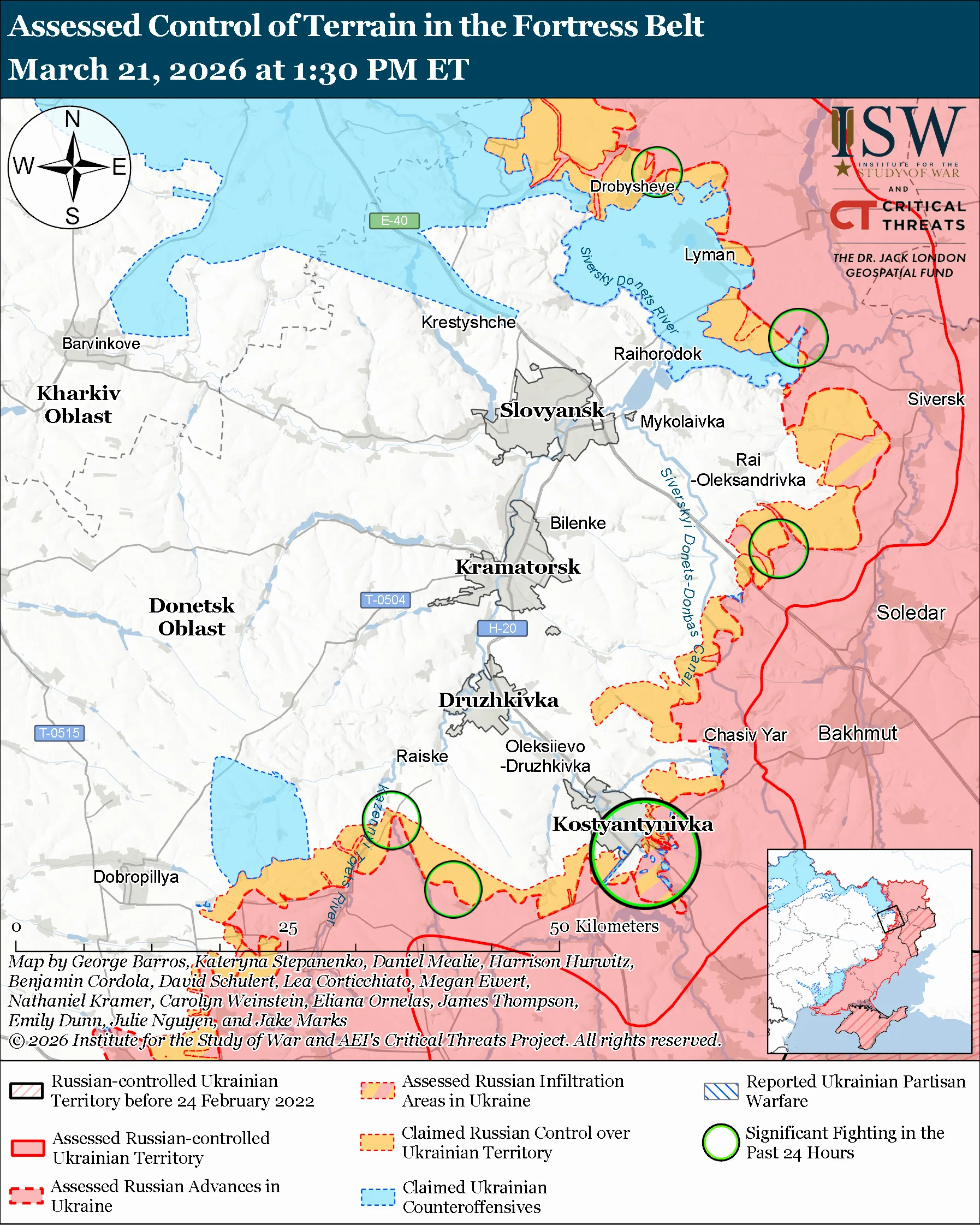
ISW noted this assault is considerably larger than most Russian mechanized attacks in recent months. The 3rd AC and Joint Forces Task Force reported that Russian forces suffered 405 casualties from the over 500 personnel involved — a rate ISW says is unsustainable and would likely degrade Russia's ability to maintain such large assaults in the medium to long term.
The spokesperson of a Ukrainian mechanized brigade operating in the Lyman direction told Suspilne on 21 March that Lyman is a key strongpoint on the route to Sloviansk and could serve as a stronghold for Russian efforts to seize both Sloviansk and Kramatorsk — meaning intensified pressure on Lyman is necessary before any assault on the Fortress Belt cities themselves. The spokesperson noted that Russian forces are adapting tactics: switching from mechanized columns to dispersing vehicles across multiple simultaneous assault prongs, mirroring dispersed infantry tactics.

Russia launched what may be the start of its spring offensive on 17 March — and lost 900 troops in 36 hours without breaking through anywhere along a 100-kilometer front
ISW said this approach may aim to overwhelm and distract Ukraine's drone-based defenses. Russian forces are also increasing strikes with KAB-3000 guided glide bombs, Lancet loitering munitions, and Molniya fixed-wing drones in the Lyman direction — part of what ISW describes as a battlefield air interdiction (BAI) campaign to degrade Ukrainian logistics and defensive depth before the ground phase can advance.
Russia sets conditions from the south: Kramatorsk and Kostiantynivka directions
Russian forces are simultaneously preparing a southern attack on the Fortress Belt. Ukrainian 11th AC Spokesperson Lt. Col. Dmytro Zaporozhets reported on 21 March that Russian forces have recently intensified ground assaults in the Sloviansk and Kramatorsk directions in preparation for future offensive operations, and are advancing toward the heights on the approaches to Kostiantynivka — the southern tip of the Fortress Belt.
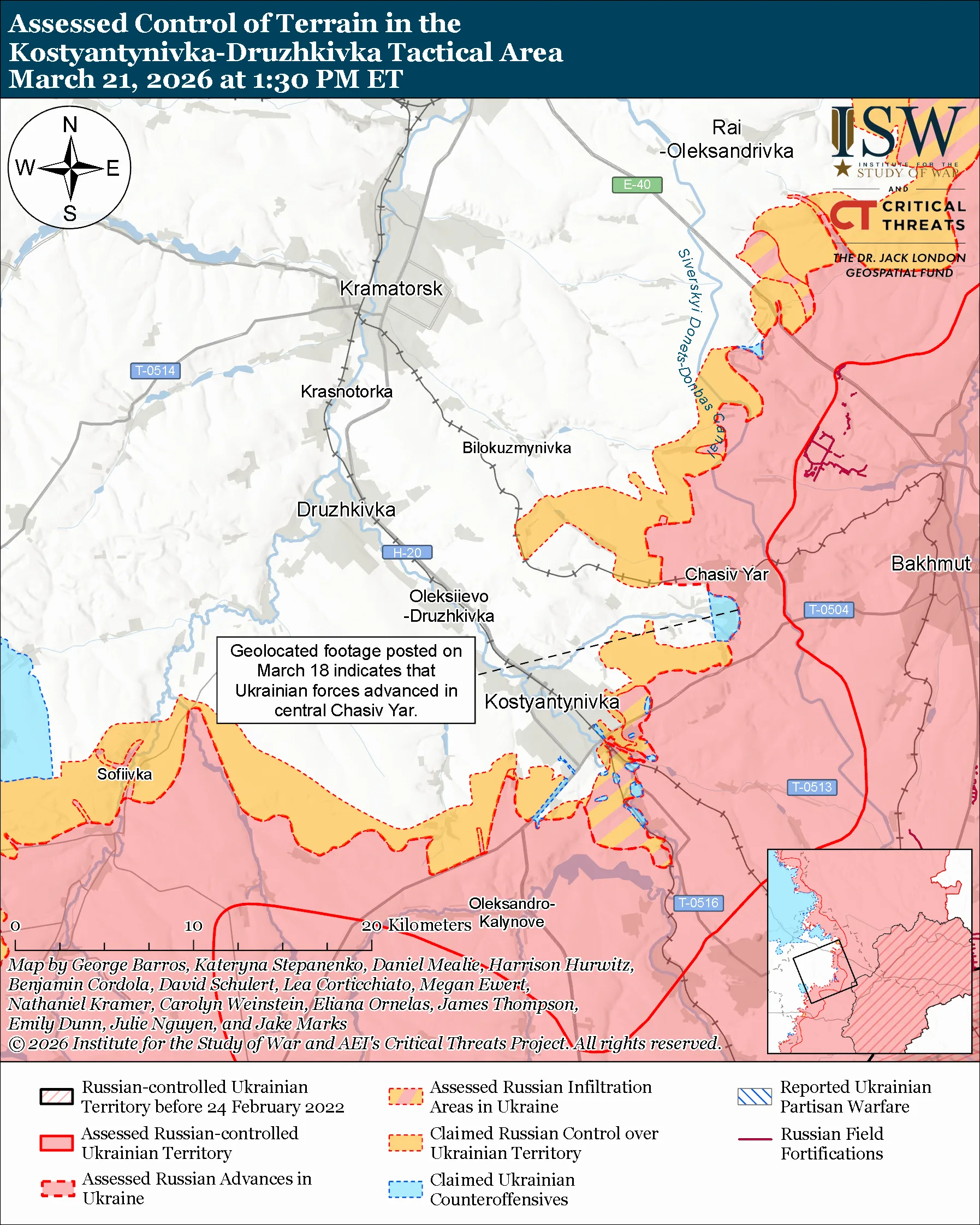
Zaporozhets reported that Russian forces are actively moving personnel on the approaches to Kostiantynivka, intensifying FPV and Molniya drone strikes from Chasiv Yar northeast of Kostiantynivka, bringing up armored vehicles, and doubling artillery and tactical aviation strikes in the Kramatorsk direction.
Trending Now

ISW: Ukraine’s drones pressure Russian command at every level — tactical, operational, strategic — likely disrupting spring offensive
ISW says Russia has also been running a BAI campaign against the southern tip of the Fortress Belt since at least late February 2026, striking key Ukrainian ground lines of communication and settlements immediately around Kramatorsk to prepare for the upcoming ground campaign, citing its 20 March and 27 February assessments.
Why the Fortress Belt will likely hold — but at a price
Despite the scope of the offensive, ISW assessed that Russian forces are unlikely to seize the Fortress Belt in 2026 and that any gains will come "at a significant cost." Ukrainian forces retain positions on dominant heights east of Sloviansk, including near Kryva Luka, which serve as drone operator positions, Zaporozhets noted. Earlier, ISW concluded that Ukrainian control of this terrain will likely complicate any Russian advance from the comparatively low-lying ground around Siversk. ISW also pointed to the exhausted, poorly trained, and overstretched state of Russian troops in the Sloviansk direction as a further constraint.
The training picture illustrates the pressure Russia is under: the Ukrainian mechanized brigade spokesperson reported that Russian forces have cut basic training for assault personnel from one month to one week — apparently to rush replacements to the frontline to compensate for heavy casualties. Ukrainian military observer Kostiantyn Mashovets assessed in February that elements of the Russian Western Grouping of Forces, including the 20th Combined Arms Army and 1st Guards Tank Army, lack the strength to seize Lyman, in part because significant forces may have been diverted to counter Ukrainian counterattacks that have significantly liberated most of Kupiansk.

Ukraine is also taking active countermeasures. Ukrainian forces are more intensively targeting Russian multiple launch rocket systems in the Sloviansk and Kostiantynivka directions to disrupt Russian artillery preparation, and are expanding their mid-range strike campaign to degrade both offensive and defensive Russian capabilities, ISW said. Ukraine will likely continue to impose high costs on Russia's spring-summer offensive through a parallel BAI campaign of its own, particularly in the Sloviansk direction, ISW concluded.
Read also
-
Ukraine’s counterattacks in Dnipropetrovsk Oblast are burning Russia’s operational reserves — ISW says Russia’s spring offensive may be spoiled
-
‘We detect and destroy everything’: Ukraine’s drone battalions hold off three Russian armies west of Pokrovsk
-
Hryshyne clearing operations continue as Russia tries to turn occupied Pokrovsk into a launchpad for the next advance


