
The Kremlin has sent a team of political technologists—operatives who engineer public opinion through media manipulation, disinformation, and influence campaigns—to Budapest.
Their goal, according to VSquare—a Central European investigative outlet, is to interfere in Hungary's 12 April 2026 parliamentary elections. VSquare cited multiple European national security sources.
The Russian political influence operation is run by Sergei Kiriyenko, Putin's First Deputy Chief of Staff and former head of the nuclear corporation Rosatom—the same man who oversaw Russia's interference campaign in Moldova, where similar tactics were used to try to unseat a pro-European president.
They briefed VSquare—a Central European investigative outlet covering democratic backsliding and foreign interference. Sergei Kiriyenko oversees the operation. Putin's First Deputy Chief of Staff and former head of the state nuclear corporation Rosatom, Kiriyenko built Russia's electoral interference infrastructure at home and abroad.
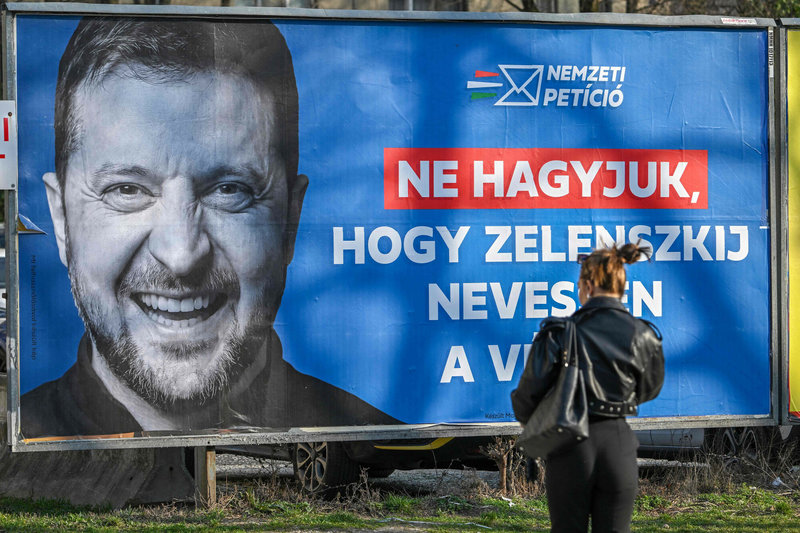
Moscow's interest in the outcome runs directly to Kyiv. For years, Orbán has blocked EU military aid packages for Ukraine, vetoed EU sanctions against Russia, and turned Budapest into the Kremlin's most reliable address inside the EU and NATO.
Opposition leader Péter Magyar is running 20 points ahead in independent polls. A Fidesz defeat on 12 April would represent a strategic loss the Kremlin cannot absorb.
An Orbán victory on 12 April is, in practical terms, another four years of a Russian veto inside EU institutions.
Russia's election interference in Hungary follows the Moldova blueprint
Kiriyenko's most aggressive foreign deployment to date was in Moldova. There, operatives under his direction ran vote-buying networks, troll farms, and on-the-ground influence campaigns to undermine pro-European President Maia Sandu. The results were mixed—but the playbook survived intact.
For Hungary, VSquare's sources describe a three-person GRU-linked team embedded in the Russian Embassy in Budapest under diplomatic cover. The team arrived weeks ago and is already in active contact with campaign operatives connected to the Orbán government.
Putin established a new Presidential Directorate for Strategic Partnership in late 2025. Kiriyenko installed his Rosatom associate Vadim Titov—a political operative with no conventional diplomatic background—to run it. The directorate provides the institutional backbone.
Trending Now
Bomb the pipeline, blame Ukraine
The GRU operation falls on prepared ground. When a Russian drone strike on 27 January hit the Druzhba pipeline's Brody dispatch station in Ukraine, Orbán blamed Kyiv, blocked a €90 billion EU loan, and deployed Hungarian troops toward the Ukrainian border.
Beyond recent events, Hungary has long hosted Russian military diplomats with suspected GRU ties. German-Hungarian pro-government propagandist Georg Spöttle maintained a documented relationship with the Russian military attaché.
Pro-Orbán outlets have amplified Kremlin narratives on Ukraine with growing intensity—a pattern Átlátszó, an opposition outlet in Hungary, has documented since the early days of the full-scale invasion. NATO allies have already begun limiting intelligence sharing with Budapest because of these ties.
If Orbán wins, Ukraine's position in the EU worsens, Hungary's veto stays, sanctions packages remain hostage, and EU accession talks will be threatened.
An Orbán fourth term means another four years of a Russian veto inside Western institutions—delivered not by Moscow's missiles, but by Budapest's ballot box.
Read also
-
Trump gives Orbán “complete and total endorsement” ahead of Hungary’s tightest election in years
-
Sanction me softly: Trump, Orbán, and the oil that binds them
-
US Treasury sanctions Hungarian official, straining NATO alliance
-
Russia bombed Hungary’s pipeline. Hungary deployed troops—against Ukraine.
-
Putin sends election fixers to Budapest to keep Orbán’s Kremlin veto alive