


In the spring of 2022, Ukraine’s economy was supposed to collapse. Real GDP fell 29.1%—the deepest annual drop in the country’s history. Millions fled. Factories, power plants, and ports fell to Russian forces or Russian missiles. Western governments scrambled to keep Kyiv solvent week by week, wiring emergency cash as the hryvnia cratered and tax revenues evaporated.
The collapse never came. Ukraine’s nominal GDP exceeds its pre-war level—$210 billion, up from $200 billion in 2021. The country built a defense industry producing $12 billion annually—with capacity for far more—from almost nothing. Tax revenues grew 23% in real terms.
In real terms, the economy remains around 17% smaller than before the invasion.
But in real terms, the economy remains around 17% smaller than before the invasion. Ten million people are gone. Fertility has dropped below one child per woman. Every power plant has been hit. Public debt is crossing 100% of GDP. And the €90 billion EU lifeline that was supposed to keep the economy afloat through 2027 is, on the eve of the war’s fourth anniversary, being held hostage by Hungary.
Maksym Samoiliuk, an economist at the Centre for Economic Strategy (CES), described 2025 to Le Monde as a year of “forced normality”—when society and businesses accepted that war had become the baseline. The numbers below show what that normality looks like.
What Russia destroyed
From the first weeks of the war, Russia targeted Ukraine’s economy. In spring 2022, Russian forces seized the Zaporizhzhia nuclear plant—Europe’s largest—shelled Mariupol’s Azovstal steelworks into rubble, and blockaded the Black Sea ports that carried 90% of grain exports.
Bridges, railways, factories, and fuel depots were hit across the country. That first winter, 2022–2023, brought rolling blackouts across Ukraine after Russia launched its first mass campaign against the power grid in October 2022, firing hundreds of missiles and drones at substations and thermal plants.
All 15 thermal power plants have been damaged or destroyed.
Each year since, the attacks have escalated. In 2025 alone, Russia launched 612 targeted attacks on energy facilities, and by winter 2025–2026, not a single power plant had escaped damage.
All 15 thermal power plants have been damaged or destroyed, their share of the energy mix collapsing from 23.5% to roughly 5%. In 2024 alone, Ukraine lost approximately 9 gigawatts of generating capacity—equivalent to one-third of pre-war consumption.
Four winters of bombardment came to a head in 2025–2026, one of the harshest in years. In January, Russia conducted near-daily strikes on energy infrastructure across at least 17 regions. Millions were left with electricity for just a few hours per day.
Rolling blackouts of 12 to 18 hours cut heat and water across the country.
In Kyiv, power cuts lasted up to 20 hours, with missiles striking combined heat and power plants that supply central heating to nearly 6,000 apartment buildings. In the Dnipropetrovsk oblast, more than 800,000 households lost power. Rolling blackouts of 12 to 18 hours cut heat and water across the country.
Ukraine’s Deputy Energy Minister Mykola Kolisnyk told ABC News: “The enemy’s plan is social instability through total blackout. This is not a hybrid threat. This is a military threat.”
The National Bank of Ukraine cut its 2026 growth forecast from 2.2% to 1.8%, citing energy attacks as the primary drag.
By January 2026, Ukraine was importing a record 896 GWh of electricity—with no exports since November—buying power from the very neighbors whose political support it depends on. The National Bank of Ukraine cut its 2026 growth forecast from 2.2% to 1.8%, citing energy attacks as the primary drag.
The people who aren’t there
At the start of 2022, about 41–42 million people lived within Ukraine’s borders. At the beginning of 2025, approximately 31 million remained, including the temporarily occupied territories. As of 2024, 6.9 to 8 million Ukrainians are abroad, mainly in the EU.
About 900,000 people serve in the armed forces, including more than 70,000 women. The fertility rate has collapsed to 0.7 children per woman—among the lowest ever recorded globally.

In 2024, Ukraine registered 176,679 births against 495,090 deaths—2.8 deaths for every birth, according to Ministry of Justice data. In the first half of 2025, 86,795 babies were born while 249,002 people died—holding steady at three deaths per birth. The birth rate has halved in a decade: from 32,000 births per month in 2016 to just 14,000 in 2025.
With an average soldier age of 43, most casualties are married fathers.
Ukraine’s population is decreasing by more than 300,000 people each year from natural decline alone—before counting emigration. With an average soldier age of 43, most casualties are married fathers—leaving an expanding population of widows and orphans, with 59,000 children now living without biological parents.

The financial ties between Ukraine and its diaspora are weakening, too. Private remittances from Ukrainians abroad are declining as refugees integrate into their host countries—finding jobs, opening local bank accounts, building lives they increasingly won’t leave.
Every soldier mobilized is a worker the economy loses. Ukraine’s workforce has shrunk by a quarter since 2021. Employers posted 427,000 job openings in 2025; only 63% were filled. A November 2025 survey by the European Business Association found 83% of Ukrainian companies have a staff shortage, with 74% calling it serious.
Companies that have doubled their staff since 2022 still can’t find enough experienced welders, machinists, and engineers.
The defense industry, Ukraine’s fastest-growing sector, lists personnel as its primary bottleneck—despite the state’s multibillion-dollar investments, companies that have doubled their staff since 2022 still can’t find enough experienced welders, machinists, and engineers.
And yet mobilizing more people means gutting the very economy that funds the war effort. That tension has no solution while the fighting continues.
What Ukraine built
Before the full-scale invasion, Ukraine’s defense industry was a fraction of what it is today—investment in the sector has since increased by 900%, with the sector experiencing 350% growth overall since 2022.
Defense output grew from $1 billion in 2022 to $9 billion in 2024 and roughly $12 billion in 2025, according to former Strategic Industries Minister Herman Smetanin—though that figure assumes all contracts were delivered on time, an expectation few in the industry consider realistic.
The vast majority of defense companies are private—only 26% of producers existed before 2022.
The Kyiv School of Economics estimates total production capacity at $30–35 billion, but only 14% of producers surveyed expected full utilization.
The constraints aren’t technological—they’re funding and the same workforce shortage that runs through every sector. The vast majority of defense companies are private—only 26% of producers existed before 2022.

In 2022, Ukraine produced one Bohdana howitzer. By 2025, the Kramatorsk plant was producing 20 per month. Domestic artillery and mortar shell production increased 25-fold from pre-invasion levels.
Ukraine is now capable of producing over 4 million drones annually from roughly 450–500 companies—up from seven before the invasion—though actual output depends on funding, with only about 45% of capacity utilized.
The country that begged for weapons four years ago now exports them.
In late 2025, after years of delay while martial law restricted exports, Kyiv tentatively opened arms sales abroad. Ten export centers are planned across Europe by the end of 2026, with drone production lines already operating in Germany.
The export potential for 2026 is estimated at “several billion dollars,” according to National Security and Defense Council Deputy Secretary Oleh Aloian. The country that begged for weapons four years ago now exports them.
The economy behind the front
The domestic economy adapted—not out of resilience, but because there was no alternative. Not a single e-commerce company closed in Q3 2025—the first quarter without closures since the full-scale invasion—while 48 new firms opened.
Trending Now

Rozetka, the dominant marketplace, expanded to 549 stores in 166 cities, including front-line Kramatorsk, 20 kilometers from the combat zone. The most popular items in front-line stores: animal feed, coffee, and tea, Rozetka founder Vladyslav Chechotkin told NV.
Online commerce grew partly because physical retail can’t staff its shops—the same workforce crisis that drives every other sector.
A growing tax base has been one of the war’s genuine economic achievements—the war changed citizens’ attitudes toward the state.
Women now register 61% of new businesses, up from 49% before the invasion. That number is not a sign of empowerment. It is the arithmetic of a country where the men are mobilized or abroad, and women stepped into the gap because someone had to.
Ukraine’s own tax revenues grew over 23% in real terms compared to 2021, driven by a wartime military levy, wage growth, and improved compliance. Luke Cooper, associate professor at the London School of Economics, told Le Monde that the growing tax base has been one of the war’s genuine economic achievements—the war changed citizens’ attitudes toward the state.
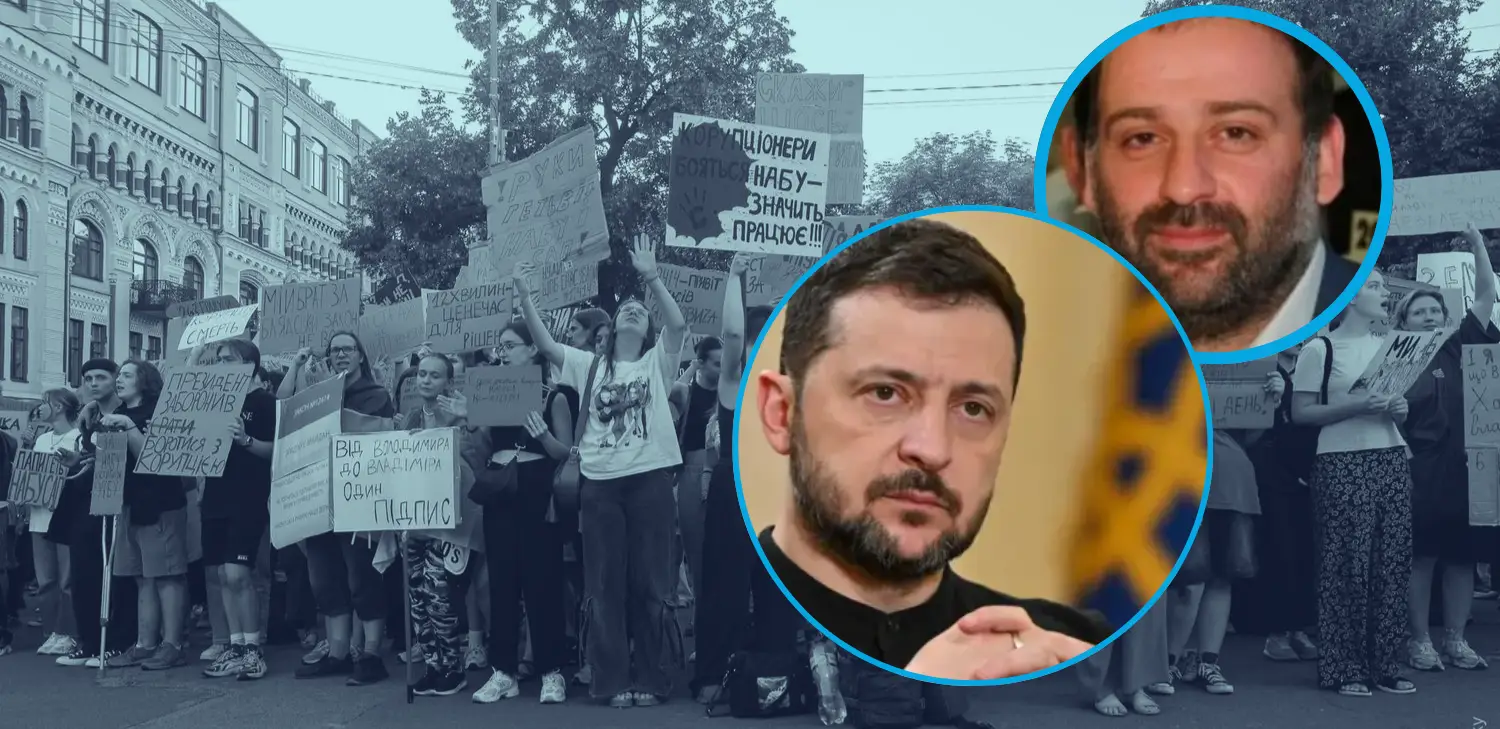
Corruption persists at the highest levels—but so does accountability.
That sits alongside continuing scandal. The Energoatom corruption case led to the ouster of presidential chief of staff Andriy Yermak, triggered the largest wartime government reshuffle, and saw former Energy Minister Herman Halushchenko detained in February 2026.
Corruption persists at the highest levels—but so does accountability: NABU and SAPO investigations continue, and public protests forced Zelenskyy to reverse an attempt to curtail anti-corruption agencies’ independence in mid-2025.
What keeps it alive
Ukraine’s defense boom, its schools, hospitals, and pensions—all run on foreign money.
Since the full-scale invasion, all domestic budget revenue has gone to defense, which consumes around half the national budget. Every civil function—teachers, doctors, pensions, infrastructure repair—is funded by international aid. In 2025, foreign assistance covered 56% of the budget’s additional needs, down from 73% in 2024. The financing need for 2026 is approximately $46 billion.

The dependency runs deeper than the budget. Ukraine’s current account deficit—the gap between what the economy earns and what it spends—ballooned from 8.4% of GDP in 2024 to 16.2% in 2025, with imports growing 21% while exports fell 4%.
Public debt is projected to exceed 100% of GDP in 2026. The trade gap is projected to widen to over 20% of GDP by 2027—a level that in peacetime would signal a sovereign debt crisis—meaning the economy’s structural reliance on foreign money will outlast any single loan package.
“Without that support from the EU and the IMF, Ukraine’s economy would most likely collapse.”
In December 2025, EU leaders agreed to provide €90 billion in interest-free loans for 2026–2027. On the eve of the war’s fourth anniversary, Hungary blocked the loan’s final approval—and an IMF program worth $8.2 billion is conditional on it going through.
The EU will likely find a workaround; it has before. But the structural vulnerability is real: one member state can hold Ukraine’s entire financial lifeline hostage at will. “Without that support from the EU and the IMF, Ukraine’s economy would most likely collapse,” Samoiliuk told the Financial Times.
How the breadbasket survived a blockade
Before the invasion, Ukraine exported over 60 million tons of grain per year through its Black Sea ports—10% of the global market, feeding more than 400 million people.
Within days of the February 2022 invasion, the Russian navy blockaded those ports. Exports plunged from over 150 commercial ships per day to nearly zero. Global wheat prices spiked immediately.
The EU launched its Solidarity Lanes in May 2022—emergency rail, road, and river corridors through Poland, Romania, and Moldova. Between May and July 2022, they were the only way out. A UN-brokered Black Sea Grain Initiative, signed in July 2022, partially reopened the sea routes.
Over 2023 and 2024, Ukrainian naval drones systematically degraded Russia’s Black Sea Fleet.
It allowed 33 million tons through before Russia pulled out in July 2023 and resumed bombing Odesa’s port infrastructure. Within weeks, Ukraine launched its own maritime corridor along the Romanian and Bulgarian coastlines—without Russian consent, UN mediation, or a navy.

Over 2023 and 2024, Ukrainian naval drones systematically degraded Russia’s Black Sea Fleet, sinking or damaging roughly a third of its combat ships and forcing the fleet to relocate from Sevastopol to Novorossiysk.
Russia launched 90 combined missile and drone attacks on Ukrainian ports in 2025 alone.
By April 2024, Ukraine’s corridor was shipping 6.6 million tons monthly—exceeding the UN deal’s peak of 4.2 million. By 2025, maritime routes handled 92% of grain and oilseed exports, close to pre-war levels.
The ports are open, but not safe. Russia launched 90 combined missile and drone attacks on Ukrainian ports in 2025 alone, periodically slashing monthly exports by 20–30% and leaving up to 10 million tons of grain sitting in storage without buyers.
Total grain production reached approximately 59 million tons in 2025, up from 56.7 million in 2024, driven by a strong corn harvest. But these figures remain far below pre-war capacity—Ukraine harvested 92.6 million tons by 2020.
Mined fields, occupied farmland, and mobilized farmers have shrunk the base.
Mined fields, occupied farmland, and mobilized farmers have shrunk the base. And agricultural output as a sector still declined 5.1% in 2025, dragged down by falling livestock production and lower commodity prices—a better harvest doesn’t mean a healthy farm economy.
Meanwhile, the EU’s wartime duty-free trade regime for Ukrainian agriculture expired in June 2025 and was replaced by an agreement that reimposed quotas on over 30 product categories—tightening terms even as Ukraine fights to keep its ports open.
Can it last?
The German Economic Team’s December 2025 forecast—the most detailed independent projection available—outlines a constrained but survivable path: real GDP growth of 2.1% in 2026 and 2.6% in 2027. Inflation approaching its target range. Nominal GDP reaching $227 billion.
That forecast was finalized on 20 December—before Hungary blocked the €90 billion loan. Its assumptions include continued international support, no loss of economically significant territory, and war intensity not reducing until mid-2027. The cumulative budget deficit for 2026–2027 is projected at $91 billion. No reconstruction is assumed—only emergency repairs.
The World Bank’s February 2025 assessment estimated the total reconstruction bill at $524 billion over the next decade, 2.8 times Ukraine’s GDP. The forecast also assumes Ukraine gets back on track with the EU’s reform program, which has been lagging.
Can an economy survive indefinitely on foreign funding when one EU member can hold the pipeline hostage at will?
But some indicators point the other way. Record foreign exchange reserves of $57.7 billion in January 2026. Bank lending growing at 18.6% year-on-year. The first NBU rate cut since the invasion, to 15% in January. Inflation at 8% by end-2025, beating its own forecast.
Cooper argued in Le Monde that Ukraine holds stronger long-term prospects than Russia, citing international market access and the possibility of EU accession.
In 2022, the question was whether Ukraine’s economy would survive the year. It did. Four years on, the questions have changed.
Can an economy survive indefinitely on foreign funding when one EU member can hold the pipeline hostage at will? Can a defense industry keep growing when every new worker comes at the cost of a soldier—or vice versa? And what happens to the $91 billion financing gap if the EU loan collapses and the IMF follows?
Ukraine answered the 2022 question. The 2026 questions are still open.


