


During their overnight drone strike near St. Petersburg, Ukraine’s Unmanned Systems Forces blasted a Russian warship, the corvette Boykiy, at the Kronstadt Naval Base, the official HQ of Russia’s Baltic Fleet.
The strike was part of a wider attack, which also caused a fire at the St. Petersburg Oil Terminal, 17 kilometers away from Russian leader Vladimir Putin’s flagship international economic forum on opening day.
A video posted by Unmanned Systems Forces commander Robert “Madyar” Brovdi showed two drones striking the ship from above—the second drone shows a big blaze erupting around the bridge.
"The corvette was deflowered by the birds of the 1st Separate Center of the Unmanned Systems Forces,” Madyar wrote.
The video shows that drones appear to strike the center of the corvette—exactly where some of the vessel’s most expensive electronics are located, including its Furke-2 airborne surveillance radar, Monument-A guided missile radar, navigational systems, electronic warfare systems, and fire control.
US intelligence company Vantor published satellite photos of the aftermath, showing fire crews working to control the fires on the ship with high-pressure water cannons. The bridge and conning tower are blackened and appear to be partially collapsed. The water used to put out the fire could also inflict further damage to sensitive components.
The affected systems are problematic to get working on this class of vessel even when it’s not engulfed in flame, according to retired Ukrainian naval officer and analyst Pavlo Lakiychuk.
Specifically, the radar and comms systems are not compatible and it’s hard to get them to play well together, Lakiychuk said. While the Boykiy’s hull probably remained intact, repairing these systems after a strike and recalibrating them will take a lot of time, money, and effort.
"Every repair takes up human resources and financial resources that are needed for other goals in a war," he said.
Some analysts have gone further, saying the ship is as good as destroyed in the economic sense: that the cumulative damage would make no sense to repair—except for propaganda value.

Armaments and technical issues
The Boykiy (Russian for “lively” or “perky”) is one of four Stereguschiy-class corvettes serving in the Baltic Fleet, created under the Project 20380 program in Russia. As warships go, it is not very old, first being floated in 2011.
Trending Now
At 105 meters long, displacing 2,250 tons when fully laden, it can reach speeds of 27 knots and has a range of 4,000 nautical miles. Vessels of its class are armed with Kh-35 subsonic anti-ship missiles, the basis from which Ukraine developed its own Neptune-class missiles that sank Russia’s Black Sea Fleet flagship, the Moskva, in 2022. Stereguschiy corvettes are also armed with 100-millimeter guns and Redoubt air defense systems.
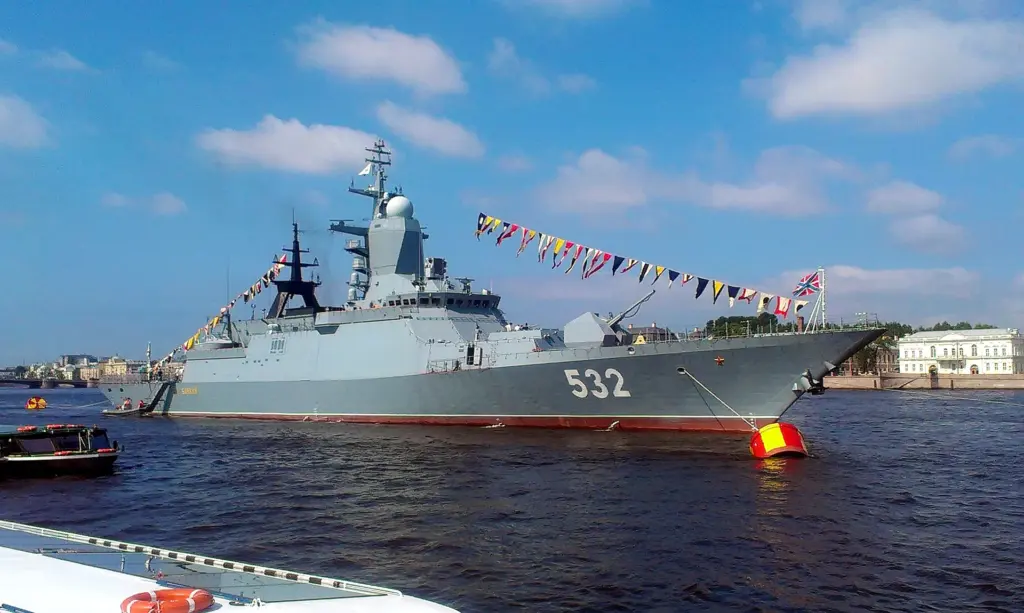
While threatening, the vessel has multiple shortcomings. In addition to their electronics compatibility issues, Stereguschiy corvettes also suffer from inefficient engines and propulsion systems, Lakiychuk added. Russia used to rely on Ukraine to build ship engines in Mykolaiv, but their supply dried up after Russia invaded Crimea, Donetsk, and Luhansk Oblasts in 2014.
These technical issues are why ships of this class spend a lot of time near at Kronstadt near St. Petersburg, instead of Kaliningrad where the majority of the Baltic Fleet is based, Lakiychuk said. According to Ukraine’s Unmanned Systems Forces, the Boykiy has been at the Kronstadt Naval Base since February.
This could explain why the ship was in dry dock at the time of the attack. Ukrainian forces used the opportunity to strike when most of its safety features such as fire suppression systems were likely shut off and its trained crews not present, as pointed out by defense analyst Jaroslaw Wolski.
Escorting the shadow fleet
Before coming in for maintenance, the Boykiy “had an enchanting history of travel and adventure along NATO borders, accompanying the shadow fleet,” Madyar wrote.
This shadow fleet and its military escorts serve two major functions for Russia. The first is exporting oil and gas, which are Moscow’s main financial lifeline, sustaining the state and its ongoing invasion.
The second is the escalation of hybrid warfare against NATO. That includes surveillance of NATO countries' territories, sabotage of undersea cables, launching drones over critical infrastructure across Europe, and electronic warfare like radio jamming and GPS spoofing, which affects allied civilian and military vessels.
Ukraine’s successful strikes on the Kronstadt Naval Base, taking a Baltic Fleet vessel out of commission for a long time, demonstrated the long reach of Kyiv’s deep strike drones like the FP-1, and served as a rebuke to Russia’s hybrid operations against Europe.
Madyar related the strike to the Kronstadt rebellion, an insurrection of Soviet sailors and civilians against the Bolshevik government in 1921, ”a slap in the face of the dictatorial regime.”
Read also
-
Russia just accidentally crashed its first Tu-95 bomber in 11 years. Its missiles will keep striking Ukraine anyway
-
In Ukraine’s Vivaldi offensive, nobody rides in the BTR-60s. Bulgaria’s old troop carriers go into Russian bunkers packed with mines
-
Ukraine’s tanks are fighting from kilometers back. A 1960s Soviet model does that nearly as well


